



New York, New York | July 10, 2026
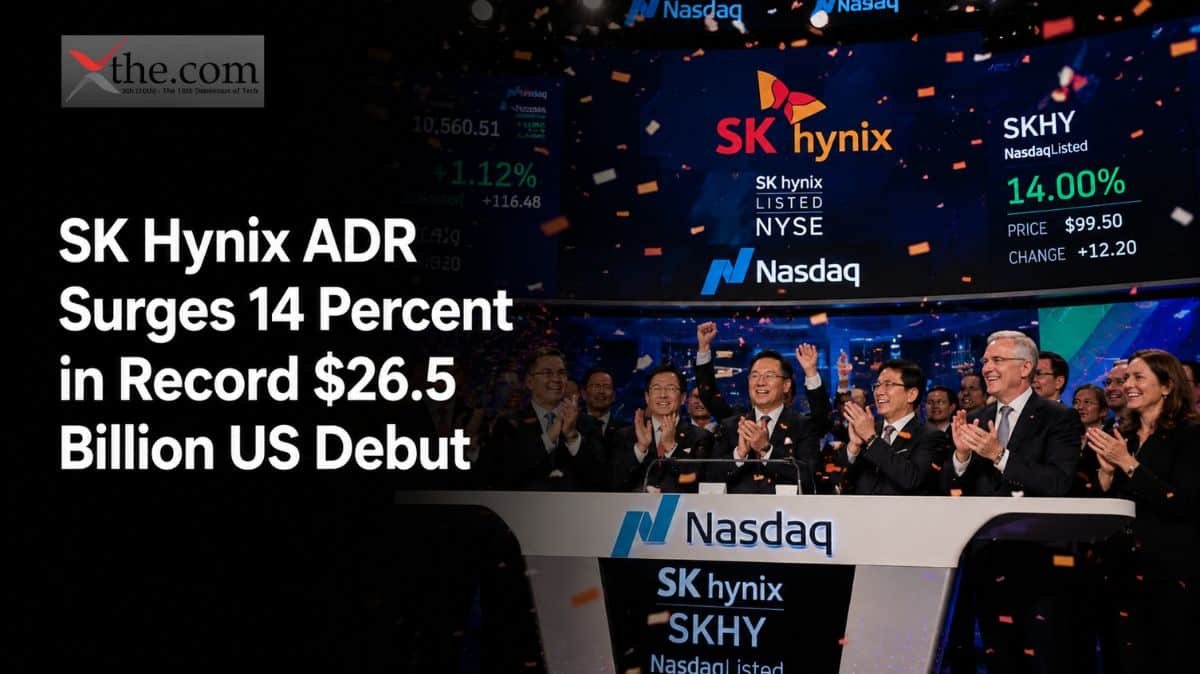
Just last month, most American retail investors couldn’t buy shares of this South Korean chipmaker. Now, SK Hynix has become one of the biggest new listings Wall Street has ever hosted. The SK Hynix ADR debut opened at $170, up 14% from the offering price. By midday, the numbers were remarkable: only one other company has ever raised more money from US investors in a single debut.
SK Hynix is the world’s second-largest memory chipmaker and is widely seen as the top supplier of high-bandwidth memory chips used in nearly every advanced AI accelerator this year. Trading started Friday morning with a temporary symbol before switching to its permanent ticker. The occasion was commemorated with an opening bell ceremony at the Nasdaq MarketSite in Times Square, attended by SK Group Chairman Chey Tae-won, Executive Vice Chairman Chey Jae-won, and SK Hynix CEO Kwak Noh-Jung. After three decades of trading mainly on the Korea Exchange, SKHY’s Nasdaq debut on July 10 is a turning point for both the company and for how global markets value firms building AI infrastructure.
A $26.5 Billion Statement
The numbers highlight the scale of this listing. SK Hynix raised $26.5 billion by listing, pricing 177.9 million ADRs at $149 each, and demand was more than seven times the number of shares available, according to people familiar with the process. About $5 billion in ADRs went to key investors such as Baillie Gifford, Coatue Management, and Situational Awareness Partners, ensuring a strong base of long-term holders before public trading began.
The SK Hynix ADR $149 price was itself the product of weeks of roadshow meetings in the US, Europe, and Asia, where executives argued that the company’s real earnings potential was held back by a structural discount. Investors seemed to agree. When trading opened at $170, it confirmed what bankers had been telling clients: the deal was priced to allow for a strong first-day gain, and the market took advantage.
Looking at the bigger picture, only SpaceX’s offering last month raised more money in a single US share sale. SK Hynix’s deal topped Saudi Aramco’s $25.6 billion IPO from 2019, which had been the standard for foreign companies listing in the US for six years. This makes this the SK Hynix largest US foreign listing on record, a milestone likely to be studied in cross-border finance for years.
Why Wall Street Showed Up
Beyond the ceremony and pricing details, the main point is clear. SK Hynix holds about 60% of the global market for high-bandwidth memory, the chips that deliver data quickly to graphics processors from Nvidia and AMD. Every Nvidia H100 and Blackwell GPU shipped this year uses memory stacks made by SK Hynix or its main rival, Samsung. Apple is also a customer. This is not a niche product; it is the key component in the generative AI supply chain, and SK Hynix is at its core.
This strong position explains why the HBM memory AI chip listing attracted so much interest from big investors. Data center operators are still expanding, and the memory needed for new AI workloads is growing even faster than the logic chips. CFO Kim Woo-Hyun has told investors that computing is moving toward agentic systems, software programs that handle multi-step tasks rather than single prompts. This change increases memory needs, not just maintaining them. If this trend continues, demand for SK Hynix’s main product will keep rising.
SK Hynix’s shares on the Korea Exchange already show this optimism. They have risen more than 280% in the past year, even after dropping about 25% from a late June high. This jump pushed SK Hynix’s market value above $1 trillion, making it South Korea’s most valuable listed company, ahead of Samsung Electronics. Still, SK Hynix trades at a lower valuation than Micron Technology, its closest US-listed competitor. Analysts call this the “Korea discount,” and today’s Nasdaq listing aims to close that gap.
The Mechanics Behind the Headline Number
For those new to depositary structures, the SKHY 14 percent first-day gain deserves a bit of unpacking. An American Depositary Receipt is not a new type of stock. It is a certificate from a US bank that represents shares held in trust on the company’s home exchange. Each SK Hynix ADR equals one-tenth of a Korean common share. This setup makes the price more available for both retail and institutional US investors, so they don’t have to deal with won pricing or Seoul trading hours.
This simple structure is what analysts say has finally removed the barrier that kept SK Hynix’s valuation low for years. Before Friday, American fund managers needed a Korean brokerage, currency hedging, and patience for overnight settlements to invest directly. Now, they can buy SK Hynix with a simple ticker search in any US brokerage account. The stock could also be added to indexes such as the Nasdaq-100 and the Philadelphia Semiconductor Index, which would require passive funds to buy shares regardless of short-term price movements.
Media coverage has summed up the event simply: “SK Hynix ADR surges 14 percent on Nasdaq debut July 10, 2026” underscores both the result and the date that will be remembered in market history. Another phrase circulating among traders on Friday — “SKHY first day trading largest US foreign listing HBM AI chips” — explains why this deal was important beyond its size: it combined a record capital raise with the most sought-after product in global tech.
Not every company in the AI supply chain had the same experience on Friday. TSMC’s June sales report, usually an important indicator for chip demand, was delayed to July 13 because Typhoon Bavi caused a production shutdown on July 10. This shows that even the biggest chipmakers can be affected by events beyond their control.
What Comes Next
SK Hynix will report its second-quarter earnings on July 29, less than three weeks after its debut. This short window gives the market little time to adjust to the new listing. Revenue is expected to rise sharply from the previous quarter, primarily driven by HBM shipments for AI infrastructure. If the results confirm the growth investors paid a premium for, the argument for closing the valuation gap with Micron becomes stronger. But if market mood turns negative before then, the stock that jumped 14% on its first day could lose some of those gains.
No matter what happens next, Friday’s session did more than just move the share price. It gave US investors direct, dollar-based access to the company that makes the memory chips now central to the AI boom. Only one other foreign company has ever matched this scale on a US exchange.
Source: SK Hynix Rises Nearly 13% in Debut on Wall Street as Demand for Memory Chips Soars Amid AI Frenzy