





Ukraine Launches More Than 1,000 Drones Across Russia and Sets St. Petersburg’s Oil Terminal Ablaze
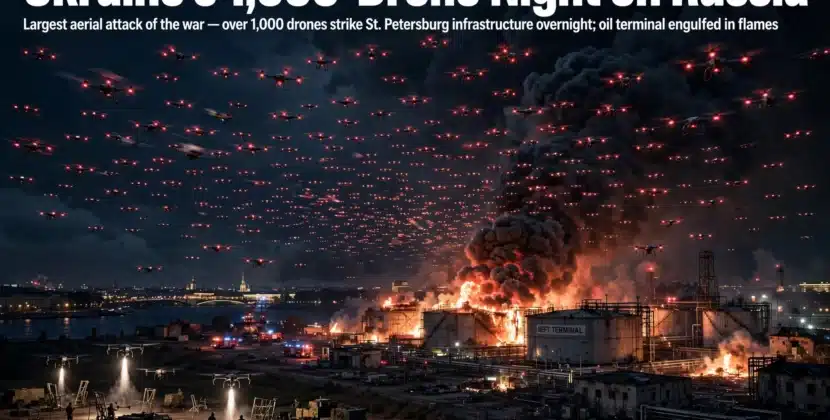
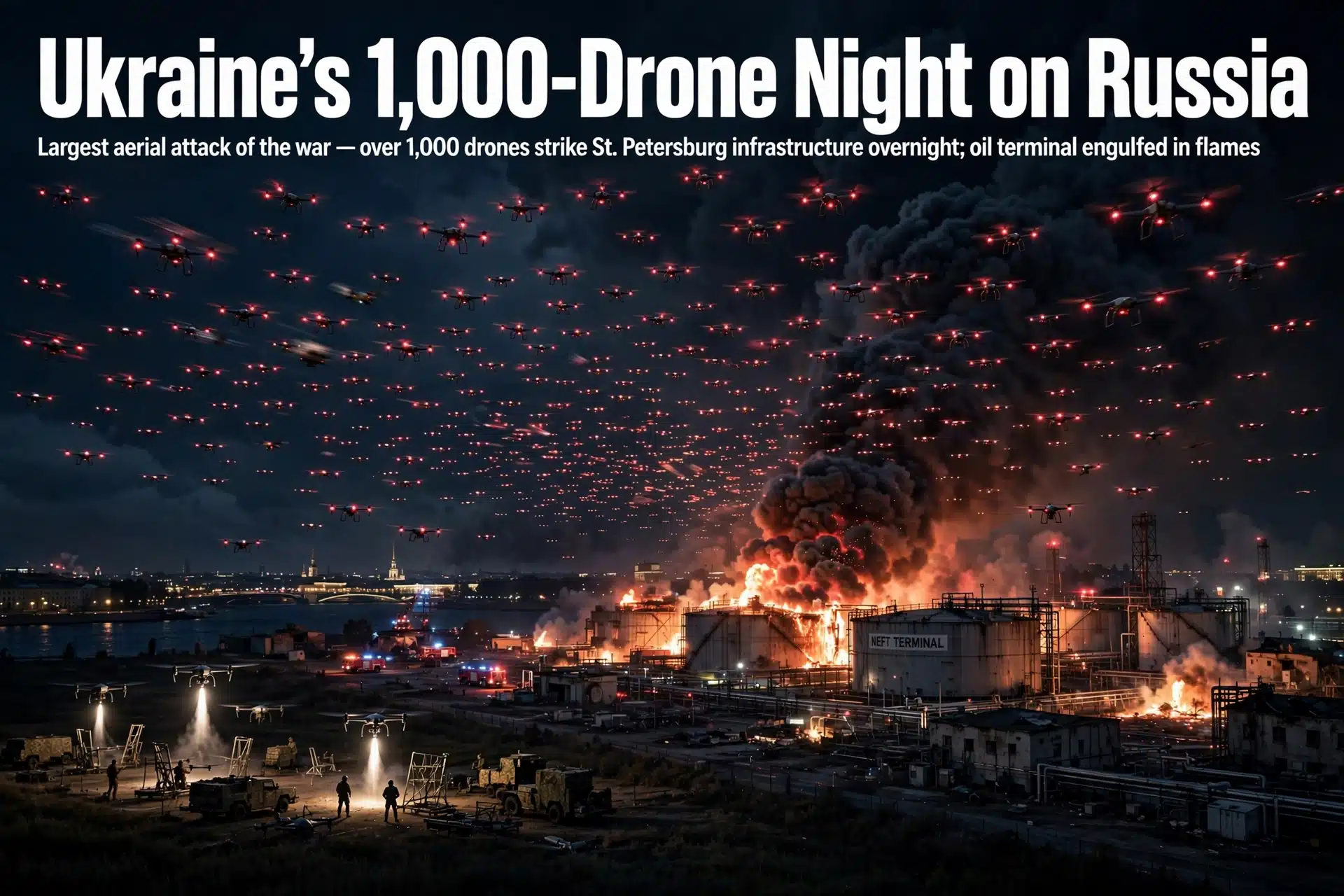
Ukraine launched more than one thousand drones at Russia overnight into Sunday, October 18, in one of the largest single-night air operations of the war, hitting the export terminal that ships Russian crude and products from St. Petersburg itself, and the Ukraine drone strike campaign has now directly targeted the heart of Russia’s Baltic energy trade. One person was killed and five injured according to the city’s governor, flights were disrupted at one of Russia’s busiest airports, and the strike landed at a tense moment, hours after President Trump defended pausing new sanctions on Moscow and days after Ukraine walked away from a claimed energy ceasefire.
Key Takeaways:
- – More than 1,000 Ukrainian drones were launched across Russia, with Russia’s Defense Ministry saying 1,015 were neutralized over 15 regions, Crimea and the Black Sea.
- – Fires burned at the St. Petersburg oil terminal, the Ruchi oil depot and industrial warehouses in the Kolpinsky district; at least one person was killed and five injured.
- – St. Petersburg’s main airport restricted operations, and attacks hit an Ozon logistics hub and a VK data center in the Leningrad region.
- – Zelensky said U.S. intelligence sharing, which had been blocked for a period, has resumed, and Trump defended his pause on new Russia sanctions as protecting negotiations.
The Night in Numbers
The scale is the story. Ukraine launched over 1,000 drones in a single night, and Russia’s Defense Ministry claimed it neutralized 1,015 across 15 Russian regions plus Crimea and the Black Sea, a figure that implicitly confirms the launch count rather than disputing it. Fires burned for hours at the Petersburg Oil Terminal, the city’s export gateway for refined products, and at the Ruchi oil depot, while industrial warehouses in the Kolpinsky district south of the city also burned. Leningrad region authorities reported 145 drones shot down over the region and roughly 20,000 residents left without electricity.
The hits were not only energy. Russian e-commerce firm Ozon reported a fire at its logistics hub, and internet company VK said drones attacked its data center, with services kept running. Pulkovo airport, one of the country’s busiest, restricted flights for safety reasons. Targeting commerce and data infrastructure alongside oil terminals shows the Ukrainian campaign’s logic: impose cost across the Russian economy, not just on pipelines.
The Collapsed Energy Ceasefire in Practice
The strike shows a ceasefire that no longer exists in practice, if it ever did. Trump announced on October 11 that Russia and Ukraine had agreed to an energy ceasefire, offering no details, and Zelensky later told the Financial Times he was done with it, saying Ukraine had held off from striking Russian energy facilities while Moscow kept hitting Ukraine’s. Zelensky wrote on X that Russia attacked Ukraine’s energy, oil and gas sectors 76 times in the week since the announcement, leaving tens of thousands of families without power, and accused Moscow of trying to cause a blackout. Overnight, Russian strikes killed a woman in Kyiv and damaged a 25-storey residential building, with more deaths in Zaporizhzhia and Volyn.
Against that record, the thousand-drone night reads as Ukraine repricing deterrence: if energy truces are one-directional, Ukraine will make Russia’s energy geography, from Gulf terminals to its Baltic flagship port, feel the war directly.
The Intelligence Sharing Fight
Two Washington decisions frame the strike. First, Zelensky said on NBC that U.S. intelligence sharing had resumed after being blocked for some period, restoring the missile-warning flows that Ukrainian air defense and cities depend on. An interruption of that supply, even for days, changes the calculus for strikes and defense alike, and its resumption signals that Washington’s punishment pause is not a full rupture. Separately, Ukrainian officials said U.S. restrictions on Starlink performance affected drone operations and some air-defense missions, an example of how commercial satellite terms have become strategic instruments.
Second, Trump, in a social media post Sunday, defended his Friday decision to hold implementation of new sanctions on Russia, saying he did not want to do anything that would foolishly drive Moscow away from the bargaining table, and rebuffing bipartisan criticism by arguing new sanctions would undermine negotiations to end the war. He also lashed out at Zelensky for striking Russian energy infrastructure, claiming the Ukrainian president does not want to end this war. The timing deserves attention: within days, Ukraine struck Russia’s largest Baltic export terminal anyway, betting that facts on the ground outrank Washington’s sequencing.
Why St. Petersburg Matters Strategically
Striking St. Petersburg is a message aimed at the Russian economy’s symbols and substance. The city hosts Russia’s Baltic export infrastructure and the Petersburg Oil Terminal’s refined-products loading, and strikes within Russia’s second city, hundreds of kilometers from the front, demonstrate that distance is no longer protection from Ukrainian drones. Russian authorities reported no interruption to exports from the terminal so far, but port operators must now factor drone insurance, firefighting capacity and repeated overnight alerts into terminal operations.
For energy markets, the relevance is cumulative rather than this week’s headline: Ukraine’s sustained campaign against Russian refining and export capacity has already demonstrated it can dent refined-product availability, and a thousand-drone night keeps that risk premium alive. Sanctions policy interacts with this directly, because the White House is signaling it prefers to keep oil flows and negotiations unchanged, while Kyiv is engineering its own pressure on the same target set.
What Happens Next
Three threads to watch. Diplomatic track: Zelensky said he spoke with U.S. envoys about the results of the October 9 Washington-Kyiv teams meeting in Miami and next steps, so negotiations continue in parallel, and a reported Russian proposal for a Ukraine peace summit including Trump and Vladimir Putin, without Kyiv, will test that line. Drone trajectory: Ukraine’s production ramp means thousand-drone volumes are becoming repeatable, and Russia’s escalating air defense claims should be read against what keeps burning. Washington policy: the sanctions pause has a de facto expiry, and the fight over intelligence and Starlink terms will set the ceiling on Ukrainian operations for the winter, the season when drone and glide-bomb activity historically peaks against energy grids on both sides.
Frequently Asked Questions
How many drones did Ukraine launch overnight?
More than 1,000 across Russia in a single night, one of the largest operations of the war; Russia’s Defense Ministry said it neutralized 1,015 over 15 regions, Crimea and the Black Sea.
What was hit in the St Petersburg Ukraine drone strike?
The St Petersburg oil terminal, the Ruchi oil depot and warehouses in the Kolpinsky district caught fire; an Ozon logistics hub and a VK data center were also struck, and the city’s airport restricted flights.
Did the US restore intelligence sharing with Ukraine?
Zelensky said intelligence sharing, which had been blocked for a period, has resumed, including flows that warn Ukraine about Russian ballistic missile launches.
What happened to the energy ceasefire between Russia and Ukraine?
Ukraine says it is done: Zelensky reported 76 Russian strikes on Ukraine’s energy sector in the week after Trump’s October 11 ceasefire claim, and Moscow continued attacks while Kyiv resumed its own campaign.
Sources: