





Federal Judge Orders the State Department to Open the Delayed DV-2027 Green Card Lottery
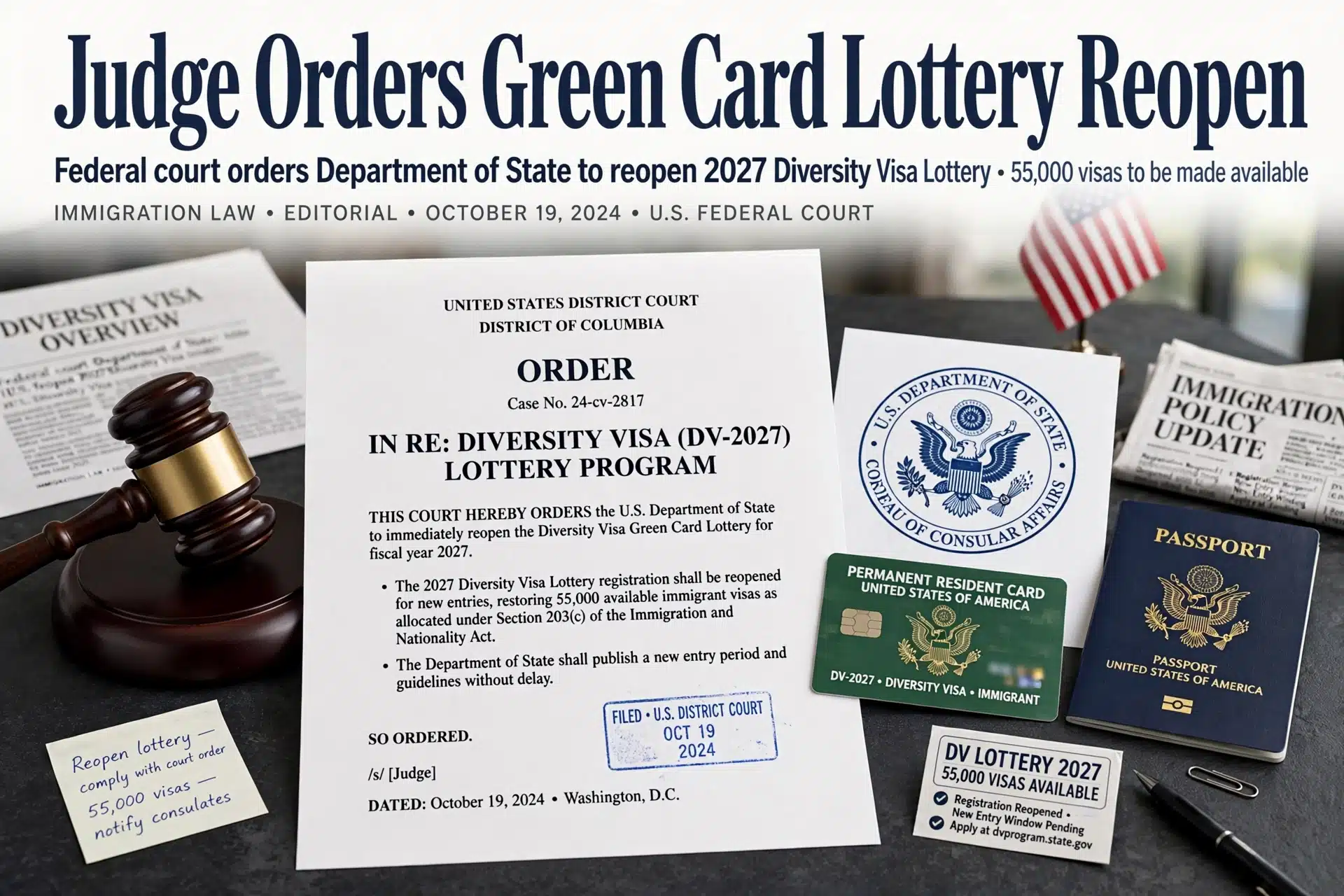
A federal judge has ordered the Trump administration to open registration for the delayed fiscal year 2027 Diversity Visa program, the congressionally created lottery that issues up to 55,000 green cards a year, after the government skipped its usual fall entry window for the first time in the program’s history. The 2027 green card lottery was effectively on hold until U.S. District Judge Jinsook Ohta granted a preliminary injunction on October 14 and ordered the State Department to announce and open a registration period of at least 30 days. For millions of eligible applicants from low-immigration countries, the program they assumed was quietly cancelled is, for now, ordered back on the calendar.
Key Takeaways:
- – Judge Jinsook Ohta granted a preliminary injunction requiring the State Department to open DV-2027 registration, with an order to announce and open it promptly, and to keep the window open at least 30 days.
- – The department must process entries until all 55,000 visas are issued or the fiscal year ends, and the court is retaining jurisdiction over implementation.
- – The lawsuit was brought by Red Eagle Law, a firm representing DV applicants, under the Administrative Procedure Act; the judge called the failure to open registration arbitrary and capricious.
- – The State Department did not open registration before the prior fiscal year ended on September 30, the first time in memory the annual window was skipped entirely.
The Ruling and What It Ordered
Ohta’s preliminary injunction compels the State Department to establish a registration period for DV-2027, with written direction to publicly announce and open the window by midnight Eastern time on Thursday following the Wednesday ruling, according to Curtis Morrison, an attorney for the plaintiffs. The registration period must remain open for at least 30 days, and the department must continue processing entries until all 55,000 fiscal-year-2027 visas are issued or the fiscal year ends, whichever comes first. The judge said the court would maintain jurisdiction over implementation, an unusual degree of ongoing supervision that signals she expects resistance in the details of execution.
The legal theory is narrow and, so far, intact. The government argued that reopening a lottery outside its normal timing would conflict with federal rules requiring a registration window of at least 30 days, effectively contending that the missed timetable made any belated opening unlawful. Ohta rejected that reasoning, finding the department could not use its own missed deadline as justification for eliminating a program Congress created, and that the failure to open registration amounted to a suspension of the program without adequate explanation.
Why the Lottery Went Dark
The Trump administration has been hostile to the Diversity Visa program since its first term, and second-term tightening has already reshaped legal immigration pathways through fee increases, vetting expansions and program suspensions. The DV program’s annual window normally opens in early October, and government filing roles for the 2026 program followed announcements in November 2025 that the department was changing how DV entry worked. Prospective applicants watched October 1 pass, then weeks, with no announcement, no portal, and no public explanation, which is the vacuum Red Eagle Law’s suit attacked.
The government’s litigation position revealed something important: it did not defend the delay as policy discretion so much as timing impossibility, arguing regulations barred a late window entirely. That posture tells applicants and Congress alike that the department’s preference was for the 2027 lottery simply not to happen, making the injunction the only reason the program proceeds.
Who the Program Is For and What Happens Next
Created by Congress in 1990, the Diversity Visa program distributes up to 55,000 immigrant visas annually, by random draw, to nationals of countries with historically low rates of immigration to the United States, with eligibility tied to country of birth, education or work experience, and winners still must clear standard immigrant-visa requirements including interviews and background checks. The 30-day window that the court ordered has real-world stakes: DV selection odds vary year to year, and compressing or extending the window changes the applicant pool and the optics of fairness, which is why the judge’s insistence on a full 30 days matters.
Practical steps for prospective applicants: wait for the official announcement on the State Department channels rather than third-party sites, avoid agents charging for entry, since DV entry is free, and prepare the educational or work-qualifying evidence winners will need later, since selection does not confer status. Watch two things next: whether the department complies with the Thursday opening order, and whether the government seeks a stay or appeal, either of which would move compliance into a second fight. The court retained jurisdiction, so implementation disputes return to Judge Ohta rather than starting from scratch.
The Economics Behind a Blocked Lottery
The fight is also economic for the people around the program. Red Eagle Law, the plaintiff that brought the suit, argued in court that the missed registration window had caused financial harm because the firm relies on work representing Diversity Visa applicants and could not recover those losses later, an argument the judge accepted as a form of irreparable harm supporting the injunction. Around that firm sits an industry of immigration attorneys, translators and consular-preparation services whose annual cycle is keyed to the lottery opening, and a season without a window strands the entire ecosystem ahead of a fiscal year with no entrants at all.
There is a dollar scale beyond the professional services, too. Each processed entry eventually flows into consular interviews, visa fees and onward settlement spending by new permanent residents, and skipping a full cohort removes the first step of all of it. Congress funded a program designed to move up to 55,000 people through selection, processing and issuance, and the department’s counterargument was that regulations made any late opening incompatible with a 30-day window. The judge’s answer, that the department’s own schedule miss cannot nullify a statute, is what converts an administrative calendar slip into a court-ordered reopening with economic consequences, and it is why the ruling’s implementation phase, which the court explicitly retained to supervise, will matter as much as the order itself.
What This Means for U.S. Immigration Policy
The ruling fits a season of judge-driven reversals of immigration policy, where courts have repeatedly slowed or blocked administrative attempts to shrink programs by attrition rather than statute. Congress wrote the green card lottery into law, and administrative inaction cannot end it, which is the principle the judge applied. The broader question is durability: registration may open, but visa issuance runs through fiscal 2027 interviews, and consular practice will be where compliance is ultimately tested.
For applicants, the immediate lesson is calendar discipline. A 30-day window on a recently announced schedule is easy to miss, and millions of the program’s habitual applicants would be discovering the reopening only through news like this. The State Department’s public posture, a spokesperson told Newsweek the department is putting American interests first in the visa process while declining to comment on litigation, gives no indication the agency plans to publicize the window beyond its minimum obligations, so family networks and community organizations will carry the word.
Note: this article is informational and is not legal advice; applicants should verify details on official State Department channels or consult an immigration attorney.
Frequently Asked Questions
When does DV-2027 registration open?
A federal judge ordered the State Department to announce and open the registration period, which must run at least 30 days; the exact opening date is set by the department’s compliance announcement.
Why was the 2027 green card lottery delayed?
The administration did not open the annual registration window before the prior fiscal year ended, and argued in court that regulations barred a late window, a position the judge rejected as effectively suspending a congressionally created program.
How many green cards does the DV lottery issue?
Up to 55,000 diversity visas per fiscal year are available under the program created by Congress in 1990, awarded by random draw to eligible applicants from countries with low U.S. immigration rates.
Do I have to pay to enter the green card lottery?
No. DV entry is free directly through official U.S. government channels, and winners pay immigrant visa fees only later in processing.
Sources: