






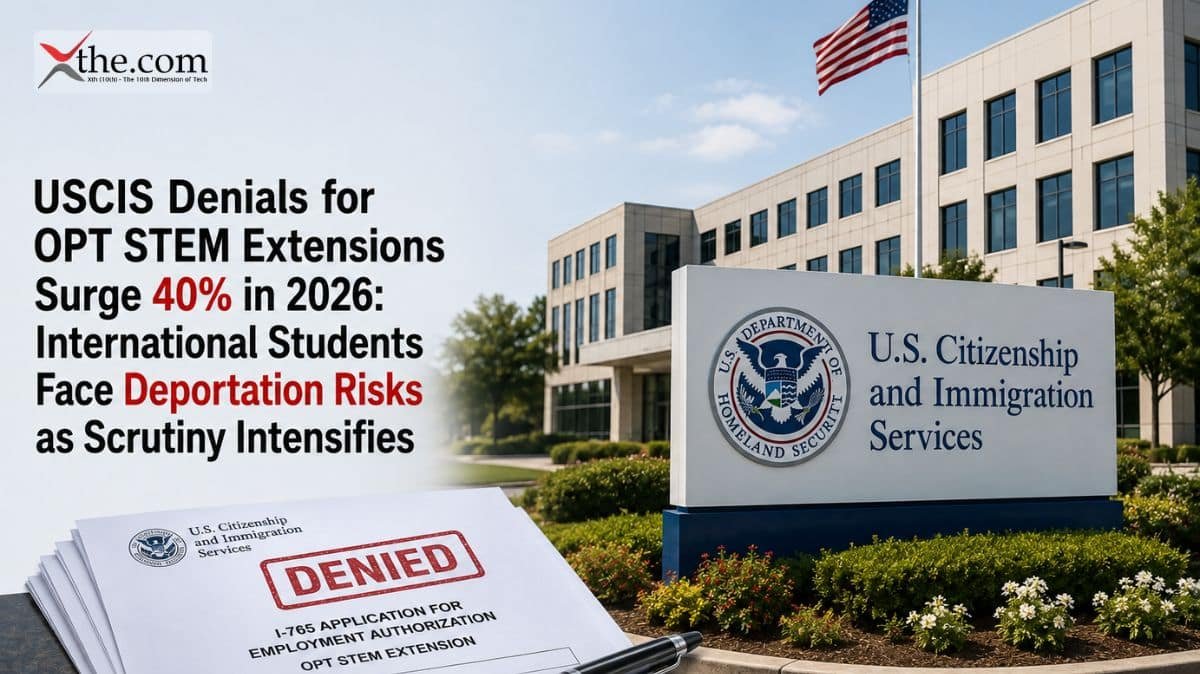
Optional Practical Training — the work authorization program that allows international students to remain in the United States for up to three years after graduation — has become a minefield of compliance requirements in 2026. Data obtained by the American Immigration Lawyers Association (AILA) through a Freedom of Information Act request reveals that USCIS denied 18,400 OPT STEM extension applications in the first seven months of 2026, a 40% increase over the same period in 2025. For the 250,000 international students currently on STEM OPT, the denial surge represents an existential threat to their American careers and legal status.
Why Denials Are Increasing
USCIS has not changed the statutory requirements for STEM OPT — the program still allows 24-month extensions for students with degrees in science, technology, engineering, and mathematics fields. What has changed is enforcement intensity and documentation scrutiny.
Reason 1: Training Plan Deficiencies
Form I-983 — the training plan agreement between student, employer, and university — has become the primary denial trigger. USCIS adjudicators are now rejecting applications for seemingly minor discrepancies:
- Vague learning objectives: Phrases like “gain practical experience” or “contribute to team projects” are deemed insufficient. Adjudicators want specific, measurable skills the student will acquire.
- Employer signature issues: Electronic signatures not using Adobe Sign or DocuSign are flagged. Hand-signed forms with illegible signatures trigger Requests for Evidence (RFEs).
- Mentor qualification gaps: The designated mentor must hold a degree in a STEM field related to the student’s training. A software engineering student supervised by a business analyst with an MBA — even at a tech company — now faces denial.
Reason 2: Employer Legitimacy Challenges
USCIS has dramatically increased scrutiny of small employers and third-party consulting placements. Companies with fewer than 10 employees, those founded within the past two years, or those with no physical office (fully remote operations) are presumptively suspect.
The “employer-employee relationship” requirement — long a theoretical concept — is now aggressively enforced. If the student works at a client site rather than the employer’s office, USCIS demands extensive documentation proving the employer (not the client) directs and controls the work. Staffing agencies, body shops, and consulting firms that place students at Fortune 500 clients are facing blanket suspicion.
Reason 3: Unemployment Day Violations
STEM OPT allows 150 days of aggregate unemployment across the initial 12-month OPT and 24-month STEM extension. However, USCIS is now cross-referencing SEVIS employment records with state unemployment insurance databases and tax filings. Students who reported employment start dates before actually receiving job offers, or who remained in SEVIS as “employed” during unpaid training periods, are being caught in data mismatches.
Reason 4: Degree Field Mismatch
The expanded STEM degree list — now 580 CIP codes — has created confusion. A student with a Master’s in Financial Engineering (CIP 52.0803) is clearly STEM-eligible. But a student with a Master’s in Business Administration with a concentration in Business Analytics (CIP 52.1301) faces ambiguity. USCIS is interpreting “related field” narrowly, denying extensions where the job title does not closely match the degree name.
The Human Cost
Behind every denial statistic is a disrupted life.
Priya Sharma, 26, Austin, Texas: A University of Texas computer science graduate, Priya received her STEM OPT denial in June after working as a data engineer at a 12-person startup for 18 months. The denial cited an unsigned page 3 of her I-983 form — a technicality. Her 60-day grace period expires on August 28. She has job offers from Google and Meta but cannot accept them without valid work authorization. “I have $78,000 in student loans and a lease through May 2027,” she said. “If I leave, my American dream ends. If I stay illegally, I can never return.”
Wei Zhang, 28, Seattle, Washington: A University of Washington electrical engineering graduate employed at a semiconductor firm, Wei received an RFE questioning whether his job — testing chip designs — qualified as “training” since he performed identical work to American employees. His employer spent $15,000 on immigration attorneys to respond. The case remains pending after 4 months. “I cannot change jobs, cannot travel home for my grandmother’s funeral, and cannot focus at work because every email from USCIS makes my heart stop,” he said.
What the Data Shows
AILA’s analysis of the 18,400 denials reveals patterns:
- 47% of denials cited training plan deficiencies (Form I-983)
- 23% of denials challenged employer legitimacy or employer-employee relationship
- 18% of denials found unemployment day violations
- 12% of denials determined the job was not sufficiently related to the STEM degree
The remaining denials involved criminal background issues, prior status violations, or administrative errors.
Geographically, students in California (22% of denials), Texas (16%), and New York (12%) faced the highest denial rates — reflecting larger international student populations and higher concentrations of small tech employers that trigger scrutiny.
University Responses
Major universities are scrambling to protect their students. MIT hired four additional international student advisors and implemented automated I-983 pre-review software that flags common errors before submission. Stanford expanded its free legal clinic from 20 hours to 60 hours weekly, though wait times still stretch three weeks. The University of Texas at Austin — with over 6,000 international students — launched an emergency fund to cover attorney fees for students facing denials.
Smaller institutions lack these resources. Regional state universities in the Midwest and South, which have aggressively recruited international students to offset declining domestic enrollment, often have one advisor for every 800 students. These students are disproportionately affected by denials because they lack pre-submission support.
What Students Must Do to Avoid Denial
- Treat Form I-983 Like a Legal Contract: Every field must be specific. Instead of “learn software development,” write “develop Python-based data pipelines using Apache Spark, gaining proficiency in distributed computing frameworks under direct supervision of a senior engineer with an M.S. in Computer Science.”
- Verify Your Mentor’s Credentials: Confirm your designated mentor holds a STEM degree. Request a copy of their diploma or transcript. If they do not qualify, ask your employer to assign a different mentor immediately.
- Document Employment Rigorously: Keep pay stubs, offer letters, W-2s, and timesheets. If you change jobs, report the new employer to your university’s international office within 10 days. Do not let even one day pass without reported employment.
- Avoid High-Risk Employers: Startups with no physical office, staffing agencies that place you at client sites, and companies with fewer than 5 employees face heightened scrutiny. If you must work for a small employer, ensure they have a dedicated office and direct supervision structure.
- File Early: Submit your STEM extension application 90 days before your current OPT expires. Early filing allows time to respond to RFEs without falling out of status.
- Consult an Attorney Before Filing: The $2,000-$3,000 cost of an immigration attorney reviewing your application is trivial compared to the cost of deportation and career interruption.
Policy Debate
The OPT program has always existed in a political gray area. Created by regulation rather than statute, it has survived multiple legal challenges and political attacks. The Trump administration attempted to restrict OPT in 2020; the Biden administration maintained the program but increased oversight.
Senator Tom Cotton and Representative Andy Biggs have introduced legislation to eliminate OPT entirely, arguing it displaces American graduates. Conversely, the Chamber of Commerce and tech industry groups defend OPT as essential for filling STEM positions that American universities cannot supply domestically.
“OPT is not charity — it is workforce development,” said Todd Schulte, president of FWD.us. “International students who train at American companies often found startups, patent innovations, and create jobs for US citizens. Kicking them out is economic self-sabotage.”
The Bottom Line
For the 250,000 students on STEM OPT, 2026 is a year of heightened vigilance. The 40% denial surge is not a statistical anomaly — it reflects a deliberate shift toward stricter enforcement that shows no signs of reversing. Students who treat compliance as an afterthought risk losing everything they have invested: tens of thousands in tuition, years of study, and the careers they came to America to build.
The advice is simple but urgent: document everything, file early, verify every detail, and seek legal counsel before submission. In the current environment, there is no margin for error.








