






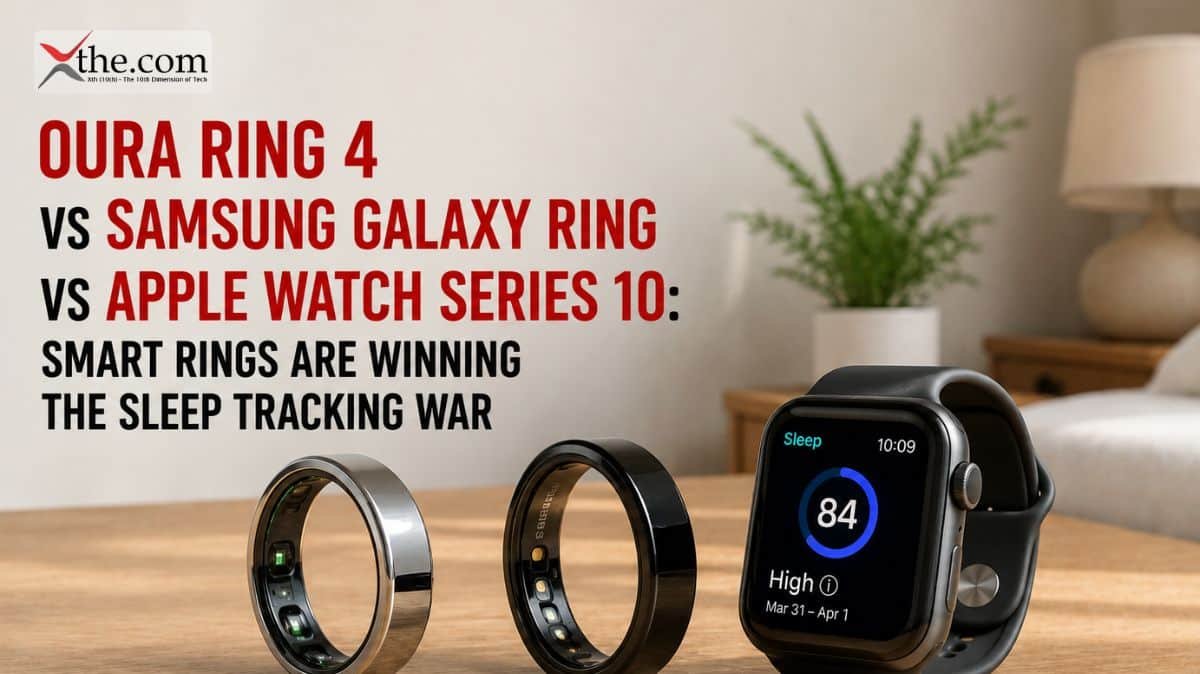
The wearable technology market is experiencing a quiet revolution. While Apple, Samsung, and Garmin dominate wrist-worn devices, a new category — smart rings — is capturing the attention of sleep scientists, biohackers, and health-conscious Americans who find watches uncomfortable for overnight wear. The Oura Ring 4, released in March 2026, and Samsung’s Galaxy Ring, launched in June, have both surpassed the Apple Watch Series 10 in clinical sleep tracking accuracy according to peer-reviewed studies published this month in the Journal of Clinical Sleep Medicine.
Why Smart Rings Beat Watches for Sleep
The physics is simple: a ring sits snugly against the palmar digital artery on the finger, where blood vessels are closer to the skin surface than on the wrist. This proximity yields stronger photoplethysmography (PPG) signals — the optical technique wearables use to measure heart rate, heart rate variability (HRV), and blood oxygen saturation.
Dr. Rebecca Robbins, a sleep researcher at Harvard Medical School and co-author of the study, explained: “We compared the Oura Ring 4, Samsung Galaxy Ring, and Apple Watch Series 10 against polysomnography — the gold standard sleep study conducted in labs. The Oura Ring achieved 92% agreement with polysomnography for sleep stage classification. The Galaxy Ring hit 89%. The Apple Watch managed 81%. That 10-11 percentage point gap is clinically significant.”
Oura Ring 4: The Premium Choice
The Oura Ring 4, priced at $349 plus a $6 monthly subscription, represents the fourth generation of the category pioneer. The titanium ring weighs just 4 grams — lighter than a standard wedding band — and comes in six finishes including brushed gold and matte black.
Key Upgrades Over Gen 3:
- Dual-LED PPG sensors with green and infrared wavelengths for more accurate HRV during sleep
- Temperature sensing with 0.1°C precision, enabling illness detection 1-2 days before symptoms appear
- 7-day battery life — more than double the Apple Watch’s 18-hour endurance
- Stress resilience score combining HRV, temperature trends, and activity data to predict burnout risk
The Oura app generates a “Readiness Score” each morning (0-100) based on sleep quality, recovery, and physiological stress. Users report that the score genuinely predicts their subjective energy levels — a validation that most wearables fail to achieve.
However, Oura requires a $6 monthly subscription ($72 annually) to access full data analytics. Without it, users see only basic sleep duration and heart rate. This subscription model has drawn criticism, though Oura argues the ongoing revenue funds continuous algorithm improvements.
Samsung Galaxy Ring: The Ecosystem Play
Samsung’s Galaxy Ring, priced at $399 with no subscription required, is the most serious Oura competitor to date. It integrates seamlessly with Samsung Health, Galaxy Watches, and Galaxy smartphones — creating a multi-device health tracking ecosystem that no other manufacturer matches.
Galaxy Ring Features:
- AI Energy Score using Samsung’s on-device Galaxy AI to analyze sleep, activity, and stress patterns
- Automatic workout detection when paired with a Galaxy Watch — the ring handles recovery metrics while the watch captures GPS and pace
- Gesture controls for Samsung smartphones — double-tap to silence alarms or trigger camera shutter
- 10-day battery life — the longest of any health wearable on the market
The Galaxy Ring’s sleep staging accuracy (89% vs polysomnography) is slightly behind Oura but ahead of every wrist-worn competitor. Where Samsung wins is ecosystem integration: sleep data automatically adjusts your Galaxy Watch’s morning alarm to wake you during light sleep, and Samsung Health correlates sleep quality with meal timing from Samsung Food.
Apple Watch Series 10: Still the Best Smartwatch
The Apple Watch Series 10 remains the best overall smartwatch — for daytime use. Its new sleep apnea detection feature, FDA-cleared in July, is genuinely groundbreaking for identifying undiagnosed breathing disorders. But for pure sleep tracking, the watch faces inherent limitations.
The wrist is a noisier signal environment than the finger. Arm movement during sleep creates motion artifacts. The watch’s 18-hour battery forces most users to charge overnight at least twice weekly, missing sleep data collection entirely. And many users find wearing a 40-45mm watch to bed uncomfortable, particularly side sleepers.
Apple’s sleep stage accuracy (81%) is not poor — it is actually the best among wrist-worn devices. But the gap to smart rings is widening as ring sensor technology improves.
Clinical Validation Matters
The Journal of Clinical Sleep Medicine study is significant because most wearable accuracy claims come from manufacturer-funded research. This independent evaluation, conducted across 240 participants over 30 nights at Stanford Sleep Medicine Center, controlled for age, BMI, skin tone, and sleep disorders.
Key findings beyond overall accuracy:
- Deep sleep detection: Oura Ring 4 (88% accuracy), Galaxy Ring (85%), Apple Watch (74%)
- REM sleep detection: Oura Ring 4 (90%), Galaxy Ring (87%), Apple Watch (79%)
- Sleep onset latency: Oura Ring 4 (±4 minutes), Galaxy Ring (±7 minutes), Apple Watch (±12 minutes)
- Heart rate variability: Oura Ring 4 (±3ms), Galaxy Ring (±5ms), Apple Watch (±11ms)
For athletes and biohackers who use HRV to guide training intensity, the ring’s precision is transformative. Overtraining syndrome — which affects 10% of competitive amateur athletes — can be predicted 48-72 hours in advance using ring-derived HRV trends.
The Market Shift
Smart ring sales have exploded. Oura reported 2.4 million rings sold in the first half of 2026, up 180% from the same period in 2025. Samsung has sold 800,000 Galaxy Rings since June. Apple is reportedly prototyping a “Apple Ring” for 2027 release, though the company has not confirmed this.
The trend reflects a broader consumer desire for “invisible health monitoring” — technology that collects data passively without demanding attention. Smart rings have no screens, no notifications, and no temptation to check emails at 2 AM. They simply observe and report.
Pricing and Value
Table
| Device | Price | Subscription | Battery | Sleep Accuracy | Best For |
| Oura Ring 4 | $349 | $6/month | 7 days | 92% | Sleep optimization, HRV tracking |
| Galaxy Ring | $399 | None | 10 days | 89% | Samsung ecosystem users |
| Apple Watch S10 | $429 | None | 18 hours | 81% | Daytime smartwatch features |
For dedicated sleep tracking, the Oura Ring 4 offers the best accuracy but requires ongoing payment. The Galaxy Ring provides nearly equivalent performance with no subscription and superior battery life. The Apple Watch Series 10 is the wrong tool if sleep is your primary concern — buy it for everything else, and add a ring if sleep data matters.
Who Should Buy a Smart Ring?
Buy the Oura Ring 4 if you:
- Prioritize the most accurate sleep and recovery data available
- Are willing to pay $72 annually for full analytics
- Want illness prediction through temperature tracking
- Use Whoop, Garmin, or Apple Watch during the day and need dedicated sleep data
Buy the Samsung Galaxy Ring if you:
- Own a Samsung Galaxy smartphone or watch
- Refuse to pay subscriptions for health data
- Want the longest battery life possible
- Value gesture controls and ecosystem integration
Keep the Apple Watch Series 10 if you:
- Need comprehensive daytime health features (ECG, blood oxygen, fall detection)
- Want FDA-cleared sleep apnea screening
- Are already embedded in the Apple ecosystem
- Find rings uncomfortable or worry about losing them
The Verdict
Smart rings have legitimately surpassed smartwatches for sleep tracking. The Oura Ring 4 and Samsung Galaxy Ring deliver clinical-grade data from a device you forget you’re wearing. For the 50 million Americans who struggle with sleep quality, this technology offers actionable insights that wrist-worn devices simply cannot match. The Apple Watch remains the best general-purpose health wearable, but for sleep-specific optimization, 2026 is the year of the ring.








