





Hsinchu, Taiwan — Dateline | July 14, 2026
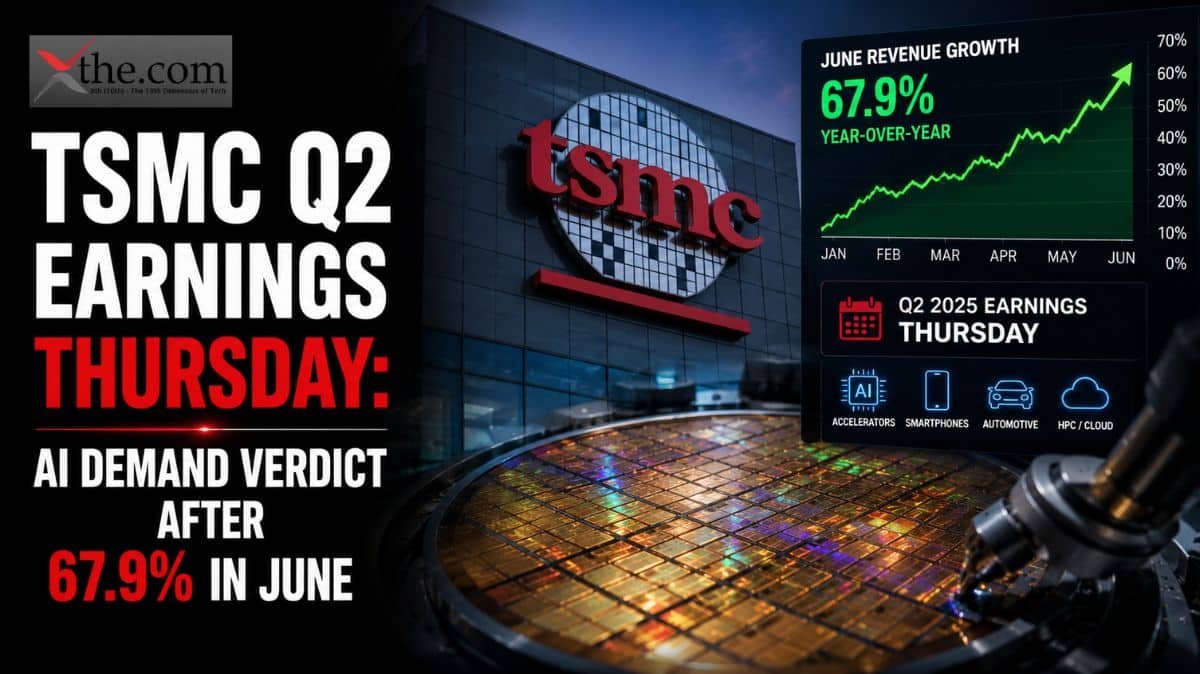
A 67.9 percent jump in monthly revenue is unusual, but that is exactly where Taiwan Semiconductor Manufacturing Company stands ahead of Thursday. TSMC’s Q2 earnings on July 16 are now the most consequential print of the week for chip investors, and the question is no longer about whether the AI buildout is real. It is how much longer TSMC’s order books can keep proving it. The TSM Q2 2026 results arrive with the company’s June revenue report already in hand, and the number inside it — a 67.9 percent year-on-year surge to NT$442.68 billion — has reset expectations for what “strong” even means in the foundry business.
TSMC usually does not release full quarterly results in advance, but its monthly revenue updates serve as a running scoreboard. April, May, and June each set new records, and the second quarter ended at about NT$1.27 trillion, matching management’s guidance of $39.0 billion to $40.2 billion from April. Revenue for the first half of 2026 reached NT$2.4 trillion, up 35.6 percent from the same period last year. These are not small gains. They make Wall Street wonder if its forecasts have been too cautious.
Why Thursday’s Call Holds More Significance Than Usual
TSMC’s Q2 earnings conference on July 16 will be held at 2:00 p.m. in Taipei, which is 2:00 a.m. Eastern Time on Thursday. It is not an ideal time for U.S. analysts, but they will be tuning in. Every semiconductor desk, AI infrastructure fund, and most hyperscalers relying on TSMC’s advanced chips will be listening for one thing: CEO C.C. Wei’s comments on whether the current pace of AI chip orders can sustain into 2027 or is just a temporary surge from a few big model-training projects.
The stakes go beyond TSMC’s own stock. As the manufacturer behind the most advanced logic chips for Nvidia, Apple, AMD, and a growing list of custom AI silicon designers, TSMC functions as the TSMC AI supply chain bellwether for the entire technology sector. When its capacity is booked solid, it tells investors that AI infrastructure spending has not yet hit a ceiling. When utilization softens, even slightly, the ripple reaches memory makers, packaging suppliers, and the cloud giants whose capital budgets depend on chip availability.
The Guidance Question
Management already increased its full-year 2026 revenue growth forecast to over 30 percent in U.S. dollars during the April call, up from the mid-twenties. Now, the question is whether that number moves again. TSMC guidance raises capex July 16. Speculation has intensified after TSMC said it plans to spend near the top of its $52 billion to $56 billion capital expenditure range for the year. Just a year ago, that would have seemed bold. Executives have called AI-related demand for high-end computing chips ‘extremely robust,’ saying the growth is driven in part by a shift toward more demanding agentic AI systems.
Citi’s semiconductor team has staked out one of the more bullish positions ahead of the print. Citi analyst Ms. Chen recently raised her price target on TSMC’s Taiwan-listed shares to T$3,800 from T$2,875, while maintaining a Buy rating and placing the stock on a 30-day upside-catalyst watch. That move shows the broader idea behind TSMC Citi price target raise July 2026 coverage: expectations that TSMC will not only beat its own revenue guidance but extend its annual outlook once more, supported by continued 2-nanometer and 3-nanometer pricing strength.
What the Numbers Need to Show
Investors looking at Thursday’s results will focus on four key numbers in addition to revenue. Gross margin, expected to be between 65.5 and 67.5 percent, will indicate whether TSMC is passing higher costs and overseas expenses to customers without hurting profits. Analysts also want to see whether full-year revenue growth guidance, now above 30 percent, will rise further. Comments on capital spending will reveal if TSMC plans to spend at the top of its announced range. Updates on N2 process capacity and CoWoS advanced packaging—now seen as the biggest bottleneck in AI chip production—will show how quickly customers like Nvidia can get the chips they need.
There are still risks. TSMC’s stock price already reflects high margins and high factory use, so it could react strongly to even a small drop in demand. Foundry revenue also trails customer orders by one to three quarters, depending on the chip type, so any slowdown in spending by big cloud companies would likely appear later in the year, not in Thursday’s results. Risks also include challenges with overseas expansion, especially the Arizona project, and the chance that higher chip prices could eventually hurt consumer electronics profits. These are factors that optimistic investors sometimes overlook.
Options markets are already pricing in a wide post-earnings swing, a signal that traders expect Thursday’s numbers to move the stock meaningfully in either direction rather than simply confirm a consensus view that has grown increasingly bullish over the past month. Still, the search terms circulating across trading desks this week tell their own story. Queries framed around “TSMC Q2 earnings July 16 AI demand verdict guidance raise expected” and “TSMC quarterly results Thursday biggest signal AI chip spending 2026” reflect an investor base that has largely stopped asking whether AI demand is real and started asking how much higher the ceiling goes. TSMC’s own June numbers did more to answer that question than any analyst note could.
The Forward-Looking Read
Thursday’s earnings conference will not end the debate about how long the AI spending boom will last, but it will give the clearest update so far. If TSMC beats income expectations and raises its guidance again, it would indicate that capacity, not demand, remains the main constraint on AI infrastructure. This would keep TSMC’s pricing power and margins strong. On the other hand, if management sounds cautious about 2027 orders, it would be the first sign that the outlook is becoming less certain. Either way, the rest of the chip industry will be watching Hsinchu closely before markets open Thursday.
Source: TSMC’s June sales drive revenue surge of 68% ahead of earnings report