




Santa Clara, California.
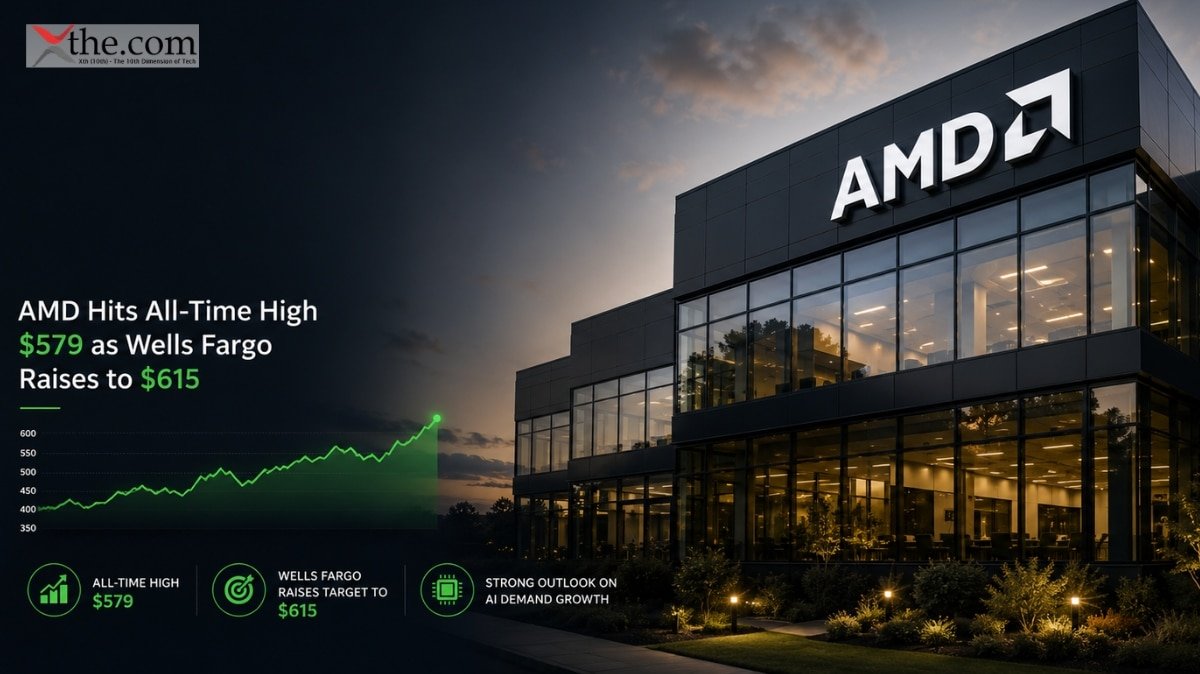
On June 30, AMD’s stock hit $579.73, setting a new record for a company often viewed as Nvidia’s runner-up. The phrase ‘AMD stock all-time high $579 Wells Fargo raises target to $615 explained June 30 2026′ started trending as AMD finished the day up over 7%. This jump prompted analysts to quickly revise their forecasts.
This upsurge was not powered by rumors or technical signals. It was sparked by a clear, data-driven recommendation from a top semiconductor analyst.
The Upgrade That Moved The Tape
Wells Fargo analyst Aaron Rakers raised his AMD Wells Fargo price target to $615 from $505, an increase of more than 21%, and maintained an Overweight rating. This action signals to institutional investors that AMD’s core outlook has improved, not just its valuation.
Rakers set his new target based on a three-year earnings outlook rather than a single product cycle. He predicts CPU revenue will reach $16 billion in 2026, $20.5 billion in 2027, and $25 billion in 2028, with about 68% growth this year. For GPUs, he expects $15.6 billion in 2026, $40.6 billion in 2027, and nearly $63 billion in 2028. These projections themselves support earnings-per-share estimates of $7.15 for 2026 and $13.40 for 2027, both above earlier forecasts.
Wells Fargo’s semiconductor upgrade is based on unit economics, applying a 33-times price-to-earnings ratio to a 2028 EPS estimate of $18.75 to reach the $615 target. Cantor Fitzgerald set an even higher target of $700, while Goldman Sachs raised its estimate to $450 from $240, citing strong AI trends. The wide range of $450 to $700 shows analysts are still reaching a consensus, but the overall outlook stays positive.
Why The Server Chip Story Matters More Than The Headline Number
Besides the record stock price, there is another important development: AMD’s sixth-generation, 2-nanometer EPYC server CPU, called Venice, started production in late May and will ramp up through late 2026. AMD says more customers are adopting Venice than any earlier EPYC generation, which is a strong commercial indicator.
Morgan Stanley expects Venice to ship 6.75 million units in 2027, beating the 5.75 million units projected for Nvidia’s competing Vera CPU in the same period. This is a new development in the NVDA AMD chip race that the market had not fully recognized before. Server CPUs usually do not attract as much attention as graphics accelerators, but AMD now estimates the total addressable market for this segment at $120 billion by 2030, according to CEO Dr. Lisa Su. Wells Fargo’s $25 billion forecast for 2028 suggests AMD could capture about 20% of that market within four years.
AI Data Center Demand Reshapes The Competitive Map
The main idea behind this rally is a shift happening in large data centers. Workloads are shifting from model training, where Nvidia has been dominant, to large-scale inference, where cost per token and performance per watt matter more than raw speed. This change is the opportunity AMD has been waiting for.
Meta plans to deploy up to 6 gigawatts of AMD Instinct GPU capacity, starting with a custom MI450-based design. Meta is also a lead customer for the Venice CPU launch. AWS, Google Cloud, Microsoft Azure, and Tencent have all expanded their EPYC-powered cloud offerings, increasing AMD’s presence among major cloud providers that once relied mostly on Nvidia chips. This variation is why demand for AMD’s AI data center chips is now a key topic for portfolio managers seeking exposure to AI infrastructure without putting all their risk in a single supplier.
The Philadelphia Semiconductor Index reflected this broader excitement, rising 3.83% that same day, with 25 of 30 stocks gaining. Moves this large across the sector are rare, except during major events, underscoring how much importance the market placed on Rakers’ report.
The Rackspace Deal Signals A New Customer Category
AMD is not just winning business from hyperscalers. On June 16, AMD and Rackspace Technology signed a deal to deploy 30 megawatts of AMD-based AI computing across Rackspace’s global data centers, formalizing an earlier agreement. The setup combines AMD Instinct GPUs, including the MI355X and MI350P series, with AMD EPYC CPUs in what Rackspace calls a governed Enterprise AI Cloud architecture.
Deployment is set to start in late 2026 and continue through 2028, focusing on regulated markets like healthcare, where compliance and vendor accountability continue as important as performance. Rackspace CEO Gajen Kandiah described the goal as a governed AI stack with one accountable partner from hardware to results, targeting enterprises that have been cautious about AI spending in the absence of clear governance. For AMD, this shows that demand is growing beyond just the largest cloud platforms.
Approaching A Trillion-Dollar Valuation
The market capitalization math has become impossible to ignore.AMD closed June near $580 per share, up more than 171% year-to-date and over 309% over the past 12 months, pushing its valuation to the doorstep of the ten-figure mark. AMD’s market cap of $1 trillion is no longer a speculative milestone; it is a near-term arithmetic outcome if the stock holds recent levels, and TradingKey’s coverage of the June 30 session framed the company as closing in on that threshold in real time.
This sets the stage for another search phrase now making the rounds among institutional investors: AMD close to $1 trillion market cap, AI chip demand second half 2026, investor analysis. The phrase underscores both the opportunity and the risks. AMD is currently trading at about 180 times trailing earnings, roughly six times Nvidia’s 30-times multiple. This means AMD’s performance must live up to the high expectations analysts have set.
Of course, this does not mean AMD’s stock will keep rising without setbacks. Some doubters note that even with a 21% price target increase, there is still room for disappointment if Venice shipments fall short or hyperscaler spending slows. However, AMD’s growth now comes from several areas—server CPUs, AI accelerators, and regulated enterprise cloud deals—giving it more ways to meet its targets than it had last year. In the second half of 2026, investors will focus less on the stock price and more on whether Venice adoption, Instinct shipments, and deals like Rackspace turn forecasts into real revenue.