






New York, New York
The $200 laptop RAM kit you bought last year may cost $400 by the end of 2027. That is not hyperbole. That is the arithmetic of a Jefferies Equity Research forecast that should alarm anyone planning to buy a computer, phone, gaming console, or tablet in the next 18 months.
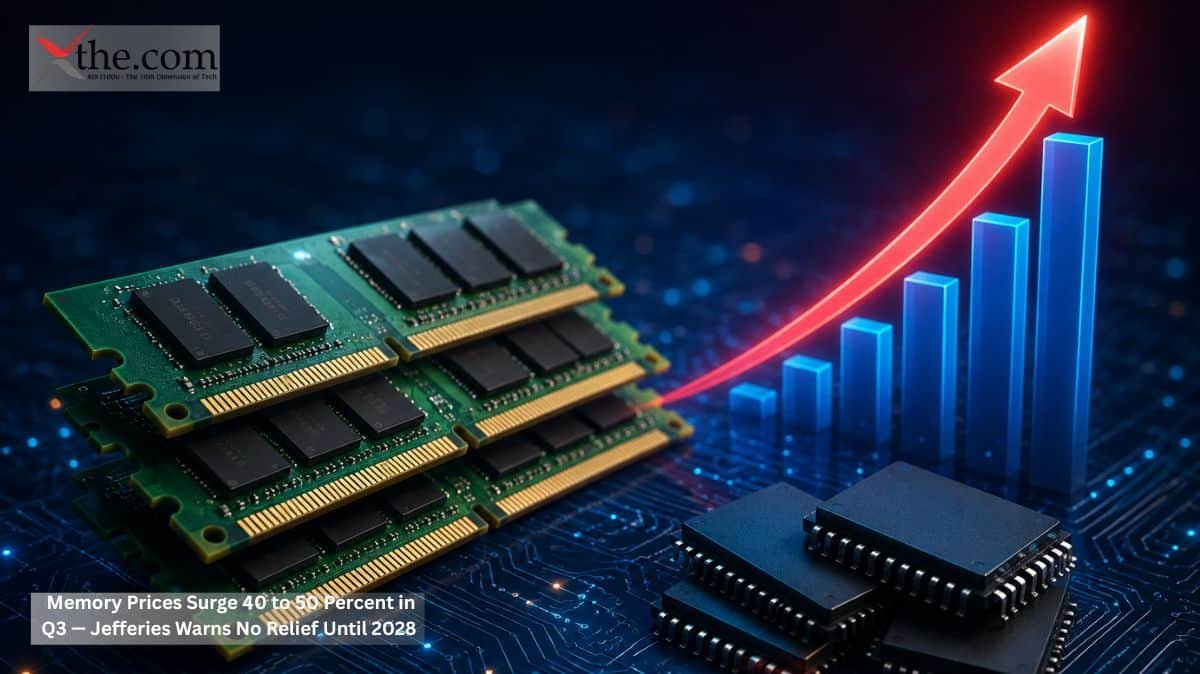
Memory chip prices surge: 2026 projections from Jefferies show a 40 to 50 percent rise in Q3 2026 versus the current quarter, followed by another 30 to 40 percent hike in Q4. In 2027, the firm projects a further 40 to 45 percent year-on-year increase. The only meaningful relief on the horizon arrives in 2028 and even then, it arrives modestly.
This is not a blip. This is a structural repricing of the entire consumer technology ecosystem.
Jefferies Memory Forecast 2026: The Numbers Behind the Warning
The Jefferies memory forecast 2026 lays out a stark trajectory. Cloud Service Providers are locking down 50 percent of total memory capacity a share that could rise to 70 percent — by signing two-year long-term agreements that require a 40 percent prepayment. No consumer electronics players have signed these agreements. That asymmetry is the entire story.
AI hyperscalers Microsoft, Google, Amazon, Meta are essentially buying memory futures at scale, pulling the available pool away from PC makers, smartphone manufacturers, and gaming hardware companies. The consumer market gets whatever is left.
Microsoft has reported paying two-and-a-half times as much for memory now as at the end of last year and expects costs to double again by late 2027. Apple has noted it has never experienced such rapid increases in component prices. Those cost increases do not stay inside corporate earnings reports. They move downstream, fast.
The Gas Station Analogy That Explains Everything
Think of global DRAM supply as a single fuel pipeline. AI data centers are the industrial buyers refineries, airlines, shipping fleets that lock in contracts for the bulk of the flow. Whatever trickles through to the retail pump is priced at whatever the market will bear, because supply is tight and getting tighter.
HBM demand, AI data center DRAM pressure are the root drivers. The big three memory makers Samsung, SK Hynix, and Micron have prioritized high-bandwidth memory production for AI accelerators, and China’s CXMT, widely hoped to be a source of cheaper supply, has not materialized as a disruptive force.
CXMT’s DRAM technology lags 1.5 to 2 generations behind global leaders. Without EUV lithography, the company cannot upgrade to DDR6 or HBM3E. The “cheap Chinese memory” thesis was, in the words of sector analysts, a myth.
DRAM Price Increase Q3 2026: What’s Already Breaking at Retail
The DRAM price increase Q3 2026 is not a future event. Its effects are already visible across the consumer electronics landscape.
Apple raised iPad and MacBook prices by hundreds of dollars this month, with Tim Cook confirming that iPhone prices will follow. The Steam Deck recently saw a 50 percent price increase, partly due to memory costs. Microsoft raised Xbox hardware pricing. Each of these decisions traces back to the same supply chain constraint: the companies building AI infrastructure are consuming memory at a pace that the existing global manufacturing base cannot keep up with.
“Jefferies warns DRAM memory prices surge 40 to 50 percent Q3 2026 and 30 to 40 percent Q4 no relief until 2028” — that headline, read carefully, describes an 18-month window in which every major consumer hardware category reprices upward simultaneously. Laptops, phones, tablets, gaming consoles, and even budget Chromebooks carry DRAM and NAND. None are exempt.
DRAM NAND Price Surge Q4 2026: Who Wins, Who Loses
Markets rarely produce a crisis that hurts everyone equally. The DRAM NAND price surge Q4 2026 creates a clear divide between shareholders and consumers.
Samsung SK Hynix memory pricing power has never been stronger. Both companies — alongside Micron — are sitting on a seller’s market that their own production decisions helped engineer. With no new wafer capacity growth projected for 2027 and only 15 to 20 percent new capacity expected by 2028, the oligopoly retains pricing control through the end of the decade. Investors holding positions in Samsung, SK Hynix, or Micron are, structurally, positioned on the right side of this shortage.
Consumers are on the other side. Smartphone shipments are expected to fall 15 percent in 2026 due to higher prices and weaker demand. The PC market is projected to decline by 11.3 percent. These are demand destruction numbers — the market signal that price increases have exceeded what buyers will absorb.
The dynamic described by “why AI cloud demand is locking up DRAM capacity and pushing memory prices higher for consumers in 2026” is not abstract. It is the reason a budget gaming laptop that cost $799 in January 2026 may cost $1,100 by Q1 2027. The AI infrastructure build-out, essential as it may be for long-run productivity, is extracting a direct and immediate tax from ordinary technology buyers.
Memory Shortage No Relief 2028: The Long Road
Memory shortage no relief 2028 is the defining constraint of the current cycle. Even Jefferies’ optimistic 2028 scenario assumes only a 15 to 20 percent increase in supply — modest relative to the demand trajectory that AI infrastructure spending has set in motion.
China’s NAND technology is expected to become more globally competitive and could catch up by 2028 — but that remains a 2028 story, not a 2026 or 2027 one. For the near term, the market structure is locked. Long-term agreements between hyperscalers and the major producers have already allocated most of the available supply, leaving consumer electronics manufacturers to compete for scraps at premium spot prices.
What to Buy Now: A Practical Guide Before Prices Go Higher
The one actionable takeaway from the Jefferies report is timing. If you need to buy, buy now. Here is how to think about it by category.
Laptops and PCs. Configurations available today reflect pricing before the Q3 surge lands at retail. A system purchased in July 2026 will almost certainly cost more in the same spec by October. If an upgrade is on your roadmap for the next 12 months, accelerate the purchase.
Smartphones. Apple has telegraphed iPhone price increases. Android flagships from Samsung and others face the same input cost pressures. Mid-cycle upgrades bought within the next 60 days avoid the repricing wave for new models arriving in fall 2026.
Gaming Consoles and Handhelds. Console prices are already moving. The Steam Deck’s 50 percent hike is a leading indicator, not an anomaly. Anyone sitting on a planned console or handheld purchase should treat current prices as a closing window.
RAM and SSDs. For those purchasing memory and storage directly, carefully reviewing your requirements and buying what you need now can help you avoid the impact of price hikes, especially since smaller configurations may see those increases sooner. DDR5 kits and NVMe drives at today’s prices represent a meaningful discount relative to where the market heads by Q4.
Refurbished and Pre-Owned. The secondary market for certified refurbished devices currently reflects older pricing. That window is narrowing as dealers adjust, but it remains a legitimate path to avoiding the sharpest near-term increases.
The memory market has entered a cycle unlike any in recent history. Supply is structurally constrained. Demand from AI infrastructure shows no deceleration. The producers who control global output are operating with pricing power they have not held in decades. For consumers, 2026 and 2027 represent a period of sustained hardware inflation with no historical playbook — except the oldest one: buy what you need before it costs more.
Source: Samsung Newsroom