





Austin, Texas
Oracle Stock Crash 2026: When the Bill Arrives for a Borrowed Future
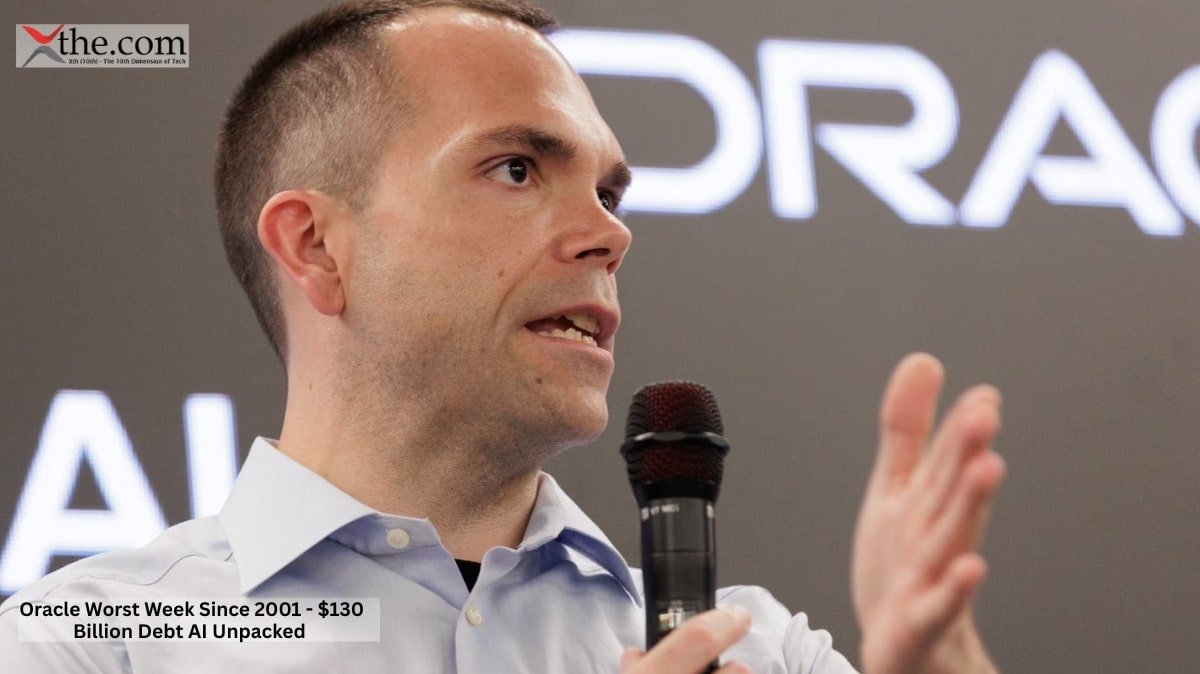
Oracle shares closed at $148.53 on June 26, capping a 19% weekly decline — the steepest since August 2001, when the stock fell 20% during the dotcom bust. The selloff erased roughly $80 billion in market capitalization. For a company whose market cap peaked near $900 billion just nine months ago, that number lands like a verdict.
The Oracle stock crash 2026 did not arrive without warning signs. It arrived because investors finally did the math — and the math on Oracle ORCL worst week territory tells a story about a company that has staked its future on AI infrastructure it cannot yet fully monetize, using borrowed capital at a scale that would make most CFOs lose sleep.
This is not a routine correction. This is a structural reckoning.
The Four Failure Signals Driving the Oracle $130 Billion AI Debt Crisis.
Signal One: A Capital Expenditure Number That Broke Its Own Forecast
Capital spending jumped 162% to $55.7 billion in fiscal 2026, overshooting the company’s own $50 billion guidance. That is not modest overspending. That is a company building faster than it planned, in a market where demand signals remain strong but cash does not.
Think of Oracle data center capex spending this way: imagine a luxury hotel developer who borrowed heavily to build 500 rooms, then decided mid-construction to add 80 more without renegotiating the loan. The rooms may eventually fill. The debt accrues regardless.
Oracle spent nearly triple what it spent in fiscal 2025 on property, plant, and equipment — chasing cloud infrastructure capacity alongside Amazon, Microsoft, and Google. The difference? Those companies can sell a full technology stack. Oracle is still assembling its competitive position while the bill compounds daily.
Signal Two: Negative Free Cash Flow at a Scale That Demands Attention
The result pushed free cash flow to a negative $23.7 billion, ballooning from a deficit of just $394 million the year before.
Oracle’s negative free cash flow 2026 of nearly $24 billion in a single fiscal year is not a rounding error — it represents a fundamental shift in the company’s financial character. Oracle built its reputation as a cash-generation machine, the kind of enterprise software business that reliably returned capital to shareholders. That identity is, at least temporarily, gone.
The hotel analogy extends here. The property is under construction. Guests — in Oracle’s case, cloud customers — are signing long-term contracts and booking rooms. Remaining performance obligations, the contracted revenue Oracle has yet to recognize, ended the quarter at $638 billion, up 363% from a year earlier and $85 billion higher than just three months before. More than half of that backlog is tied to a single customer: OpenAI. The bookings look extraordinary. But the hotel is not yet generating enough room revenue to service its construction loans.
Signal Three: $130 Billion in Debt and Counting
The Oracle $130 billion AI debt figure is the centerpiece of investor anxiety. Total debt stood at $156.2 billion at the end of May, comprising $149 billion in long-term debt and $7.2 billion in short-term obligations. A year earlier, total debt was roughly $87 billion.
Oracle was sitting on about $130 billion in debt at the end of May, with capital expenditures rising 162% to nearly $56 billion in the 2026 fiscal year. The variance between the $130 billion figure widely cited and the more precise $156 billion reflects the speed at which Oracle’s balance sheet is changing — the number has been a moving target.
That debt does not sit idle. It accrues interest. It constrains flexibility. And it amplifies downside risk if AI adoption timelines slip or if a customer of OpenAI’s significance were to renegotiate or delay. One concentrated relationship backing $319 billion in backlog is a feature in a bull case and a catastrophic vulnerability in a bear case.
Signal Four: Planning to Borrow $40 Billion More
In fiscal 2027, Oracle plans to raise $40 billion through debt and equity financing, including a $20 billion share sale announced earlier, after $43 billion in debt sales and $5 billion from equity issuance last fiscal year.
This is the signal that broke investor patience. The market had already absorbed the capex numbers and the negative cash flow. When Oracle disclosed it intended to add another $40 billion in financing — including a dilutive equity offering — the message was clear: this cycle is not ending soon. ORCL investor analysis now centers on whether the company can grow into this capital structure before the cost of carrying it overwhelms the income statement.
The Ellison Factor: Absent at the Earnings Call, Falling on the Billionaire Rankings
Larry Ellison, Oracle’s co-founder, was absent from the earnings call this month, leaving dual CEOs Clay Magouyrk and Mike Sicilia and recently appointed finance chief Hilary Maxson to answer questions. “Hilary has a tough life,” Magouyrk said on the call.
That line, meant as a passing joke, became the inadvertent tagline for the week.
Oracle Larry Ellison’s net worth drop has been swift and visible. Because of Oracle’s retreating stock price, Ellison has been surpassed on the world’s list of wealthiest people by Google co-founders Larry Page and Sergey Brin, Amazon founder Jeff Bezos, and Michael Dell. Ellison’s absence from the call raised questions that the earnings presentation could not answer — about strategic conviction, about the internal read on where this trajectory leads, about whether the architect of Oracle’s AI ambition is prepared to defend it publicly.
The company’s headcount shrank 13% to 141,000 employees during fiscal 2026, with a notable pullback in sales and marketing, raising questions about Oracle’s ability to diversify its customer base while simultaneously scaling infrastructure. A company cutting its sales force while betting its balance sheet on a single hyperscale customer relationship is not operating from a position of comfort.
Wall Street Divided: Buy Ratings vs. Structural Warnings
The analyst community on the Oracle stock crash June 2026 causes has not reached consensus, and that disagreement itself is instructive.
Evercore analysts, who recommend buying the stock, wrote in a note on Wednesday: “We expect financing/leverage and the pace of equity issuance to remain the central investor debate near term, even as demand signals stay strong.” That framing — bullish on demand, cautious on structure — represents the more optimistic camp’s honest read. The revenue growth is real. Total revenue rose 21% to $19.2 billion. Cloud revenue jumped 47% to $9.9 billion, led by a 93% surge in cloud infrastructure. Non-GAAP earnings came in at $2.11 a share, up 24% and ahead of estimates.
Piper Sandler maintained a constructive view, with analysts writing that they “believe ORCL will remain debated, but we are constructive on ORCL’s AI-driven consumption growth.” On the other side, the Oracle data center capex collapsehas caused free cash flow to swing by more than $23 billion in a single year — a trend that has prompted others to flag structural cash flow deterioration as a concern that growth metrics cannot paper over indefinitely.
What History Says About the Oracle ORCL Stock Worst Week Since 2001 Dot-Com Bust
The historical pattern matters here, and it cuts in two directions simultaneously.
Since its 1986 IPO, Oracle has fallen 25% or more in a single month only 10 times — most recently in June 2026, down about 29%. The last time the stock fell this hard in a single month was August 2001, near the bottom of the dot-com collapse.
In the month following a 25%-plus monthly crash, Oracle posted an average loss of 8.8%. Six months out, Oracle returned an average 21.7% and a median 36%, positive two-thirds of the time. A year later, the average ballooned to 113%, though the median settled at a still-powerful 93%.
That recovery data is real — but it masks a critical nuance. Following the 2001 crash, Oracle did not immediately recover. Investors who bought the initial dip absorbed further losses before the longer-term rebound materialized. The Oracle $130 billion AI debt situation is fundamentally different from 2001 in one important respect: the company then was burning cash on speculative enterprise software deals. Today, it is burning cash on physical infrastructure, backed by signed customer contracts. Whether that distinction justifies a faster recovery — or whether the debt load creates a ceiling on any rebound — is the question that $56 billion capex negative free cash flow investor analysis must ultimately answer.
The Reckoning Ahead
Oracle’s revenue trajectory is not the problem. Cloud infrastructure revenue growing 93% in a single year would, in any other capital structure, be cause for celebration. The problem is that the company building this infrastructure has taken on debt at a pace that now requires almost perfect execution — strong utilization rates, continued AI demand, a compliant credit market, and a diversified customer base — to justify the risk premium investors are being asked to absorb.
The hotel is nearly built. Whether it achieves the occupancy rates its debt covenants assume will determine whether fiscal 2027 becomes the year Oracle grows into its balance sheet — or the year the market decides the rooms are priced too high for the uncertainty they carry.
Source: MLQ News