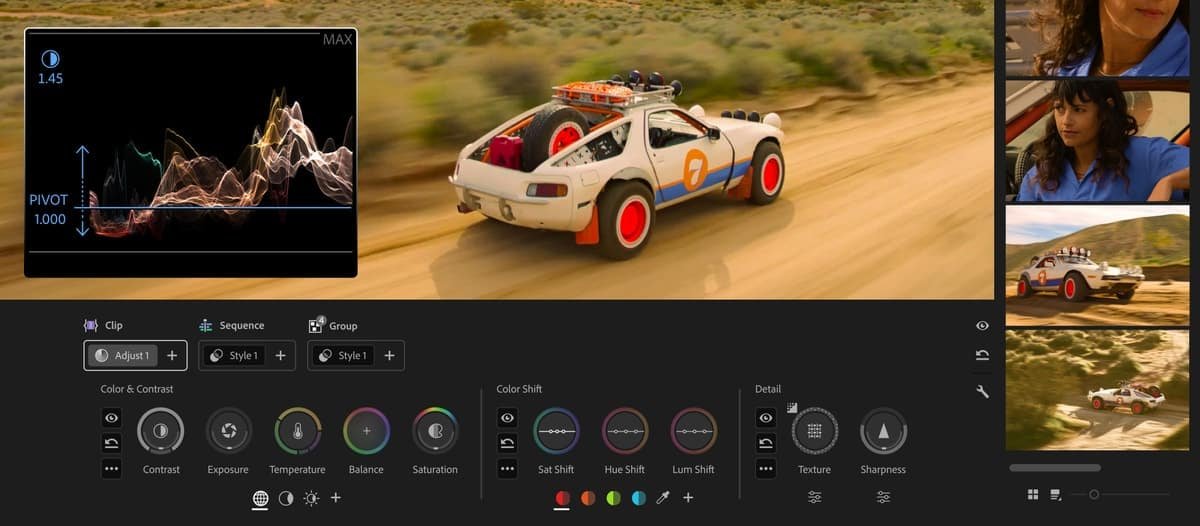
Adobe has unveiled a new way for video makers to create without having to shoot any additional footage; this new generative AI capability automatically extends frames beyond their initial borders, creating visual continuity between the two pieces of media. This represents a large leap in using AI to assist in creating content; this improvement allows software programs to generate new visual elements from existing media that share similar styles, lighting, and motion.
This update will further advance Adobe’s long-term goal to incorporate generative AI into its creative suite of solutions, giving its customers increased flexibility when it comes to production and editing of video content; allowing for expanded frame portions will provide customers with many new avenues to tell stories, create precise edits, and provide for experimentation in visuals.
Extending the Limits of Video Editing
Video editing using traditional methods limits you to what you already have; for example, if the shot is too tight or lacks enough context, the editor may be forced to sacrifice some of the shot’s quality to reframe properly.
Through Adobe AI, frame expansion extends the available material to create more visual content beyond the original frame. Thus, you can reframe shots, change aspect ratios, or create new compositions without requiring reshooting.
What this means for the video editor is that editing video is no longer about making choices and organizing things into a sequence; instead, it has been transformed into a process of generating creativity.
How Generative Frame Expansion Works
Generative artificial intelligence creates new content by considering the visual context of existing content. This is done using advanced generative AI models trained on large datasets of images and videos. By doing this, the AI can analyze factors such as texture, lighting, depth, and movement to predict what lies beyond the frame’s edges.
Then, when the user wants to extend the video frame, the AI uses its predictions to generate new pixels that seamlessly merge with the original content. In this way, both the visual and motion factors are continued smoothly and seamlessly.
Adobe’s emphasis is on creating realistic content; therefore, AI-generated content should blend naturally with the existing content.
Enhancing Creative Flexibility
Expanding frames allows creators more freedom when creating and editing videos. Shots previously deemed unusable due to poor framing can now be altered and made usable again.
Editors can test different compositions, e.g., turning horizontally shot footage into vertically shot footage, and publish on social media. This adaptability is especially beneficial in today’s digital world, where optimization of all types and sizes on multiple platforms is required.
Adobe is enabling creators to continue pushing the limits of visual storytelling by moving beyond constraints imposed by original capture conditions.
Applications Across Media and Production
Extending video frames has many uses across industries, such as film, advertising, and Social Media content creation. Filmmakers can use this technology to improve scenes, provide visual context, and fix framing problems after shooting or during long post-production processes.
Advertising agencies can repurpose their existing content for new platforms without having to shoot new footage, while social media creators can quickly adapt their video files to meet the requirements of specific sites.
Adobe’s tools are designed for a wide range of applications, enabling users from all backgrounds to access advanced editing features.
Reducing Production Costs and Time
The use of generative frame expansion offers a major advantage in reducing production costs and time. Creators can complete a project efficiently by removing the need for reshoots or other supplemental shots.
With budgetary or deadline constraints on projects, capturing more footage is often impossible. Therefore, AI from Adobe is working on integrating generative technology into an editing workflow as a means of streamlining production and increasing efficiency.
Challenges in Maintaining Realism
Generative frame extension still faces challenges, such as realism and consistency, but the ability to generate content that matches the original footage in both detail and motion is crucial to the overall quality of the generated frames.
Producing seamless frames can become more complicated in complex scenes. This requires the AI to take into account additional factors, including the effect of perspective on the generated frame, variations in lighting, and interactions among multiple objects.
Adobe is continually improving the accuracy and reliability of its models in these circumstances.
Ethical Considerations in AI-Generated Content
There are many ethical concerns about using AI technology to edit videos. The biggest concern is whether or not something is real or artificial. As technology improves, it becomes harder to tell what was created physically and what was made with AI.
Many creators and platforms will need to set rules and maintain transparency to ensure this technology is used responsibly. Adobe has stated that it is essential to use AI responsibly and ensure that all AI-generated content is transparent and grounded in reality.
Competitive Landscape in AI Creativity Tools
Integrating generative AI into creative software has become a dominant trend in the race for technological control among companies. Advanced features like frame expansion are enabling new levels of creativity and setting new standards for creators.
Adobe’s leadership in creative software will play an important role in the continued integration of creative tools, AI, and user-focused design.
The Future of AI-Driven Video Editing
Video editing is likely to be made increasingly easier and more flexible as generative AI evolves. Future video editing tools may allow creators to change entire scenes, create new surroundings, simulate camera movements after filming, etc.
Frame expansion is an initial method by which AI will assist creatives to achieve results that have previously been too difficult or impossible.
Overall, it appears the future of video creation will be heavily influenced and powered by intelligent, generative systems, as Adobe’s developments suggest.
Conclusion: Redefining Creative Possibilities
Adobe’s new artificial intelligence technology enables users to expand their video frames by generating new frames from existing footage and audio. This will allow creators of all kinds to extend their visual storytelling capabilities into new areas, changing how we perceive and understand what can be done with video content, especially short videos in a wide range of styles. The use of these technologies by content producers, video editors, and filmmakers will continue to change how digital content is created and edited year over year.
Source: Adobe Blog