






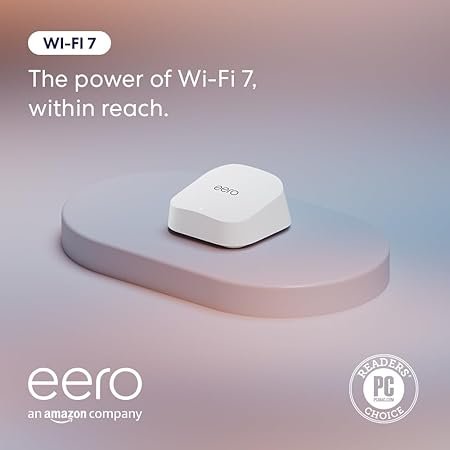
Many homeowners know the frustration of having fast internet in one room but losing connection in another. You might enjoy smooth video calls in the living room, but experience freezing as soon as you move to the kitchen or upstairs office. These dead zones can stop productivity and interrupt daily routines. As we head into 2026, people expect reliable coverage everywhere at home. To meet this need, Amazon has launched new networking hardware that keeps your internet connection strong throughout your house, so you are not stuck in one spot.
The new EERO 7 and PRO 7 use Wi‑Fi 7 to create a strong network throughout your home. Unlike older systems, Wi‑Fi 7 allows devices to use multiple frequency bands simultaneously, reducing congestion and dead zones in busy neighborhoods.
Engineering a Dead Zone Solution
Traditional routers are like a single light bulb in a big house. The farther you go, the weaker the signal. Range extenders often create separate networks that require manual switching and can slow you down. Amazon’s mesh system places several nodes throughout your home, automatically sending data along the best path. The 2026 Eero Pro 7 goes even further with its drive-in setup and 2.5 Gbps Ethernet ports. It is built for homes with thick walls or multiple floors where Wi‑Fi signals often struggle to penetrate. The system uses draw-run technology to smoothly switch your connection between nodes. This means you can move from an upstairs bedroom to a basement gym without noticing any lag, even during a 4K video stream or an intense gaming session.
Closing the Gap Between Indoors and Outdoors
One of the most frequent complaints about home Wi-Fi is the cutoff at the home’s boundary. Backyards, patios, and detached garages have historically been the ultimate signal dead zones. To fix this, Amazon has a common home Wi-Fi problem. The signal drops as soon as you step outside. Backyards, patios, and detached garages often have no coverage at all. To solve this, Amazon has created the EERO Outdoor 7. Unlike simply putting an indoor router outside, this device is designed for outdoor use and rated to withstand temperatures from -40 to 55 degrees Celsius. It extends the fast Wi‑Fi 7 canopy beyond the physical walls of the house, making sure security cameras, smart irrigation systems, and laptops maintain a multi‑gigabit connection regardless of environmental obstacles like foliage or brick siding.
Reliability Through Cellular Integration
Dead zones aren’t always caused by weak signals. Sometimes your internet goes out because your provider has an outage. To keep your home network running without disruption, Amazon introduced the Eero Signal. This device acts as a backup, automatically switching your entire network to a 4G LTE or 5G connection if your main internet fails. Once the primary service is restored, the system seamlessly reverts to the wired connection, and the cellular link returns to standby for households that depend on constant connectivity for medical monitoring or remote enterprise tasks. This redundancy completes the connectivity puzzle.
Intelligence over Raw Power
Many bigger antennas or faster speeds alone don’t solve dead zones. The 2026 Eero systems use smart software to select the clearest channels, reducing drops caused by interference from other devices. The system operates only on 2.4 GHz, leaving more room for things like video calls and 8K streaming.
Closing Thoughts: A New Standard for Home Connectivity
With these new Wi‑Fi systems, Amazon aims to eliminate dead spots by combining fast Wi‑Fi 7, cellular backup, and rugged outdoor hardware for seamless, reliable connectivity.
As data-heavy technology advances, the 2026 ERO Banner aims to make dead zones a thing of the past.
Source: https://www.amazon.com/Introducing-Amazon-eero-dual-band-router/dp/B0D954FD8R?th=1








