






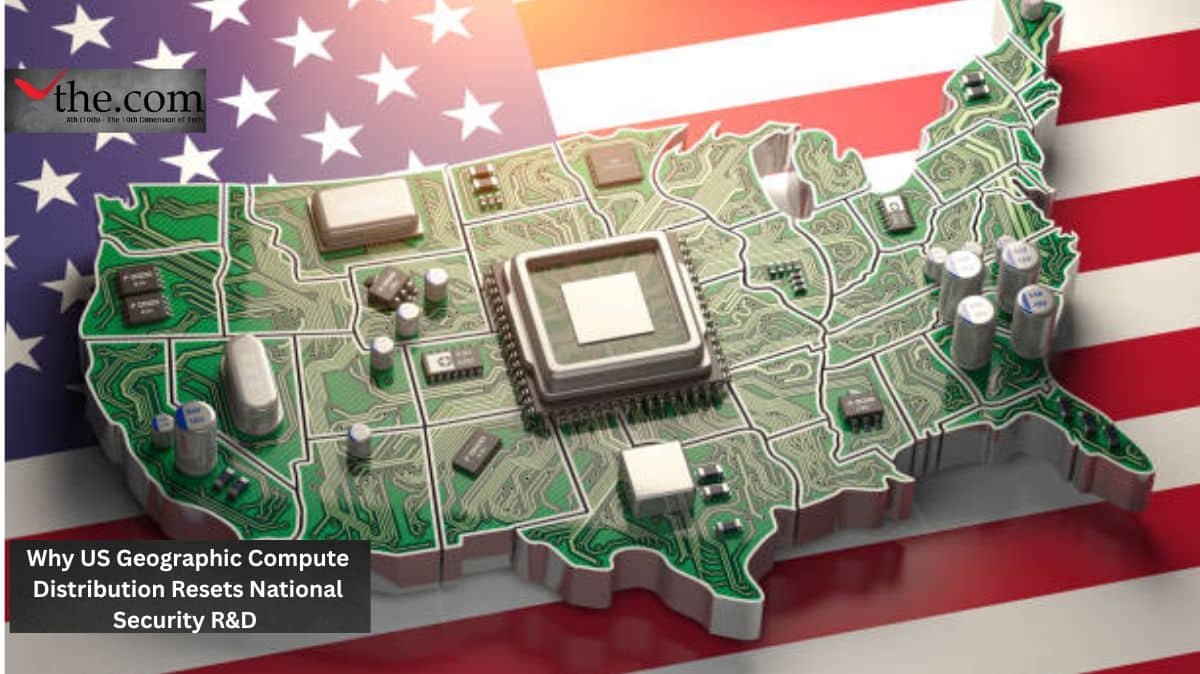
Washington, DC. A single power outage outside Northern Virginia in 2024 briefly disrupted access to several cloud-dependent government systems. The interruption lasted less than an hour inside defense and intelligence circles. However, it reinforced a growing concern: the United States has concentrated too much digital capacity in too few places. That problem now sits at the center of AI geopolitics and the future of compute sovereignty.
The race for artificial intelligence leadership no longer depends solely on better algorithms. It depends on where the compute infrastructure lives, who controls it, how resilient it remains under stress, and whether allies can access it during geopolitical disruption. Washington increasingly views geographic compute distribution not as a technical optimization problem, but as a national security imperative tied directly to US national security goals.
Compute Sovereignty Is Replacing Centralized Cloud Thinking
For years, economic factors led companies to build huge data centers in areas with cheap power, strong internet connections, and tax breaks. Northern Virginia is the best example. Analysts say that almost seventy percent of global internet traffic passes through this region at some point.
That concentration worked when cloud economics prioritized efficiency above all else.
Now, the equation has changed.
Military planners, federal agencies, and those who run key infrastructure are concerned that having too much computing power in one place is a risk. A cyberattack, sabotage, or a local power failure can simultaneously disrupt defense modeling, intelligence work, financial systems, and AI-powered command operations.
The worry has accelerated discussions about compute sovereignty across government and industry. More and more policymakers define sovereign compute as keeping secure, reliable, and domestically controlled processing power during times of global or operational trouble.
The idea is about more than who just owns the hardware. Where the computing resources are located is just as important as the amount of power available.
How AI Geopolitics Changed Infrastructure Priorities
The competition between the United States and China over AI has made compute infrastructure a key part of strategy planning. Restrictions on semiconductors are no longer the only factor. Governments now see that where and how compute resources are set up affects military strength, industry, and diplomacy.
That shift explains the surge in federal and private-sector investment in infrastructure build-out projects across Arizona, Texas, Ohio, and the Pacific Northwest.
The aim is not just to build more data centers. The real goal is to create backup systems at different locations.
Imagine a defense scenario in twenty twenty-eight. A cyber conflict in the Pacific could cut off undersea cables and regional cloud connections. If most advanced computing is still concentrated on one coast or in a few large regions, military AI systems could slow down or encounter problems just when coordination is most important.
Spreading out compute resources helps lower that risk.
This new approach is also changing international partnerships. Countries now look for trusted infrastructure partners instead of just buying technology. This development might give the United States an edge in export promotion related to AI infrastructure, secure cloud systems, and advanced semiconductors.
The New Arms Race Centers on Advanced Computing
In the 20th century, oil was the key to global power. In the 21st century, it may be compute capacity.
The United States is already ahead in high-end GPUs and large-scale AI training. But staying ahead entails investing more in advanced compute infrastructure beyond the usual big data center areas.
The need has grown as generative AI has pushed up electricity demand. Training the latest models now requires significant computing power, steady energy, and fast networks.
Several states have responded quickly.
Texas has increased incentives for data centers connected to the power grid and linked to semiconductor manufacturing. Arizona has built stronger partnerships among the public and private sectors for chip production. Ohio is working to become a Midwest hub for computing, striving to spread out resources and reduce risks from global coastal concentration. These projects help the economy and also play a key role in US national security planning.
Federal agencies now want AI systems deployed across multiple locations. This way, they can handle classified work, run defense simulations, and remain resilient against online threats without relying on a single area.
This approach fits with the wider US strategy for advanced compute and AI infrastructure in 2026, which is now guiding federal buying decisions and defense upgrades.
Why AI Alignment Now Includes Infrastructure
Most public talks about AI alignment focus on how models behave, safety checks, and/or oversight of algorithms. But national security officials are starting to see the issue in a new way.
AI systems that work well need infrastructure that is just as reliable and secure.
If important AI tasks rely too much on foreign supply chains, weak electric grids, or unstable regions, then technical protections are not enough. Being able to keep running under stress becomes part of what alignment means.
This signals a significant shift in how federal leaders view AI policy.
The Department of Defense, intelligence agencies, and energy regulators now assess infrastructure risks alongside software security. They are asking questions that were rarely discussed just five years ago.
Can advanced military AI systems continue operating during regional grid instability?
Can allied nations access trusted compute environments without exposing sensitive data pipelines?
Can domestic cloud systems withstand coordinated cyber and physical disruption campaigns?
These questions link AI alignment directly to having a strong, spread-out infrastructure.
Infrastructure Build-Out Creates Economic Leverage
The political impact goes well beyond just defense.
Large-scale infrastructure build-up projects create regional economic power centers tied to energy, semiconductor logistics, fiber expansion, and advanced manufacturing. Local governments increasingly compete for AI-related investment because compute ecosystems generate high-income technical employment alongside long-term industrial development.
Policies from the Biden era onward have accelerated this shift. Federal incentives for semiconductors, domestic manufacturing, and AI research have made infrastructure planning a key part of economic policy.
But the main goal is still clear: lower the risks of dependency and boost America’s tech advantage.
The goal also helps with export promotion. Countries seeking secure AI systems may choose US-backed infrastructure over Chinese alternatives if the US can offer a reliable, scalable, and stable partnership.
At this point, AI geopolitics moves from theory to real business.
Rules for cloud management, AI safety, and interoperability could become important diplomatic tools in the coming years.
The Geography of Compute Will Shape Strategic Power
For decades, the United States led the way in software, semiconductors, and large internet platforms. Now, the next stage of computation is becoming more about physical infrastructure,
power networks, fiber networks, water access, and regional resilience all remain important again,
This is why compute sovereignty is now part of talks that used to focus only on military bases or energy security,
The new US strategy for advanced computing and AI infrastructure in 2026 shows a broader understanding: Leading in AI is not only about better models, but also about robust infrastructure that can withstand global instability, cyberattacks, and economic changes.
Countries with strong, reliable computer networks will likely lead the next wave of industrial policy, defense, and global AI rules. Those who don’t spread out and protect their computing resources may find that relying too much on others for digital power is as risky as past dependence on energy.
Source: Who Will Make Money on AI?








