





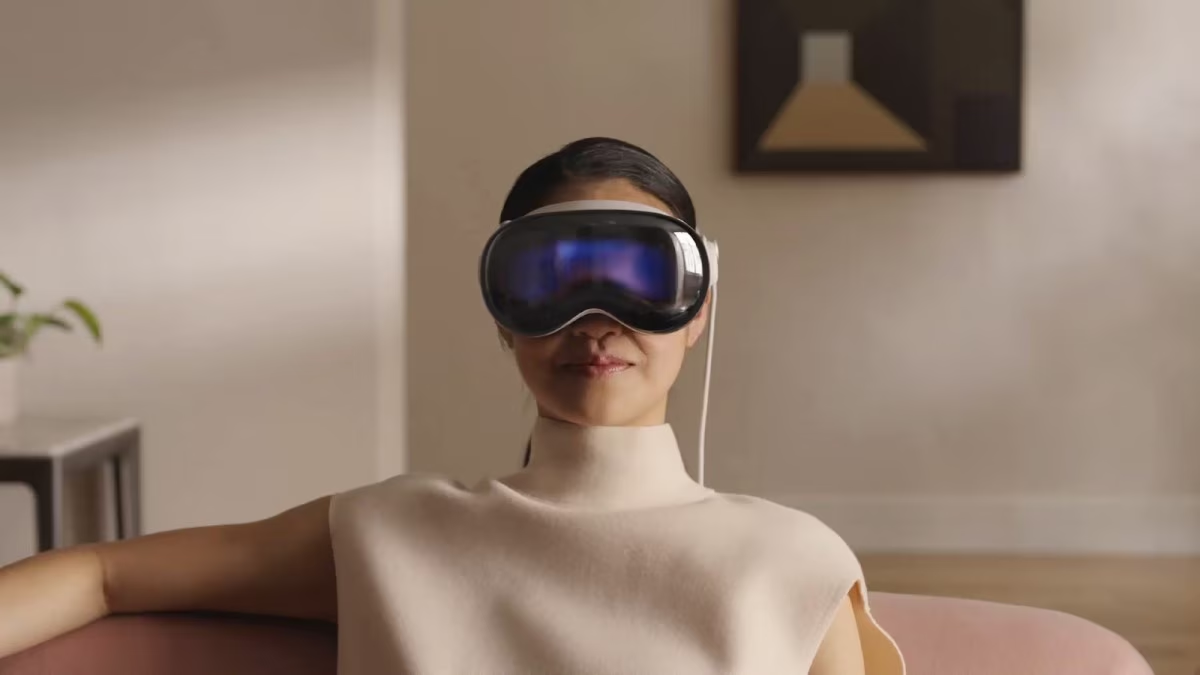
Apple is showing its intention to develop augmented reality technology, which it plans to use for various healthcare applications through its new patent, which demonstrates how Apple Vision Pro can serve medical and business purposes. The development points to a broader strategy in which AR devices move beyond consumer experiences into high-value professional environments such as hospitals, clinics, and medical training institutions.
The patent describes medical systems that enable users to create three-dimensional environments that display medical data and to interact with them using advanced methods. Apple is investigating spatial computing as a potential way to enhance critical healthcare operations that require precise work and rapid access to information.
Expanding AR Beyond Consumer Use
The primary purpose of augmented reality devices remains to provide users with tools for entertainment, communication, and general work activities. The healthcare industry within enterprise sectors provides businesses with opportunities to establish deeper relationships while developing more valuable solutions.
The Vision Pro platform from Apple uses advanced sensors, high-resolution displays, and spatial computing technology to support professional applications. The patent suggests that these features could be leveraged to create specialized applications for medical environments.
Apple moves into healthcare markets to connect its AR technology with industries that require precision and reliable results, thereby creating additional business opportunities and practical applications.
Enhancing Medical Visualization
Current AR technologies in medicine have made significant advances over traditional methods because of their ability to display detailed images to assist in diagnosing patients through X-rays, MRIs, CT scans, and 3D models used by healthcare practitioners as tools for diagnosing patient conditions.
The Apple Vision Pro system enables users to experience data through immersive three-dimensional displays, allowing doctors to investigate body structures in greater detail. The process helps people better understand information when making choices about difficult situations.
The AR technology in Apple’s patent will create new methods for medical professionals to engage with patient data through interactive systems that require less effort to understand.
Real-Time Data Integration in Clinical Settings
The patent establishes its main element by incorporating continuous data streams into the augmented reality space. The system will present essential vital signs, complete medical documentation, and operational instructions to users through their visual perspective.
Healthcare workers would benefit from the system because it enables them to obtain essential information without interrupting their primary work. The system enables surgeons to access patient information during operations, improving their understanding of the current situation as they work.
Apple investigates the potential of AR technology to enhance work processes by reducing the need for multiple devices and displays.
Applications in Medical Training and Education
The application of augmented reality technology in medical education represents a field where it will produce substantial results. Standard training methods use three main components: textbooks, simulations, and supervised practice.
The Apple Vision Pro system enables students and trainees to participate in virtual reality simulations, which create authentic, real-world experiences. The system provides an interactive educational experience that allows users to practice skills in a safe environment, helping them develop skills and build self-confidence.
Apple’s research into educational training tools demonstrates how augmented reality can revolutionize training in specific academic disciplines.
Supporting Remote Collaboration and Telemedicine
The introduction of AR technology into medical practice enables healthcare professionals to work together from distant locations. The AR system allows specialists to monitor ongoing procedures while providing remote guidance to on-site staff at the same facility.
Telemedicine will benefit from this feature because it enables doctors to conduct more engaging and thorough patient assessments. The AR interface allows a distant expert to support surgical operations by delivering real-time operational feedback to the medical team.
According to Apple’s patent, spatial computing will enable healthcare professionals to access expert knowledge more efficiently, thereby improving patient outcomes.
Challenges in Healthcare Integration
The implementation of augmented reality technology in healthcare systems faces multiple obstacles, despite its promising capabilities. The medical field demands equipment that functions with complete dependability while maintaining precise performance standards and complying with all governmental regulations.
The safety evaluation process requires devices to undergo extensive testing, while software developers must create their products to protect confidential information with the utmost security. Healthcare staff members require training to operate these systems to their full potential.
Apple must solve these problems before it can successfully implement augmented reality solutions in medical environments.
From Patent to Real-World Application
The patents present potential technical concepts that may not fully realize commercial implementation. The documents outline the areas Apple wants to pursue and provide details about its future plans.
The healthcare focus demonstrates that AR serves two purposes as both a consumer technology and a professional and enterprise tool. Apple’s ongoing financial support of spatial computing research shows that these technologies will become increasingly important in its upcoming product innovations.
Conclusion: AR Enters High-Value Sectors
Apple’s patent shows that augmented reality technology now supports healthcare applications, which its Vision Pro platform offers. Through its AR development work in high-value business markets, Apple investigates how augmented reality technology delivers real value to customers beyond entertainment and workplace efficiency.
The successful implementation of these technologies will transform medical workflows, enabling better training and improved patient care. This development marks a new stage in the progression of spatial computing technology.
Source: Trademark classification goes agentic with USPTO’s announcement of “Class ACT” assistant