Round Rock, TX
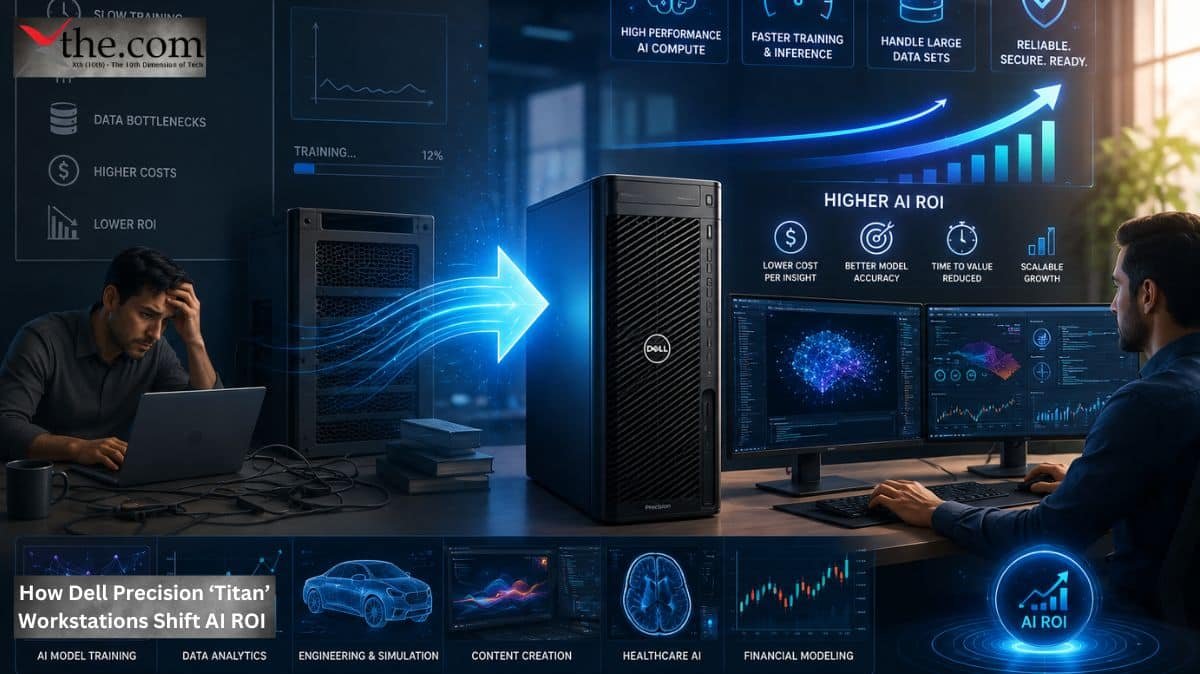
Atomic answer: Dell has introduced the Precision Titan lineup, the world’s first workstation family with two NPU configurations and NVIDIA RTX GPUs. With this “hybrid computing” system, software developers can run AI supervision in the background on the NPU while using the GPU for rendering tasks.
An important shift in enterprise computing is currently underway, with many organizations moving away from centralizing AI workloads in cloud-based facilities toward more localized workstation computers.
Today, software developers and other professionals need equipment capable of performing AI inference, AI rendering, automation, and AI governance tasks concurrently without relying solely on cloud infrastructure. The launch of Dell Precision Titan dual NPU workstation 2026 systems reflects a growing movement toward AI-native enterprise hardware capable of balancing local AI processing with high-performance graphical workloads.
This is something Dell aims to achieve through its newly launched Precision Titan line of computers.
With this product, the company introduces a hybrid computing architecture that uses GPUs and dual neural processing units to efficiently distribute AI workloads across different hardware levels.
According to Dell, this innovation can help boost the efficiency of enterprise AI while reducing long-term costs associated with cloud dependency.
This release also represents how enterprise workstations are rapidly evolving amid developments in AI-enabled devices.
Reasons Why AI Computing Is Becoming More Device-Based
AI is increasingly becoming device-based in response to the demand for speed, enhanced privacy controls, and reduced operational latency.
Rather than relying on cloud infrastructure to handle every task, it is now possible to perform most AI-related activities in-house thanks to specialized hardware designed for these tasks.
The following benefits arise:
- Increased speed in AI computations
- Decreased reliance on cloud infrastructure
- Improved privacy control and data security
- Decreased operational latency
- Enhanced ability to run AI algorithms offline
The rise of hybrid compute NPU GPU developer AI productivity environments is expected to benefit industries focused on engineering simulations, media production, financial modeling, and software development.
As businesses leverage intelligent applications, efficient local machines have become even more crucial to productivity workflows.
Introduction of Hybrid AI Architecture in Precision Titan
One significant feature of Precision Titan is the hybrid compute architecture.
The hybrid workstations incorporate powerful graphics cards with two NPUs, enabling the separation of AI governance tasks from graphical computing and rendering.
In essence, the hybrid compute architecture enables background AI tasks to run independently while the graphical processor handles the heavy lifting.
The hybrid system can be used in several enterprise processes, including:
- AI-driven design and development
- Rendering and simulation
- Productivity automation
- Development of machine learning models
- Local AI governance processes for enterprises
Dual processing in the Dell hybrid architecture enhances hardware efficiency by limiting resource competition between AI processes and graphical computation. his makes Dell Precision Titan dual NPU workstation 2026 deployments especially valuable for developers and creative professionals managing multiple AI-intensive processes simultaneously.
NVIDIA RTX AI Workstations Improve Enterprise Capabilities
Additionally, the new series of workstations significantly contributes to enterprises’ transition to NVIDIA RTX AI workstations.
In addition to graphics rendering, today’s RTX GPUs are equipped to perform tasks such as AI inference, large model acceleration, simulation environments, and generative workflows.
Titan workstations from Dell leverage these features to boost enterprise productivity across industries.
Some key operational benefits include:
- Increased efficiency in rendering tasks
- Greater efficiency in running AI models locally
- More efficient simulation environments
- Decreased compute costs in the cloud
- Increased efficiency in multitasking development
This means that using RTX GPUs alongside NPUs ensures the AI ecosystem is balanced enough to handle ongoing enterprise processes without overwhelming any single component.
As AI gets integrated into enterprise applications, the need for hybrid workstations will increase. Dell also positions these systems as a way to achieve Dell Titan 50% cloud DevBox cost reduction on-device by shifting more AI operations away from cloud-hosted development environments.
Enterprise Refresh Cycles Are Evolving
Precision Titan’s launch also underscores the evolution in the enterprise refresh cycle within corporations’ IT landscapes.
Traditionally, workstation updates have been driven by advancements in CPUs and graphics. But the increasing reliance on AI-native workloads is prompting companies to rethink their hardware purchasing plans completely.
Some key criteria being used when evaluating systems are:
- AI-acceleration features
- NPU compatibility
- Inference capability
- Hybrid AI processing
- AI-compatibility
These trends are expected to drive the enterprise adoption of AI-optimized hardware over the next few years.
The emergence of Dell Titan Windows 12 AI Edition NPU GPU orchestration environments further highlights how operating systems are increasingly being optimized around dedicated AI hardware acceleration.
At the same time, enterprises are beginning to evaluate operational factors such as Titan 20% peak power draw legacy Precision upgrade requirements when replacing older workstation fleets with newer AI-ready systems.
With the proliferation of AI workloads, companies may look at investing in AI-compatible workstations as an important operational expense.
Benefits of NPU Infrastructure in Productivity Efficiency
The incorporation of dual NPU solutions is among the key innovations in the Titan framework.
An NPU is a specialized chip designed solely for AI inference and learning.
Compared to regular CPUs and GPUs, NPUs can continuously perform lightweight AI functions with minimal energy.
The benefits of incorporating dual NPUs in Titan include:
- Increased AI background-processing efficiency
- Reducing workload of GPU in AI operations
- Optimized energy consumption
- Increased multitasking abilities during AI operations
- Increased local automation performance
However, industry analysts are also monitoring potential procurement concerns such as dual-NPU supply volatile 6-month batch order risk, particularly as enterprise demand for AI-optimized hardware continues increasing globally.
As AI capabilities are increasingly embedded in both operating systems and business software, NPUs will become a mandatory feature in any enterprise computing solution.
Conclusion
Dell is promoting Precision Titan as a future-oriented enterprise workstation ecosystem that can help support productivity powered by AI. With the synergy between state-of-the-art Precision Titan architecture, highly scalable NVIDIA RTX AI PCs, and innovative dual NPU, the company is moving toward a new era of local computing infrastructure upgrades.
Industry experts are increasingly evaluating how Dell Precision Titan’s dual NPU and NVIDIA RTX GPU hybrid compute double developer productivity by running AI governance and heavy rendering simultaneously as organizations seek efficient alternatives to fully cloud-dependent workflows.
Overall, the larger purpose of the Dell Precision Titan workstation AI deployment guide is to highlight the growing significance of hybrid AI hardware solutions that are proficient at local inference, rendering, and automation operations.
As enterprises worldwide rapidly adopt AI technologies, AI-native workstations can become a hallmark of future computing platforms.
Enterprise Procurement ChecklistEnterprise Procurement Checklist
- DELL Strategy: Target the Titan series for “Heavy AI” roles (Data Science, 3D Design) to maximize local ROI.
- Procurement Risk: Dual-NPU supply is volatile; secure batch orders 6 months ahead of enterprise refresh.
- Migration Challenge: Requires Windows 12 (AI Edition) to properly orchestrate tasks between NPU and GPU.
- Operational Step: Update internal power-consumption profiles; Titan units draw 20% more peak power than legacy Precision.
- ROI Implication: 50% reduction in cloud-based DevBox costs by shifting developer environments to local Titan hardware.
Source- Dell Blog