






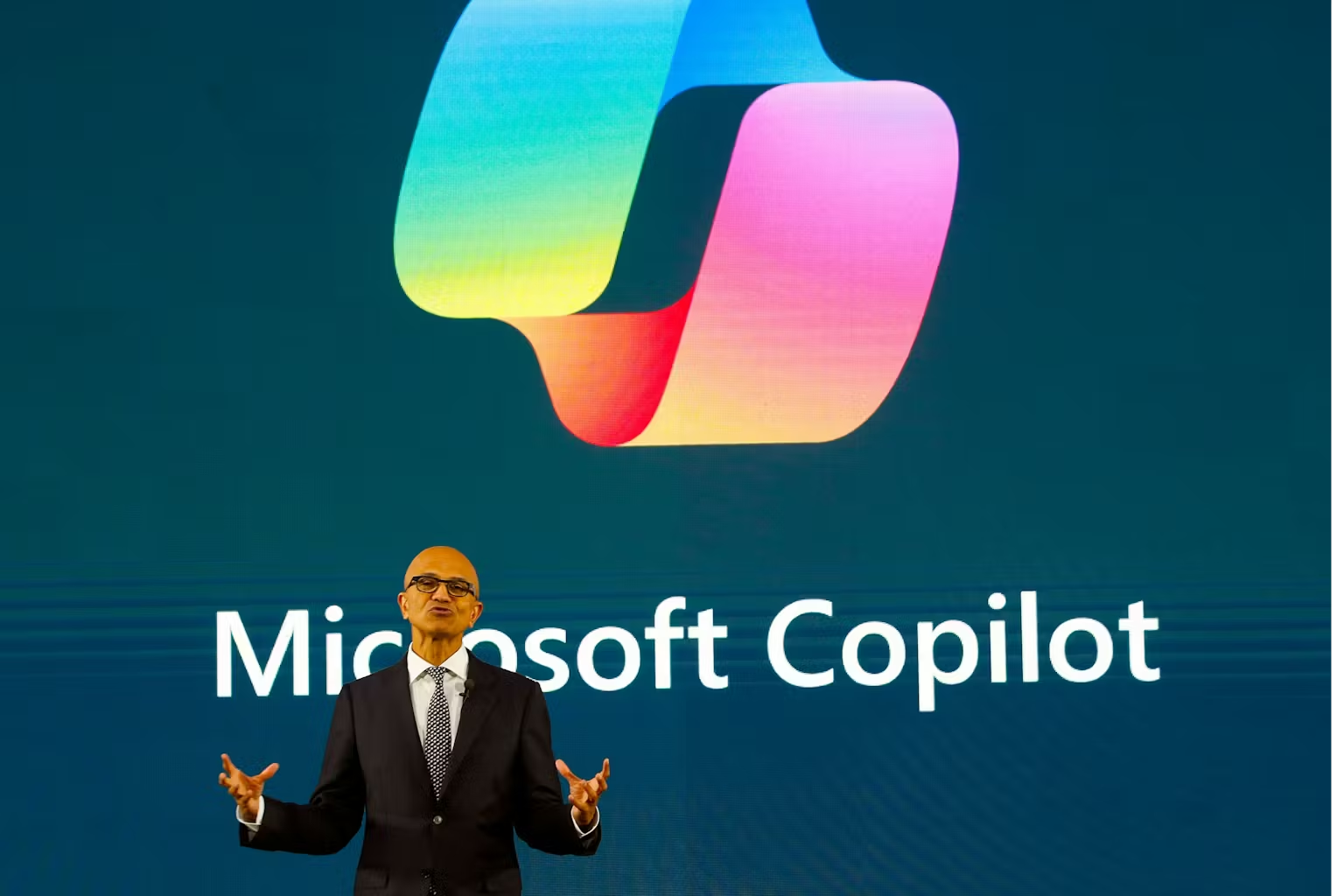
The all-you-can-eat era of enterprise software is facing a structural collapse. For decades, the per-seat license was the bedrock of corporate budgeting, providing a predictable fixed cost for every employee added to the payroll. However, as the computational intensity of generative models begins to strain global data centers, the industry’s heavyweights are fundamentally rewriting the contract. This one is the most significant shift that occurred as AI pricing at Microsoft transitions away from request-based limits toward a metered credit-based framework. This pivot from access to outcomes marks the decisive end of subsidized experimentation and the beginning of a high-stakes era of margin protection.
The Death Of The Flat Rate AI Subscription
In late April 2026, Microsoft announced that GitHub Copilot, the leading tool in its AI lineup, would switch all users to a usage-based billing model starting June 1. Before this, users worked under a premium request system that hid the real cost of computing. Now, every action is measured using GitHub AI credits, a virtual currency that tracks inputs, outputs, and even cached tokens. This detailed tracking means a quick syntax check costs much less than a long automated coding session that uses thousands of tokens.
This change is part of a larger trend driven by the unpredictable costs of modern AI tools. Unlike traditional software, where a mouse click uses very little power, a single complex AI prompt can cost vendors several dollars in specialized GPU time. By moving to usage-based billing, Microsoft is passing these costs directly to customers. This means heavy users, especially those running full AI-driven development workflows, will pay amounts that match their actual use of computing resources.
Strategic implications of SaaS pricing changes
These SaaS pricing changes are already affecting the executive level. For a long time, IT leaders focused on managing costs by controlling the number of software seats. Now, token-based billing adds a new hard-to-predict variable. If a marketing team increases content production or a development team automates its workflow with AI, the monthly bill can jump by 300% even without adding new employees. This unpredictability is making companies rethink how they manage financial operations.
Companies now have to go beyond managing software seats and focus on compute governance. Microsoft’s new model offers a pooled credits feature for businesses and enterprise customers, letting lighter users help offset the costs of heavier users within the same company. While this helps, it also means organizations need more internal controls. Admins must set strict overflow budgets and user caps to stop a few automated agents from using the entire quarterly budget in just a weekend.
Navigating Enterprise AI Pricing And Optimization
As enterprise AI pricing becomes clearer, leaders are now focused on optimizing AI costs. The aim is not just to use AI, but to use it as efficiently as possible. This has led to model distillation, where companies rely on smaller, cheaper models for everyday tasks and reserve the more expensive models like OpenAI’s GPT 5.4 or Anthropic’s Opus 4.7 for complex problems. Microsoft’s new billing system supports this by charging different credit rates depending on the model’s complexity.
- Token management: engineering teams are making prompts shorter and more direct, which lowers the cost of input tokens.
- Caching strategies: using cached tokens can help organizations save up to 50% on repeated queries, especially in routine workflows.
- Model tiering: move simple chat tasks to lightweight models and reserve higher-cost credits for complex code reviews.
- Budget guardrails: set up real-time stop-loss triggers at the cost center level to keep spending predictable.
The Shift Toward Cloud Billing Models And Pay-Per-Use
Switching to pay-per-use AI is making software more like a utility, similar to electricity or water. This approach matches cost to value more fairly, but it also takes away the extra benefits companies enjoyed during the subsidized growth years of 2024 and 2025. Now, cloud billing models focus on marginal value. If an AI solution saves $20 in labor, the vendor may charge $2 for the computing. We are shifting from paying for the tool itself to paying for the result it delivers.
This maturation of AI pricing Microsoft and its peers signals a broader industry trend where the ROI reckoning has finally arrived. Boards and CFOs are no longer satisfied with vanity metrics like time saved or user engagement. They are demanding to see how AI investments directly impact the P&L through measurable margin movement. If the cost of AI credits exceeds the efficiency gains, those projects are being shuttered with a ruthlessness not seen since the dot-com bubble.
Future Proofing the Autonomous Workspace
Moving to metered AR is a natural result of the limits of current hardware. While usage-based models can be unpredictable, they also offer more control and transparency than seat-based pricing. Companies that get good at token FinOps will be able to grow their automated workflows without risking their budgets. The future desktop will be more than just a workspace. It will be a high-powered engine that needs a steady, efficient supply of digital resources.
As we move into the second half of 2026, the hallmark of a mature IT strategy will be crypto fiscal agility. This means having the infrastructure to switch between models, providers, and billing tiers in real time as prices fluctuate. The companies that succeed will be those that stop viewing AI as a premium add-on and start managing it as a core raw material. The era of the unlimited AI buffet is over; the era of the efficient metered enterprise has begun. This structural shift in AI pricing, Microsoft, is simply the first page of a new manual for the digital economy.
Source: Unlocking human ambition to drive business growth with AI








