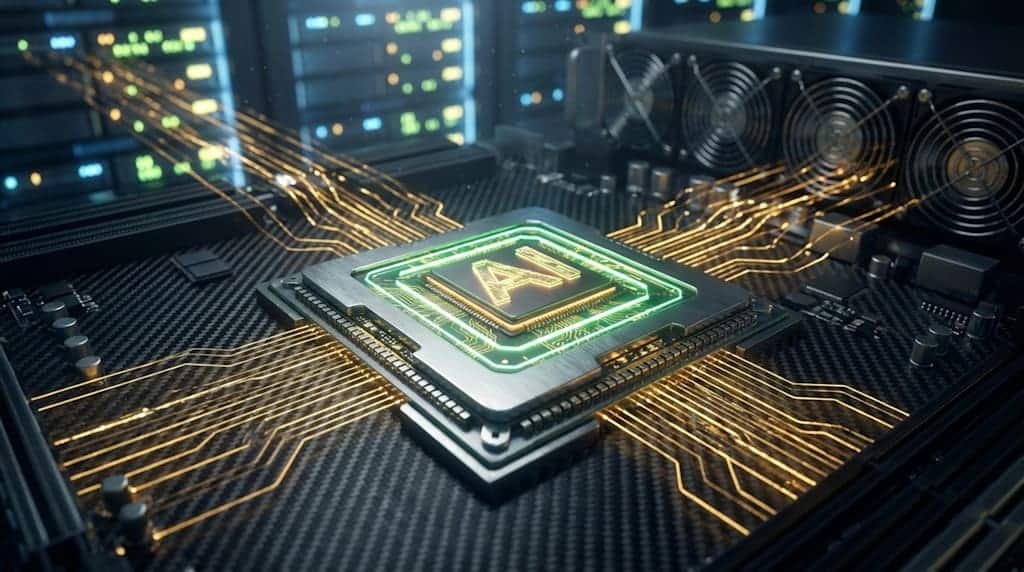
NVIDIA is creating AI-enabled workstation units that leverage the latest technology to run demanding tasks locally, minimizing long-term operating expenses. NVIDIA’s goal is to provide high-powered desktop and notebook computers that can deliver the same level of capabilities, or better, across a wide range of potential uses of Cloud-Based AI.
The increasing number of companies implementing AI into their daily operations is placing substantial burdens on all companies, as well as on their budgets to run models in the cloud. Therefore, to achieve fast response times, ensure reasonable control over data, and maintain consistent financial cost structures, NVIDIA is focusing on migrating a portion of these workloads to physical equipment.
The Rising Cost of Cloud-Based AI
Cloud-based computing has become crucial for AI scaling, providing large amounts of powerful compute infrastructure without requiring upfront capital investments in hardware. But with increased use of cloud services come higher operating costs, including compute time, storage, and data transfer.
Organizations that operate AI workloads continuously or at large scale can see these costs mount rapidly. Subscription-based pricing models and the demand for high-performance GPUs create significant ongoing costs associated with cloud AI.
By promoting on-device processing, NVIDIA addresses an increasing need for cost-effective alternatives to reduce reliance on external infrastructure.
RTX Workstations and Local AI Processing
NVIDIA’s RTX workstations serve as the foundation for this workforce shift. The RTX workstations have the processing power to run sophisticated AI workloads and other computationally intensive tasks. A few examples of these types of tasks include 3D modeling and rendering, simulation, machine learning, and real-time data processing.
RTX systems are engineered for Artificial Intelligence and do not use conventional workstation hardware. However, they do possess specialized hardware features designed for artificial intelligence workloads, such as Tensor Cores, that accelerate deep learning and enable users to run or train their models locally, where they were previously limited by speed restrictions in the Cloud.
NVIDIA’s workstation strategy revolves around enabling individual users and teams to access AI capabilities at the Enterprise level.
Reducing Latency and Improving Performance
On-device AI processing has a major advantage by reducing latency. Processing data close to the user means that there is no need to transfer data over a network and wait for a remote server to respond, so actions can be executed much faster.
This is especially important whenever an application requires real-time operation, such as video editing, simulation, or interactive design, so users can work more productively without disruptions caused by network latency.
With NVIDIA hardware, high-performance AI capabilities will enable desktop environments to run this type of processing efficiently.
Enhancing Data Privacy and Security
Another issue why companies are moving towards localized AI processing is data privacy. Cloud-based systems require data to be transferred and stored outside their premises, which creates potential compliance and security risks for companies.
Organizations can control their sensitive information by storing it on their local computers. This is important for industries like government, finance, and healthcare, where data protection is of utmost importance.
NVIDIA’s workstation solutions enable companies to achieve high-performance computing while maintaining their own data governance.
Supporting Creative and Technical Workflows
Many professionals use RTX workstations for creative and technical applications, including engineering, architecture, scientific research, and media production. Workflows that use RTX workstations can benefit from AI capabilities, which automate some parts of these processes by providing advanced analysis and automation tools.
One example of how AI can help with these kinds of workflows is that designers can create photo-realistic renderings with AI by simulating lighting effects. A similarly complex example is that engineers can use AI to run simulations in a fraction of the time it would take without it. Those who make videos can also use AI for tasks such as upscaling, noise reduction, and other effects.
As a result of this position, NVIDIA is marketing its hardware as relevant and as providing the foundation for people using AI to leverage the local resources they have to do more with them.
Balancing Cloud and Local Infrastructure
Although on-device AI can deliver significant value, there is still a need for cloud use; many companies are looking to implement a hybrid approach that makes full use of both their internal computing resources and those available in the cloud.
By using local resources for all routine operations or where latency is critical and then performing large-scale training or data processing in the cloud, businesses can better align their cost and performance objectives with their actual use case.
NVIDIA has created products that easily integrate with the cloud, providing customers with multiple options for ongoing deployment.
Economic Implications for Businesses
Running AI workloads on-premises could significantly change the economic landscape for many organizations by reducing their reliance on the cloud and making their recurring expenses more predictable through improved budgeting.
While the initial cost of buying hardware to run these workloads may be high, over time, the savings from reduced reliance on the cloud will offset this initial investment. In addition, on-premise processing of AI workloads can lead to increased employee productivity, thus improving the overall ROI.
NVIDIA’s workstation ecosystem is well-positioned as a long-term solution for controlling AI-related costs.
Challenges in Scaling On-Device AI
Scaling on-device artificial intelligence has benefits; however, there are several hurdles to overcome. Because of their high-performance requirements, workstations require abundant electrical power and cooling, which hinders mobility and complicates operation.
Managing and optimizing local AI systems will necessitate specialized skills from team members. Organizations must ensure their team members have the skills necessary to use such capabilities effectively.
NVIDIA will continue to provide software tools/subsidiary support for companies experiencing these challenges.
The Future of Distributed AI Computing
On-device artificial intelligence is just one example of distributed computing, in which processing tasks are performed across many local machines rather than relying solely on a single central server. This model has many advantages, including greater power efficiency, fault tolerance, and scalability.
As processors continue to improve, more types of AI workloads will begin moving to local devices, reducing reliance on large data centers or corporate clouds to run. As a result, we could see a more balanced and much more sustainable computing ecosystem.
NVIDIA’s strategy for its workstations reinforces this vision with an extreme focus on flexibility and performance.
Conclusion: Redefining AI Infrastructure Economics
The drive by NVIDIA for workstations enabling AI computation indicates changing attitudes toward computing infrastructure in organizations. By supporting high-performance processing locally rather than relying on cloud-based technologies, NVIDIA is delivering an alternative model that lowers costs, increases device capability and performance, and improves data control.
As more organizations implement AI, how they balance local and cloud computing resources will be a key determinant of the direction technology will take in the future. Therefore, workstations with powerful GPUs will constitute an important part of this emerging environment.