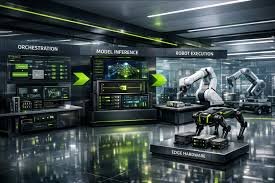
SANTA CLARA, Calif. — A paradigm shift is underway in industrial automation as NVIDIA Isaac offers innovative features that enable AI models to be integrated directly into machinery. The introduction of Edge-Native LLMs into robotics systems marks a breakthrough that will see factories no longer reliant on the cloud for intelligent operations, but instead making decisions locally, immediately, and with zero latency. It is important to note that the conventional use of AI in manufacturing relied heavily on server-based computing systems. Although functional in controlled environments, any delay in processing may lead to inefficiencies and, in extreme cases, cause malfunctioning machinery.
Why Edge AI Has Become a Necessity
Modern assembly lines require constant interaction between robots, workers, and numerous variables. Depending on cloud computing for decision-making in such a dynamic environment comes with unacceptable delays. An Edge-Native LLM ensures that machine learning models operate seamlessly without the need for networking, offering the following benefits:
- Decisions are made immediately, independent of network connections.
- Improved safety due to rapid reactions.
- Reduced the need for reliable internet access.
- Autonomy of robotics systems.
NVIDIA Isaac: Paving the Path for Industrial Revolution
In this regard, NVIDIA Isaac is a platform that leverages GPU-accelerated artificial intelligence to streamline robotic development through an open Robot Operating System with modular navigation, perception, and manipulation capabilities. According to the NVIDIA Developer Blog, with Isaac ROS, developers can implement AI algorithms in their embedded systems, freeing their robots from cloud computing.
This feature is extremely beneficial for industries because:
- Network failures may occur frequently.
- Quick responses are highly necessary.
- Confidentiality and data safety are primary concerns.
By directly incorporating AI into robotic systems, NVIDIA has revolutionized the concept of modern factories.
Zero-Latency AI: A Major Step Towards Progress
One of the greatest benefits offered by this innovation is zero-latency AI. Milliseconds can make all the difference in manufacturing performance, leading to accidents such as machine collisions or faulty operations.
The following are some significant aspects of zero latency systems:
- They detect hazards instantly and prevent any damage.
- They coordinate multiple robots effortlessly.
- They ensure constant operation without stoppages.
- They increase accuracy for complicated activities.
Effects on AI in Industry and Automation
The use of Industrial AI through edge-based models is revolutionizing the definition of automation, as machines can interpret data, learn, and adapt to it rather than executing pre-programmed actions.
This trend is giving way to the proliferation of Autonomous Factories, in which machines operate without requiring human input, and in which:
- Robots are able to detect and fix errors on their own
- Maintenance problems can be spotted before breakdowns happen.
- Processes can respond to production demands
GE’s Strategic Implementation of Technologies
One of the most important examples of implementing such technologies is GE Manufacturing, which is beginning to deploy edge-based AI that enables self-monitoring and self-repair.
As a result:
- Systems can continuously monitor themselves.
- Problems can be predicted in advance and dealt with promptly.
- Processes are becoming more efficient.
Reducing Downtime With Local Intelligence
Perhaps the strongest benefit of this method is its potential to boost efficiency. The phenomenon of How local AI models are reducing downtime in U.S. heavy manufacturing is gaining popularity in the industry as companies look to avoid any disruptions in their operations.
The use of local intelligence allows for:
- Quick detection of system faults
- Prompt response measures without any need for outside assistance
- Constant surveillance without any lag in data transmission
This means that less time will be spent addressing problems, leading to smooth functioning in the production lines.
The Industry-Wide Effect
The effect of this change can be felt across the board as more manufacturers turn to edge computing.
Some important industry-wide changes are:
- Lower need for cloud-based industrial AI applications
- Stiffer competition among device makers
- More focus on on-device computational capacity
Companies that are not ready to make this transition could put themselves at a disadvantage.
Competitive Environment Moving Forward
The emergence of NVIDIA Isaac means there will be an entirely new dynamic in the field of industrial automation. Those firms that embrace edge AI technology stand to benefit greatly, but those that remain stuck in their ways risk being left behind. In other words, the adoption of intelligent systems in edge computing will be a game-changer, giving some organizations a distinct edge over others.
Conclusion
The addition of edge-native language model technology is a major step forward in industrial development. By harnessing the power of edge AI technology, advanced robotic capabilities, and decision-making prowess, NVIDIA Isaac sets the stage for a new generation of more efficient plants. In the coming years, as industries continue to develop, the emphasis will shift from automation to autonomous systems.
Source:– NVIDIA Technical Blog