





San Jose, California —
With each passing year, artificial intelligence networks are growing in size and capability, along with an increased reliance on continuous inter-cluster communication for proper operation. As neural networks become more advanced, it appears that cloud architects are up against yet another problem: an infrastructure bottleneck.
Contemporary agents have been found to constantly exchange data across numerous servers while working with large volumes of data in real time. All of that might lead to problems like lags, miscommunications, and escalating costs associated with such operations.
According to NVIDIA, its NVIDIA Vera Rubin architecture was specifically developed to address these emerging infrastructural issues.
The tech company announced an update to its production infrastructure earlier today, emphasizing the NVIDIA Vera Rubin platform’s ability to streamline computing by eliminating latency in persistent operations. Instead of focusing solely on boosting computational efficiency, the system aims to overcome the physical barriers that prevent smooth interactions within an AI network.
As AI evolves towards agentification, NVIDIA believes efficient infrastructure management may become as important as speed.
The Challenges That Multi-Rack AI Systems Are Facing
In the modern business environment, it is increasingly uncommon to find an AI workload running on a single server. Modern large AI systems require deployment across multiple racks in a cloud data center.
Within those racks, there are processors, memory, network, and storage that need constant communication while AI processes run on top of them.
That leads to significant Agent Bottlenecks whenever multiple AI agents try to communicate across separate infrastructures.
It particularly affects:
- Processes of persistent reasoning
- AI processes involving real-time AI coordination
- Processes of autonomous workflow management
- Multi-agent simulations
- Inference processes
- Orchestration processes in the cloud
Small communication delays between racks have a significant impact on performance.
According to NVIDIA, the Vera Rubin platform was developed specifically to solve this problem.
NVIDIA Vera Rubin Infrastructure Changes
There are several significant improvements to how the racks communicate within large-scale AI applications in the NVIDIA Vera Rubin architecture.
Rather than treating rack units as discrete groups of hardware communicating via the usual networking tiers, NVIDIA redesigned the architecture to use fast communication channels.
As NVIDIA engineers claim, the new system provides increased Interconnect Bandwidth between processing systems, with no data transfer congestion during large-scale AI operations.
It helps the agents communicate much more quickly within the large infrastructures without causing excessive latency.
Some of the areas that were significantly improved by the new architecture include:
- Rack-to-rack communications
- Coordination of shared memory
- AI process synchronization
- Data exchange in real time
- Efficiency of the processing pipeline
- Distributed reasoning
Another important improvement is reducing bottlenecks in long-term background AI processes.
The Role of NVL72 Racks
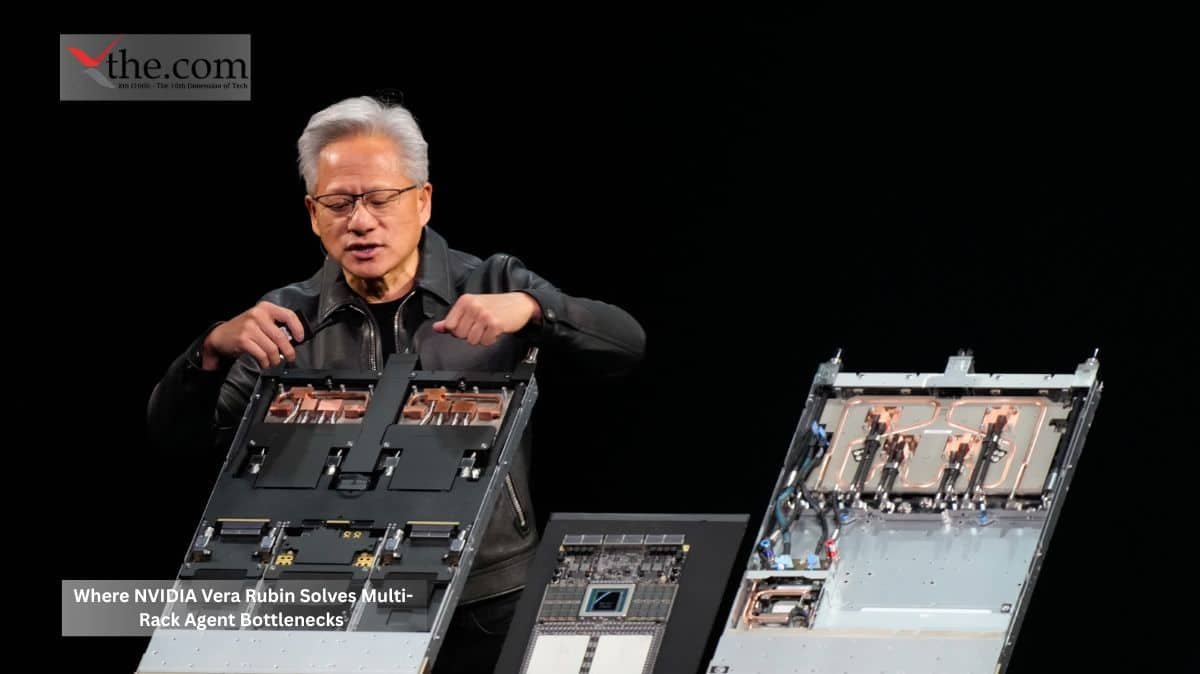
One of the primary aspects included in the announcement is the NVL72 Racks infrastructure from NVIDIA.
The racks are intended for high-density AI processing systems that feature many GPUs and memory working simultaneously.
In most cases, standard infrastructures are ineffective at managing such tasks. According to NVIDIA, the new NVL72 Racks configuration improves communication speeds by optimizing the placement of processors, network systems, and memory paths within the data center.
The improved design is claimed to decrease the number of unnecessary paths and help balance the heat output of all infrastructure components.
Advantages of infrastructure solutions include:
Improved memory synchronization
- Decreased network congestion
- Workload balancing
- Communication speed improvement
- Heat reduction
- Increased processing speed of AI tasks
NVIDIA claims the changes will prove essential when organizations implement more autonomous AI systems.
Why Interconnect Bandwidth is Critical Now
As AI models grow larger and more communicative, Interconnect Bandwidth is gradually becoming one of the most pressing constraints in cloud architectures.
Unlike their predecessors, modern agentic AI systems usually work through continuous communication among several agents.
Therefore, such AI models create tremendous pressure on the underlying network infrastructure.
According to NVIDIA, Vera Rubin drastically reduces the latency between processing units by redesigning the interconnect hardware channels.
While previous solutions focused exclusively on improving software, NVIDIA has now found a way to change the structure of information exchange at the hardware level.
It may prove increasingly critical to adopt such an approach if AI models evolve into autonomous infrastructures capable of persistent operation.
Why Infrastructure Scale is Crucial for Enterprises?
It has become increasingly pressing for enterprises to consider the problem of Infrastructure Scale since the deployment of enterprise-level AI systems continues to grow exponentially.
Enterprise-level AI infrastructures can handle extremely large workloads, including automating customer service, cybersecurity, software development, logistics planning, and real-time analysis.
Therefore, even minor communication inefficiencies will lead to higher expenses.
For example, NVIDIA suggests that Vera Rubin can improve efficiency and reduce wasteful spending on AI infrastructure.
Why Should American Cloud Developers Be Concerned?
American cloud developers have already spent billions of dollars expanding their artificial intelligence infrastructure; however, the problem of escalating operating expenses remains highly relevant today.
As many researchers confirm, interconnected AI processes cause significant performance degradation when multiple racks are used for computation.
This becomes particularly relevant in scenarios where AI agents work autonomously around the clock.
By changing its infrastructure approach, NVIDIA addresses these problems through optimizing intercommunication rather than processor speeds.
Experts suggest that advancements in NVIDIA Vera Rubin multi rack agentic AI performance will affect future cloud infrastructure regulations.
The company’s shift to hardware optimization might also affect how future corporate data centers are designed.
The Future of Agentic AI Infrastructure
The rise of autonomous AI systems is transforming infrastructure requirements.
The future enterprise AI infrastructure might need thousands of interacting, autonomous AI agents operating across different infrastructure systems worldwide. To support such workloads effectively, new types of communication infrastructure would be needed.
This shift towards the needs of future autonomous AI seems already anticipated by NVIDIA through its focus on infrastructure coordination rather than mere computing power.
The Vera Rubin architecture seems to be one of the first attempts to develop specialized infrastructure architecture for agentic multi-agent systems.
Conclusion
The latest announcement from NVIDIA about Vera Rubin highlights an emerging shift in priorities for the development of enterprise AI infrastructure.
Instead of merely accelerating computing power, NVIDIA targets another bottleneck of interconnected AI systems – the need for improved communication infrastructure.
Through Interconnect Bandwidth improvement, optimized NVL72 Racks layout designs, and improved Hardware Execution infrastructure architecture, NVIDIA seeks to design the next generation of AI infrastructures.
Given the expansion of enterprise AI across global cloud infrastructure, addressing multi-rack communication bottlenecks may prove to be the key challenge for the future of AI infrastructure.
Source- Nvidia Newsroom