






Palo Alto, California
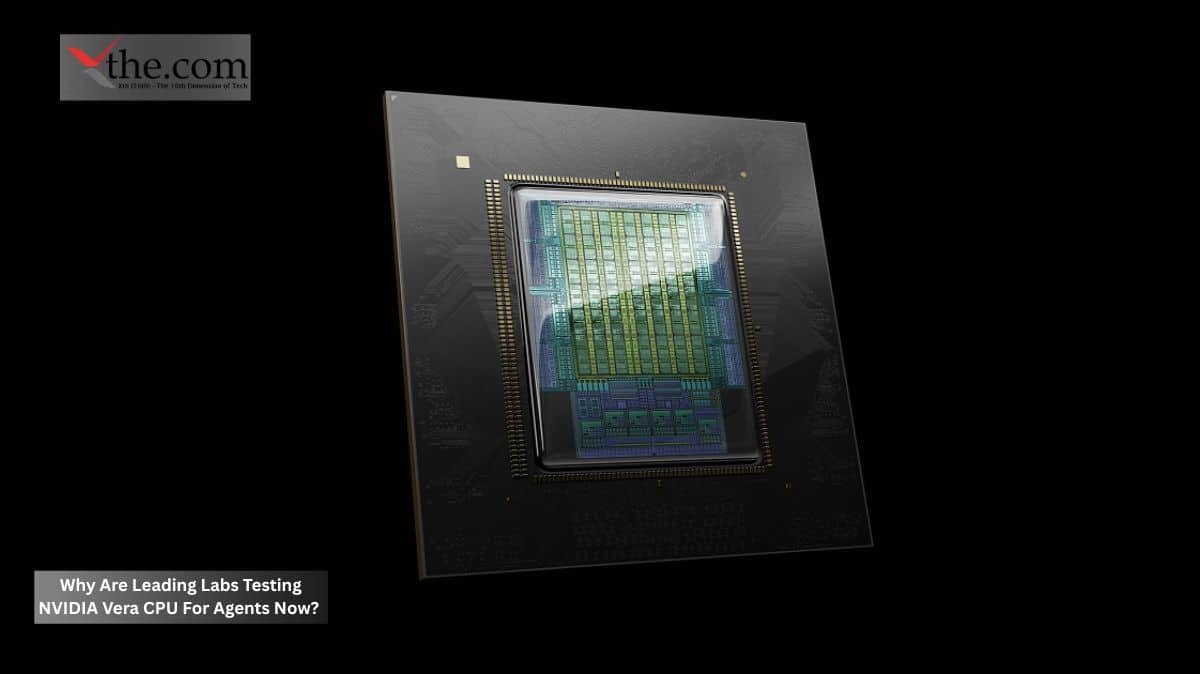
If an AI agent fails, it can use up thousands of tokens in just a few minutes. When this happens on a large scale, it quickly becomes a budget issue that big labs must address. That is why leading AI labs like Anthropic, OpenAI, and XAI are now testing the NVIDIA Vera CPU platform more seriously. Their interest is practical, not just for show. Early benchmarks shared by infrastructure engineers suggest these chips can run agent sandbox workloads about 50% faster than regular server processors, while also reducing token-computing costs across large inference clusters.
This is important because the costs and economics of AI are evolving faster than the technology itself.
Why the NVIDIA Jetson CPU Is Different
For about 20 years, Nvidia focused on graphics acceleration. Their GPUs became the standard for gaming, scientific computing, and later, generative AI. The Nvidia Vera CPU marks a new direction. Instead of acting like a typical computer processor, this chip is built more as a coordination tool for autonomous software agents.
This difference is a big deal.
Today’s AI agents do much more than just generate text. They handle tasks, use APIs, create temporary environments, check their results, and repeat decisions as needed. Regular processors struggle to keep up with this workload because they were designed for general-purpose use, not for nonstop agentic AI inference.
The Vera chip is said to focus on memory bandwidth, fast scheduling, and direct interaction with graphics processing unit clusters. In practice, this allows an AI coding agent to test software, check results, and try again if something fails, all without overloading the system.
For big labs, saving even a few seconds is important. A research cluster running 100,000 agent tasks at once could save millions of dollars each year if each task ran just a bit more efficiently.
The Hidden Cost Problem Inside AI Infrastructure
Most consumers never see the costs behind running AI systems, but investors pay close attention to these numbers.
Each time a chatbot responds, it uses tokens, checks results, retrieves memory, and manages scheduling. When this happens billions of times, the costs add up quickly. Experts say that advanced reasoning models are much more expensive per query than basic chat systems because they use more complex workflows and require more memory.
That is where the token computing cost becomes central.
Over the past three years, the industry has focused on making models smarter. Now leaders are seeking data efficiency. If the NVIDIA Vera CPU can reduce task management overhead and speed up agentic AI, inference could gain an advantage over other labs working on autonomous systems.
The timing also corresponds with a wider redesign of the enterprise server architecture. Traditional clouds were built for web applications and databases. AI agents require persistent memory states, fast context switching, and synchronized communications between CPUs and accelerators. That pushes data centers toward entirely new layouts.
Standard Enterprise servers struggle to handle thousands of AI agents simultaneously. Vera seems to be built specifically for this kind of workload.
Why Investors Are Watching Closely
Investors now judge AI infrastructure companies more by their ongoing computing demand than by the amount of hardware they sell. NVIDIA already leads the market with products like the H100 and Blackwell systems. However, just being strong in GPUs might not be enough for the future.
Agent-based computing is creating a new area of competition.
As companies start using autonomous AI agents in areas like legal research, software engineering, healthcare, and finance, they’re building systems in which CPUs and GPUs work closely together for continuous reasoning tasks. Whoever controls this kind of system could influence the costs and direction of enterprise AI.
This is why investors paid close attention to news about Vera being used in top AI labs. The market sees that Nvidia is trying to go beyond graphics hardware and build complete systems for advanced AI.
Many engineers now use a key phrase: high-performance hardware built for autonomous AI agents.
The wording suggests that computing is undergoing a major change.
The Supercomputer Race Is Becoming More Specialized
The next wave of supercomputer hardware probably won’t look like the old high-performance clusters. Instead, they’ll be more like digital factories for AI agents. These agents will use resources differently from how simulation or gaming software does. They need constant coordination, flexible memory, and quick task management.
This shift opens up big opportunities for companies capable of redesigning modern server architecture around autonomous reasoning agents.
Imagine a legal assistant working at a Fortune 500 company. It checks contracts, reviews compliance, drafts changes, and flags risks independently. Each step involves several rounds of processing. To run millions of these tasks efficiently, you need high-performance hardware built for autonomous AI agents, not the general-purpose processors from years ago.
This is why the Vera project is more important to more than just chip fans.
It marks a move toward building systems made specifically for digital coworkers.
Why Regular Readers Should Care
Most people may never buy a machine with a Vera chip themselves, but they will still notice the impact.
Lower token computing costs could lead to cheaper AI subscriptions, quicker responses, and smarter assistance in everyday software. Companies might be able to use AI workers for much less money. Smaller businesses could get features that used to be available only to the biggest tech firms.
Looking deeper, the AI industry is moving from simply testing models to deploying them at scale. Chips made for agentic AI inference could become as important as the servers that made the cloud possible.
If early results from top AI labs are accurate, the NVIDIA Vera CPU could be the first widely used processor built not just for computing, but for working alongside machines that act more and more like human assistants.
Source: Nvidia Newsroom