






Mountain View, CA | July 17, 2026
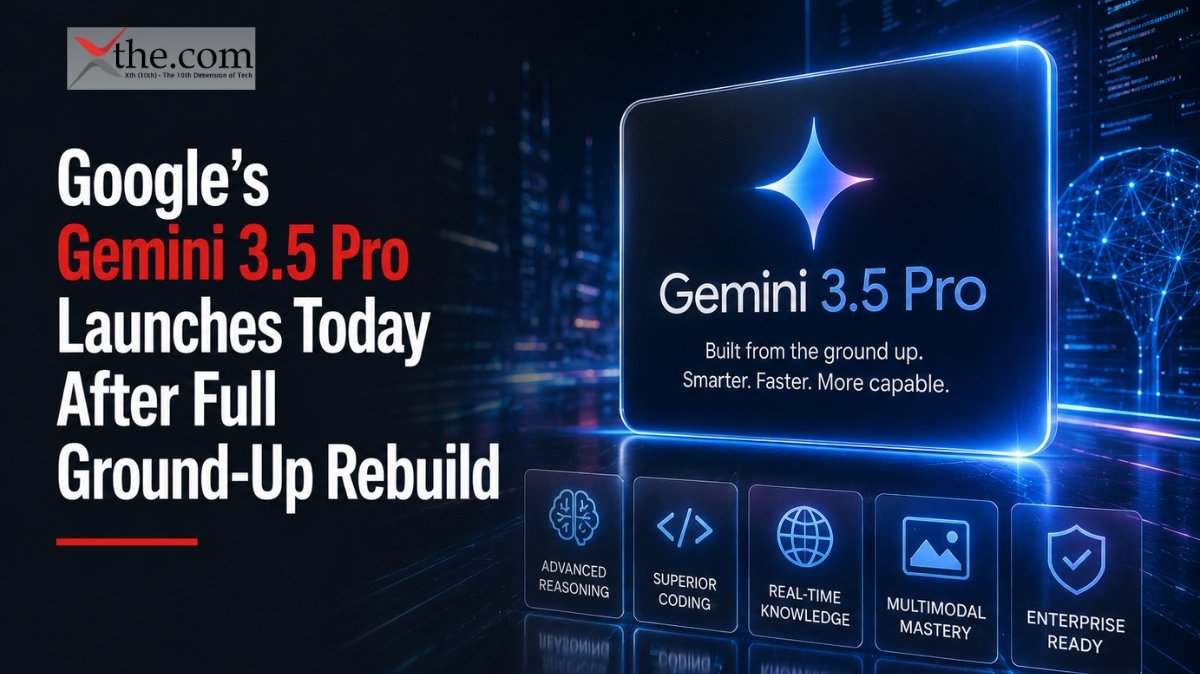
One decision could shape Google’s AI strategy for years to come: starting from scratch. Rather than improving its existing foundation model, Google DeepMind reportedly abandoned its original training run and rebuilt Gemini 3.5 Pro after internal tests showed weaknesses in intricate reasoning, coding accuracy, and multi-step problem-solving. That decision culminated in the Google Gemini 3.5 Pro release on July 17, making the Gemini 3.5 Pro launch date one of the most closely watched events in artificial intelligence this year.
The launch comes just days after OpenAI released GPT-5.6 and soon after xAI announced Grok 4.5, increasing competition among leading AI models. For enterprise buyers, developers, researchers, and tech leaders, today’s release is more than just another update. It shows that Google is willing to rethink its AI plans rather than make only small improvements.
Gemini 3.5 Pro launch date arrives after an unusual development cycle.
It’s rare for major AI companies to admit they abandoned a nearly finished model. According to industry insiders, Google DeepMind decided that the first Gemini 3.5 training process would not meet its standards, particularly in mathematical reasoning, software development, and accuracy in long conversations.
This decision reportedly led to a completely new pretraining process, making the Google DeepMind rebuilt model one of the most ambitious AI redevelopment projects in recent years.
Google has confirmed the release date for Gemini 3.5 Pro, but some technical details reported before launch are still unverified until the official documentation is published. It’s important to separate confirmed facts from industry leaks, as enterprise customers now rely more on transparent benchmarks than on marketing claims.
What Google has confirmed versus what remains unconfirmed
Google says Gemini 3.5 Pro is a major upgrade over earlier Gemini models, highlighting big improvements in reasoning and coding performance.
However, several widely reported features remain credible but unconfirmed as of now.
One of the most talked-about leaked features is Gemini 3.5 Pro’s 2-million-token context window, which would greatly increase the amount of information the model can process at once. If confirmed, this would allow organizations to review lengthy legal contracts, software code, medical papers, financial reports, or thousands of pages of documents without extensive summarization.
Another feature getting attention is Gemini Deep Think reasoning mode, which is said to help with very complex analytical tasks. Leaks suggest this feature may only be available to premium subscribers, not all users.
Trade publications say the Gemini 3.5 Pro pricing Ultra tier might be available through Google’s $250-per-month Ultra subscription, and API pricing could start at about $1.25 per million input tokens. Google had not confirmed these prices when this article was written.
Google Gemini 3.5 Pro’s July 17 release raises expectations for reasoning performance.
The timing of today’s announcement shows just how fast the AI market has changed in 2026.
Just a year ago, people mostly compared models based on chatbot quality. Now, enterprise customers focus more on measurable reasoning, software engineering, math accuracy, and how well models handle long tasks.
Google appears to have rebuilt Gemini specifically to address those priorities.
Developers who tested Gemini 3.5 Pro early noticed big improvements in code generation, debugging, planning, and multi-step reasoning. These features are important because businesses now use AI for tasks that need rational consistency over many steps.
Gemini 3.5 Pro vs GPT-5.6: Early expectations
The inevitable comparison following today’s launch is Gemini 3.5 Pro vs GPT-5.6.
While full independent benchmark tests will take time, some differences are already clear from what we know so far.
GPT-5.6 continues emphasizing strong reasoning, conversational quality, and broad enterprise integration across Microsoft’s ecosystem.
Gemini 3.5 Pro seems to focus on longer context, better software engineering, and stronger intricate reasoning.
If Gemini 3.5 Pro’s 2-million-token context is confirmed, Google would have a real advantage for organizations that handle large datasets. Research groups, pharmaceutical companies, law firms, and engineering teams often work with documents that exceed the usual context limits.
At the same time, the rumored Gemini Deep Think reasoning mode could make Google a stronger competitor in scientific computing, advanced math, and complex planning, where more computation can lead to better answers.
Actual performance comparisons between Gemini 3.5 Pro vs GPT-5.6 will ultimately depend on independent evaluations rather than vendor demonstrations.
Developers are watching pricing as closely as performance.
Raw capability alone no longer decides whether enterprises adopt a model.
Organizations using AI at scale often spend millions each year on API usage. Even small differences in token pricing can have a big impact on costs.
Current reports suggest the Gemini 3.5 Pro pricing Ultra tier will offer both consumer subscriptions and enterprise API access.
If the leaked prices are correct, Google may price Gemini competitively with other top models, while keeping premium features in the Ultra subscription.
Businesses will probably look at more than just benchmark scores. They’ll also consider total cost, speed, reliability, API stability, and how well the model fits into their systems before making big commitments.
Why restarting from scratch could matter.
Starting from scratch, it entails high financial and engineering costs.
Training advanced AI models requires thousands of powerful GPUs, extensive data preparation, months of fine-tuning, and significant energy. Very few companies have the resources to throw away a nearly finished model and start over.
This makes the reported Google DeepMind rebuilt model noteworthy beyond today’s launch.
This decision shows Google chose long-term competitiveness over releasing the model sooner. If the new architecture brings real improvements in reasoning, software development, and science, the extra investment could help Google’s position in enterprise AI for years to come.
On the other hand, if independent tests show only small improvements, competitors might say the costly restart brought few real benefits.
Enterprise implications of a larger context window
One feature generating particular interest is the reported Gemini 3.5 Pro 2-million-token context.
Large context windows can completely change how organizations use AI.
Instead of splitting large datasets into smaller parts, users could analyze entire books, software codebases, lengthy compliance manuals, legal evidence, or years of company documents in one go.
This feature helps keep information together and preserves connections across thousands of pages.
Healthcare researchers, financial analysts, and software engineers could all benefit if Google verifies these features.
The feature everyone wants clarified.
Of all the reported features, Gemini Deep Think reasoning mode has triggered the most curiosity.
Extended reasoning systems require more computing power to produce answers. Rather than focusing on speed, they aim to improve logic, reduce errors, and give more accurate solutions for tough analytical problems.
Whether Google ultimately limits this functionality to premium subscribers through the Gemini 3.5 Pro pricing Ultra tier remains one of today’s most important unanswered questions.
Enterprise customers will likely weigh whether better reasoning is worth higher subscription costs, especially software engineering, financial modeling, research, and advanced data analysis.
What happens next
Today’s announcement is just the first step in evaluating Gemini 3.5 Pro.
Google still needs to release full technical documentation, benchmark results, pricing details, safety information, and an official model card confirming final specifications. Until those materials become available, reports concerning the Gemini 3.5 Pro 2 million-token context, the Gemini Deep Think reasoning mode, and the Gemini 3.5 Pro pricing for the Ultra tier should be seen as aware but unconfirmed.
This release is just the start of comparisons between leading AI systems. In the coming weeks, independent researchers, enterprise developers, and software vendors will compare Gemini 3.5 Pro vs GPT-5.6, looking at coding performance, reasoning, speed, and cost. Whether Google’s rebuild was visionary or just costly will depend on how the technology performs in real business use, not just on launch-day news.