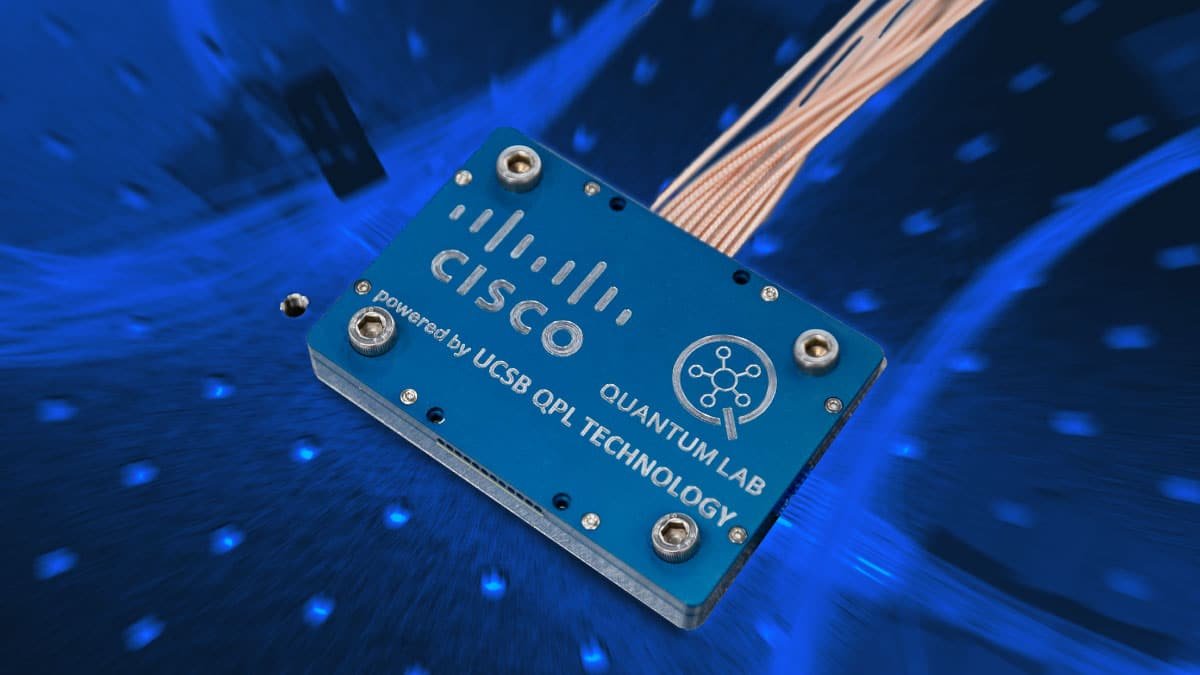
SAN JOSE, Calif. — The organization has developed a networking innovation that uses its Cisco Quantum Switch to enable quantum data transmission through existing telecommunications systems.
This announcement represents a significant milestone within the evolution of Secure Communications; the initial use of a Room-Temperature Quantum system signifies that this will not be limited in terms of access to room-temperature-based operations only, but rather, it will completely eliminate the need for the complex and expensive Cryogenic environments that most existing Quantum Technologies require.
The shift will accelerate enterprise adoption of quantum-secure networking technologies, leading to new encryption standards used across worldwide fiber networks.
Why the Cisco Quantum Switch Matters
The Cisco Quantum Switch represents an attempt to bridge classical networking systems with future quantum communication environments.
Scientists needed to work in remote laboratory spaces because traditional quantum networking experiments required specialized equipment that could not connect to the real world.
Cisco developed its system to work with existing telephone networks, enabling quantum communications to operate over standard internet transmission methods.
The technology is gaining significant importance because it applies to both enterprise- and carrier-scale deployments.
Room-Temperature Quantum Changes Deployment Economics
An announcement cites Room-Temperature Quantum operation (RTQ) as being its most valuable component.
To function properly, quantum systems require ultra-low-temperature environments to support their quantum states, resulting in high operational costs and complex installation challenges.
Cisco improves access to quantum technology infrastructure by developing quantum switching that operates at standard temperatures.
The technology has the potential to make quantum networking systems commercially viable.
Qubit Routing Enables Dynamic Quantum Networking
In addition to the sophisticated routing of qubits, dynamic quantum communication across various network types will also be possible with this advance in technology. Quantum communications employ qubit states to transmit data; as a result, they use alternative forms of information transmission compared to classical binary data transmission.
A scalable quantum networking architecture requires efficient routing of quantum states to function properly.
The development of Qubit Routing technology is the main factor that will determine how quantum internet infrastructure evolves in the future.
Telecom Fiber Gains Extended Relevance
Cisco’s strategic advantage lies in its ability to work with existing Telecom Fiber systems.
The quantum switching system enables operation within existing fiber-based transmission networks, eliminating the need for a completely new communication system.
The system’s compatibility with enterprise and carrier networks enables cost savings during deployment by simplifying integration.
Telecom Fiber usage enables organizations to maintain their current infrastructure investments.
Modal Conversion Supports Hybrid Networks
The technology depends on Modal Conversion technology because it enables networks to transform and use multiple signal states.
The technology needs this capability to enable its two communication systems to operate simultaneously on a common network infrastructure.
Modal conversion helps maintain signal integrity while improving interoperability across hybrid communication architectures.
The growing field of quantum networking will drive the development of Modal Conversion systems to achieve their full potential.
Post-Quantum TLS Gains Strategic Importance
The development of quantum-capable communication systems leads to increased awareness of Post-Quantum TLS protocols, which safeguard future internet traffic against quantum-fueled attacks.
Quantum computing power will eventually render traditional encryption systems ineffective, according to current security predictions.
The goal of post-quantum security systems is to maintain the security of encrypted communication as quantum computing advances.
The development of quantum networking at Cisco directly supports their efforts to update encryption systems throughout the organization.
NIST FIPS Compliance Remains Central
The integration of quantum-secure communication technologies will also depend heavily on alignment with NIST FIPS standards and federal cybersecurity certification frameworks.
Standardized validation processes for encryption and security compliance must be in place before government and enterprise organizations can begin using quantum networking systems.
NIST-related standards will determine the commercial deployment of quantum infrastructure technologies as they continue to develop.
The future governance of quantum networking will establish NIST FIPS standards as its primary governing framework.
Encryption Becomes Infrastructure Agnostic
The Cisco Quantum Switch supports the development of encryption systems that can operate independently of their chosen transmission media.
Future encryption systems will use dynamic adaptability to operate across classical and quantum transmission systems, rather than relying on specific hardware requirements.
The system provides enhanced resilience and improved compatibility for operating across different types of infrastructure systems.
The outcome leads to a communication security framework that possesses greater capacity for adaptation.
Existing Fiber Networks Gain Quantum Potential
The broader significance of implementing room-temperature quantum switching in existing fiber networks lies in the ability to modernize current infrastructure without complete replacement.
Future organizations will incorporate quantum-secure communication systems into their existing telecom infrastructure.
The solution will enhance adoption rates by reducing implementation challenges while keeping business operations running smoothly.
Quantum Networking Moves Toward Commercialization
The transition to room-temperature quantum networking signifies that this area is now entering another stage of development: practical use.
Enterprise interest will rise as operational costs decrease, and compatibility with current infrastructure improves.
The investment rate across telecom, defense, finance, and cloud infrastructure sectors will experience acceleration from this development.
Conclusion: Cisco Pushes Quantum Networking Toward Mainstream Infrastructure
Cisco has developed the Cisco Quantum Switch, which creates the first real-world implementation of quantum-compatible networking technology.
Cisco is transforming future encryption systems through its Room-Temperature Quantum operation capability, which includes advanced Qubit Routing and Modal Conversion, as well as Telecom Fiber infrastructure compatibility.
The growing significance of Post-Quantum TLS and the NIST FIPS frameworks indicates that secure communication standards have entered a new era, requiring quantum resilience and infrastructure flexibility.
As enterprises explore implementing room-temperature quantum switching in existing fiber networks, the future of encryption may increasingly depend on adaptable architectures that operate seamlessly across both classical and quantum communication layers.
Source: Talking Agentic Ops and the evolution of artificial intelligence, with Akshay Bhargava