




Seattle, Washington
An enterprise chatbot handling 40,000 customer engagements per hour can cost millions of dollars in GPU compute each year. The main expense is not processing speed, but moving data. Each time an extensive language model retrieves context, re-ranks tokens, or performs multi-step reasoning, data moves across hardware layers that were not built for large-scale conversation.
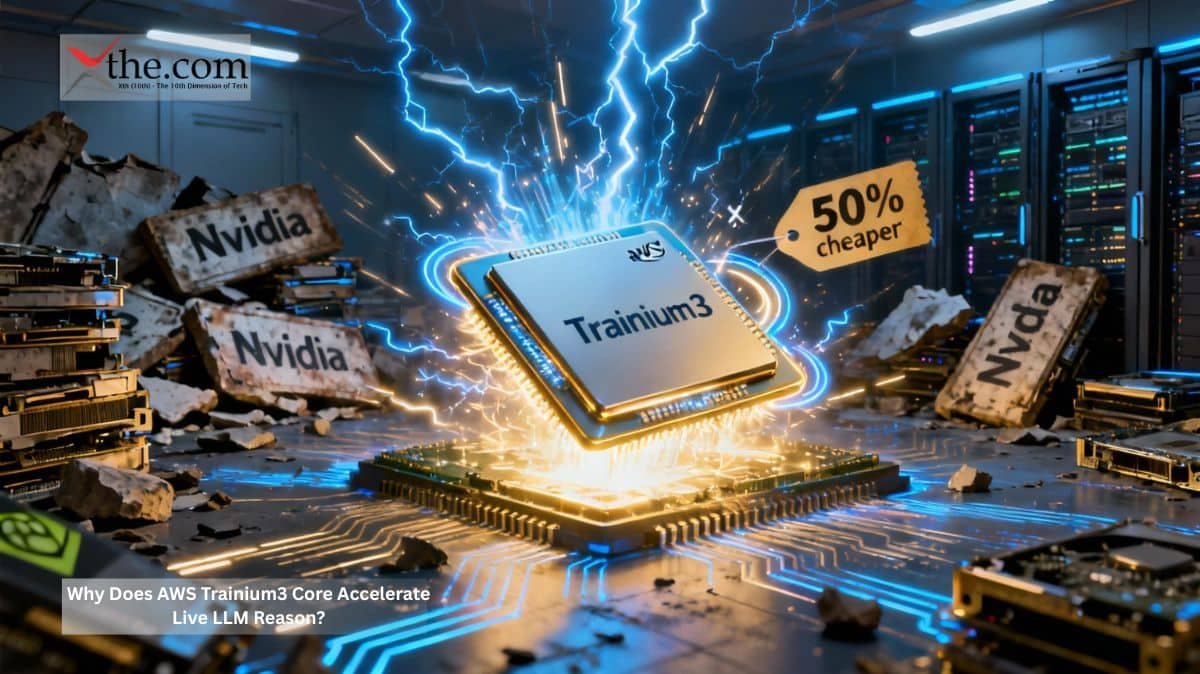
This bottleneck shows why the new AWS Trainium3 core is important. Amazon redesigned the processor because modern LLM reason workloads spend more time managing memory and synchronizing tensors than actually generating words.
Why Amazon Built a New AI Core
For years, large-scale AI systems depended on third-party accelerators. Such reliance led to higher prices, delays in obtaining hardware, and less flexibility for cloud providers seeking to expand their AI services worldwide.
Amazon’s answer is deeper vertical integration through custom silicon.
The AWS Trainium3 core uses matrix engines that connect directly to fast memory. Instead of treating memory as something separate, Trainium3 embeds memory scaffolding close to the computational components. This design reduces delays for tasks that require models to revisit earlier token states.
This is especially important for enterprise co-pilots, legal assistants, and coding agents that use chain-of-thought processing. These systems do not just answer once; they keep looping through phases such as checking, ranking, retrieving, and correcting.
Traditional accelerators have trouble in these situations because token dependencies cause memory congestion in distributed clusters.
Amazon seems to have designed Trainium3 to solve this problem.
How AWS Trainium3 Core Manages Multi-Step Reasoning
Integrated Matrix Engine Helps Reduce Token Delays
The chip has a new matrix compute system designed for transformer workloads. Instead of spreading tensor operations across different areas, Trainium3 brings matrix multiplication and cache management together in a single space.
This is important because live LLM reasoning often leads to recomputing matrices across attention heads.
For example, when an AI assistant reviews a legal contract, it might compare clauses across thousands of tokens while creating new outputs. Each reasoning step introduces more tensor calculations.
The AWS Trainium3 core lowers this overhead by reducing the amount of data that needs to be moved off the main chip.
Amazon’s approach is similar to what high-speed trading systems did years ago, placing compute closer to memory to reduce communication latency.
Coordinating At The Fabric Level In Accelerator Clusters
The next big change is how clusters coordinate.
Instead of relying on external switches, Trainium3 improves connection efficiency within the accelerator cluster. This lets multiple chips share inference tasks with less delay.
In real-world AI deployments, this can make a big difference in costs.
A customer support platform with 24/7 multilingual support often sees spikes in usage, leading to overprovisioning. Traditional GPU setups leave unused capacity because they cannot coordinate inference efficiently when traffic changes.
Trainium3’s local communication design tries to reduce these unused periods.
Amazon has not just made a faster chip; it has built a more efficient system for cloud-based reasoning.
Why Real-Time Insurance Policies Are Important for US Businesses
US companies now face a tough challenge with AI. Customers want instant responses, but costs rise quickly as models grow larger and reasoning becomes more complex.
A healthcare analytics platform that processes insurance claims is a good example. Simple requests finish in milliseconds, but fraud-detection models that check invoices can require much more computing power.
This is where real-time inference efficiency becomes key for costs.
The AWS Trainium3 focuses on steady reasoning performance, not just pitch benchmarks. By reducing memory and synchronization overhead, AWS can lower the cost per token for online workloads.
This is especially attractive to US software companies with tight cloud budgets.
Why Domestic Custom Silicon Matters Strategically
Geopolitics also has a role.
By investing in custom silicon, Amazon relies less on foreign supply chains for accelerators, which is important as AI demand keeps growing faster than manufacturing can keep up.
For businesses, this means more predictable deployments.
Cloud customers now look for more than just top benchmarks. They want certainty in resource assignment, regional access, and enduring stability.
The phrase “AWS Trainium3 chip design architecture benchmarks 2026″ has already begun circulating among infrastructure analysts as next-generation AI performance increasingly depends on efficiency per watt metrics rather than raw theoretical throughput.
This change benefits tightly integrated systems.
The Future of Cloud Native LLM Reasoning
The AI infrastructure race is no longer just about having the fastest processor. Now, the main challenge is running continuous reasoning workloads without high operating costs.
The AWS Trainium3 core signals a broader industry shift toward integrated AI systems, where networking, memory, and tensor processing work together as a single system rather than separate parts.
For developers creating long-running AI agents, autonomous robotics, and enterprise reasoning systems, this design approach may be more important than top benchmark scores in the coming years.
Source: Amazon Global Press Center