



Mountain View, California
An AI startup with 50,000 daily active users can quickly spend $40,000 a month just to keep its inference workload running on standard GPU nodes. This isn’t a rotation. It’s a deeper problem with how the industry has always built hardware: using a single chip for every task, all the time, no matter what’s actually needed.
Google has changed that approach.
The Split That Changed the Map on Cloud Bills
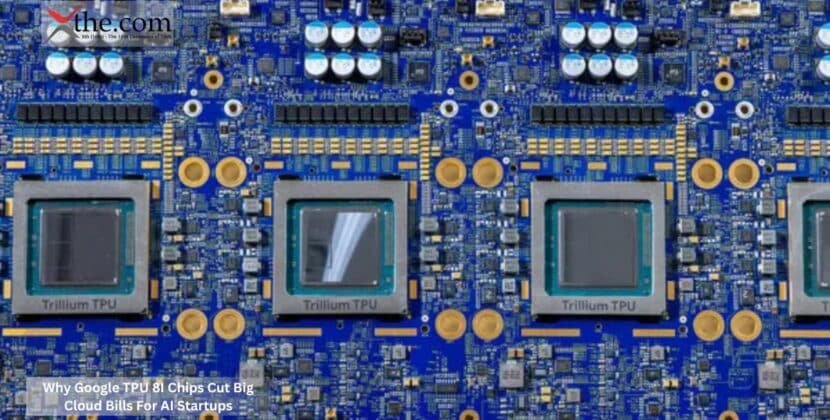
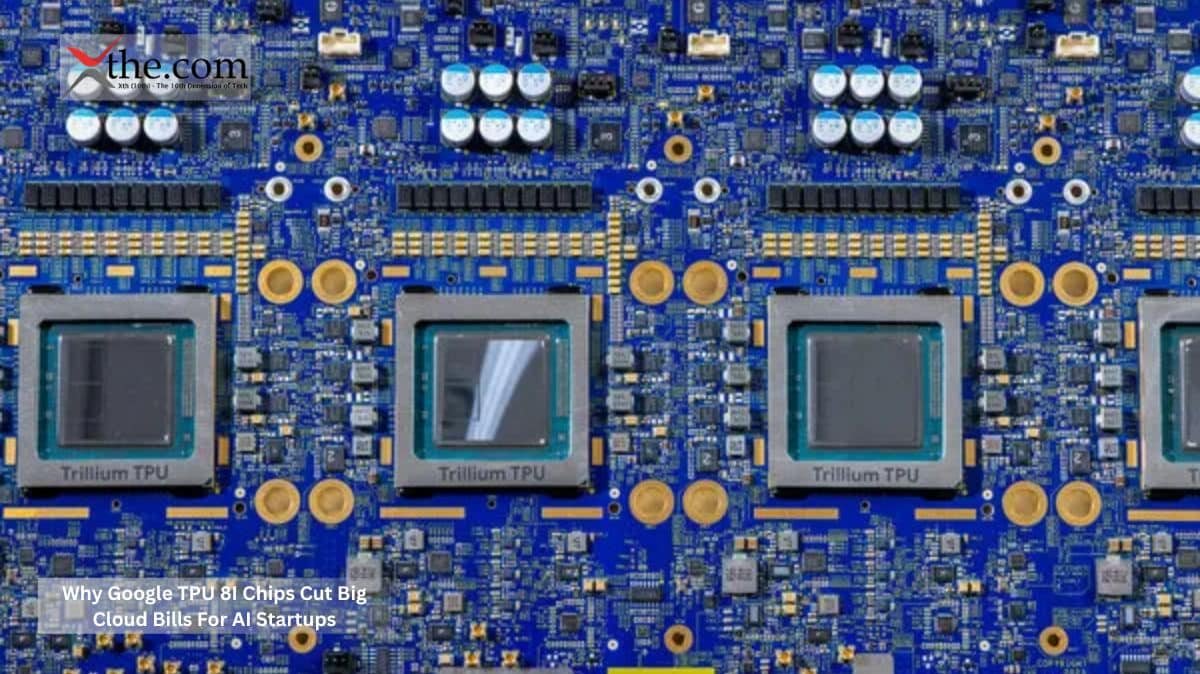
Announced at Google Cloud Next 26, the 8th-generation chips come as a pair rather than a single design: the TPU 8T for training and the Google TPU 8I chips for inference. Each is built for a different part of today’s AI workload. For startup founders focused on operating costs, the inference chip is where the biggest savings are found.
The idea is simple. Training a model happens only once or rarely. Running that model for live users is a constant, around-the-clock task. Charging the same rate for both jobs on the same hardware has always been a waste of money. Google’s new training split architecture solves this problem.
What the Google TPU 8i Chips Actually Do Differently
The TPU 8i is built to meet the low-latency, high-throughput needs of AI agents. In real-world use, its prominent feature is its memory setup: 288 GB of high-bandwidth storage and 384 MB of on-chip SRAM, which is three times as much as before. By keeping AI models’ active data on the chip, it reduces processor idle time, especially as you scale up.
This is especially important for startups running customer support agents that handle thousands of sessions at once. Idle processor time still costs money. You’re paying for computing power even when it’s not doing useful work.
The improvements in constant processing are just as important. The TPU 8i offers 80% better performance per dollar than Ironwood, Google’s previous chip, especially for a diverse set of expert models that require low latency. Both new chips also deliver up to twice the performance per watt, lowering electricity costs and, in turn, cloud prices.
Google Cloud TPU 8i vs. 8t Possession Cost Comparison: Two Jobs, Two Price Profiles
The Google Cloud TPU 8i vs. 8t processing cost comparison is not simply about which chip is cheaper. It is about pairing the right tool to the task and eliminating the premium you currently pay for misalignment.
The TPU 8t delivers up to 2.7x performance per dollar improvement over Ironwood for large-scale training workloads. Technically, the TPU 8t carries 12.6 SP4 petaflops with 216 GB of HBM3e running at 6528 GBs, while the TPU 8i offers 10.1 SP4 petaflops, 288 GB of HBM3e at a faster 8601 GBs, and 384 MB of on-chip SRAM.
The 8i gives up some raw computing power in exchange for faster memory for inference tasks. This is the right choice. A user waiting 400 milliseconds for a reply doesn’t care about unused computing power. They care about speed. The 8i is designed with this in mind.
Here is a real-world example to learn. A Series A startup launches a document analysis assistant. If they use general-purpose GPU arrays, they might use the same hardware for both weekly model fine-tuning and non-stop real-time queries. With Google’s training split approach, the 8T manages the weekly job at 2.7 times the price efficiency, while the 8I handles daily inference at 80% better cost performance. Over a year, these savings could mean the difference between needing extra funding and staying self-sufficient.
Why Competitors Now Have a Pricing Problem.
Google’s eighth-generation silicon chips are set to go into mass production in the third quarter of 2026 using TSMC’s 3-nanometer process, with over 5 million units expected in 2027. With this scale, Google Cloud’s costs improve even as AWS and Azure will struggle to match unless they develop similar custom chips. AWS offers Trainium for training, but its custom inference chips aren’t as advanced. Microsoft still relies mostly on Nvidia for both types of workloads.
The TPU 8I focused on inference and delivers 80% better performance per dollar for a low-latency mixture-of-experts model. This model type is used by most leading AI products, including some that compete with Google’s Gemini family. So, the efficiency gains are real and apply directly to the models most startups will use.
The Structural Shift In Google Cloud Next Pricing Conversations
For executives planning their annual cloud budgets, Google Cloud Next 2026 wasn’t just another product launch. It changed what people expect when a provider shows that real-time processing can cost 80% less per dollar than before. It becomes much harder for competitors to justify higher prices.
The days of treating inference as an afterthought in hardware design are coming to an end. The startup that understands the Google Cloud TPU 8.0 and 8T processing cost comparison today holds a procurement advantage over the competitor, still running everything on undifferentiated GPU capacity. That gap will only grow as the 8i becomes widely available later this year.