



Austin, Texas. On average, an American car assembly line incurs about $22,000 in losses per minute of unforeseen downtime. When a line stops because of tired workers or equipment problems, profits take a big hit. To address this, the industry is turning to physical AI as the main intelligence on the factory floor. By moving past fixed automation and into robotic labor, manufacturers hope to separate production from human physical limits. Tesla is leading this change. The company’s move into robotics represents a larger shift, in which intelligence now interacts directly with the physical world rather than remaining behind a screen.
The Convergence of Intelligence and Hardware
Conventional industrial robots cannot see. They follow strict preset paths and stop working if a part is even a little out of place. Physical AI changes this by permitting machines to sense, think, and act in changing environments. This is not simply a small improvement to factory automation. It is a complete overhaul of how manufacturing works.
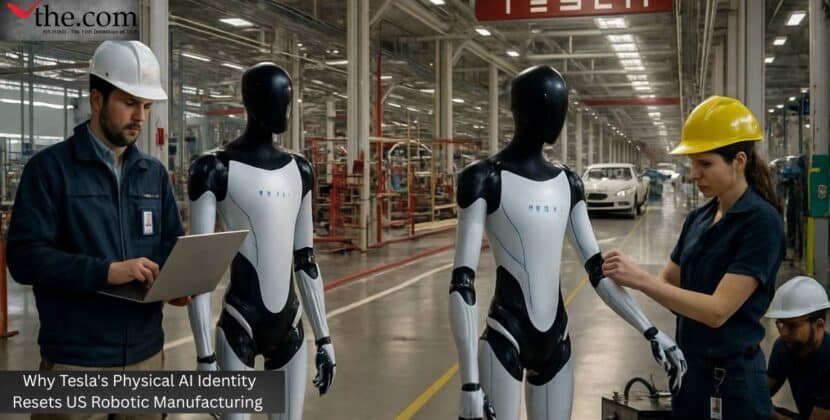
Tesla Optimus is the main example of this new intelligence. It is a humanoid robot made to work in spaces designed for people. Unlike the specialized robotic arms in older factories, Tesla Optimus can perform many different tasks, such as moving battery cells or sorting parts. By using these robots in its own Giga factories, Tesla creates a feedback loop that helps the robots learn from real-world situations.
This training depends on neural networks that handle large amounts of image data. These networks are the same ones used in Tesla’s vehicles, but now they control the robot’s joints, motors, and sensors. If a robot fails to grab something, that mistake is recorded, studied, and fixed on all robots. This shared learning means a solution from Texas can be used right away in Nevada.
Redefining the Assembly Line: The Unboxed Process
The factory’s layout needs to change as its technology evolves. Tesla’s unboxed process differs from the traditional assembly line pioneered by Henry Ford. Instead of moving the car down a single long line, it is built in separate sections or boxes simultaneously.
The Unboxed Process requires robots that can move freely and work together in tight spaces. Older robots do not have the same level of awareness required for this kind of teamwork. But with vision-based intelligence, these robots can work on different parts of the car simultaneously, such as the interior, underbody, and drive unit, before everything is put together. This approach reduces the factory by 40% and cuts costs for new production lines.
Scaling through real-world fleet data
In robotics, the main advantage is now data, not just hardware. Tesla uses huge amounts of free data from its vehicles to improve its models of the world. Every mile driven gives information about how things move, how light works, and how physics affects motion. This data helps a robot grow. Musk says that a robot knows that a cardboard box is light and a brake rotor is heavy before it even picks them up.
The same intelligence is used to develop the Robotaxi. A Robotaxi is a robot that carries people, while a humanoid robot carries tools. Both use the same computer vision systems to move through the world. By sharing these systems, Tesla can spread the cost of AI research across several products, something smaller robotics companies cannot do.
The Fiscal Reality: Impact On Labor Costs
The economic effects on the domestic industrial sector are considerable. Tesla’s physical AI impact on US manufacturing labor costs will likely define the next decade of American competitiveness. By switching to a model in which robotic labor handles the full set of dirty and dangerous tasks, manufacturers can reduce the rising costs of human wages and overtime.
Take a top supplier with high turnover in its stamping department. By swapping five human jobs for two robots, the company keeps production steady and avoids the cost of constantly training new workers. While buying a robot costs a lot upfront, over time, it is expected to cost less than paying a worker in a high-wage country like the US.
Physical AI also enables lights-off manufacturing. Factories can run at full speed all night with little need for heating, lighting, or ventilation, further lowering costs. This kind of efficiency is the only way for countries with high wages to compete with cheaper manufacturing centers around the world.
The Future of General Purpose Robotics
We are entering a time when the line between a car company and a technology company is fading. The aim is not just to make better machines, but to create machines that can build other machines. This needs a level of independence beyond simple tasks like picking and placing parts.
Tesla Optimus and similar robots will succeed if they can handle rare, unpredictable events in busy factories. As these machines get better at handling surprises, people will only need to supervise rather than step in to fix problems.
Adding vision-based neural networks to factories is the last key step. This brings a level of flexibility that was not possible before. Now, a factory can switch to making a new product in just days by updating the robot’s software, rather than taking months.
American manufacturing is facing a big decision. Companies that stick with old, specialized automation will struggle to compete. Those that adopt physical AI and new robotic labor will be able to produce more at lower costs in ways that formerly seemed impossible. The change has already begun, and now it is a race to see who can keep up.
Source: Tesla Blog