




Seoul, South Korea
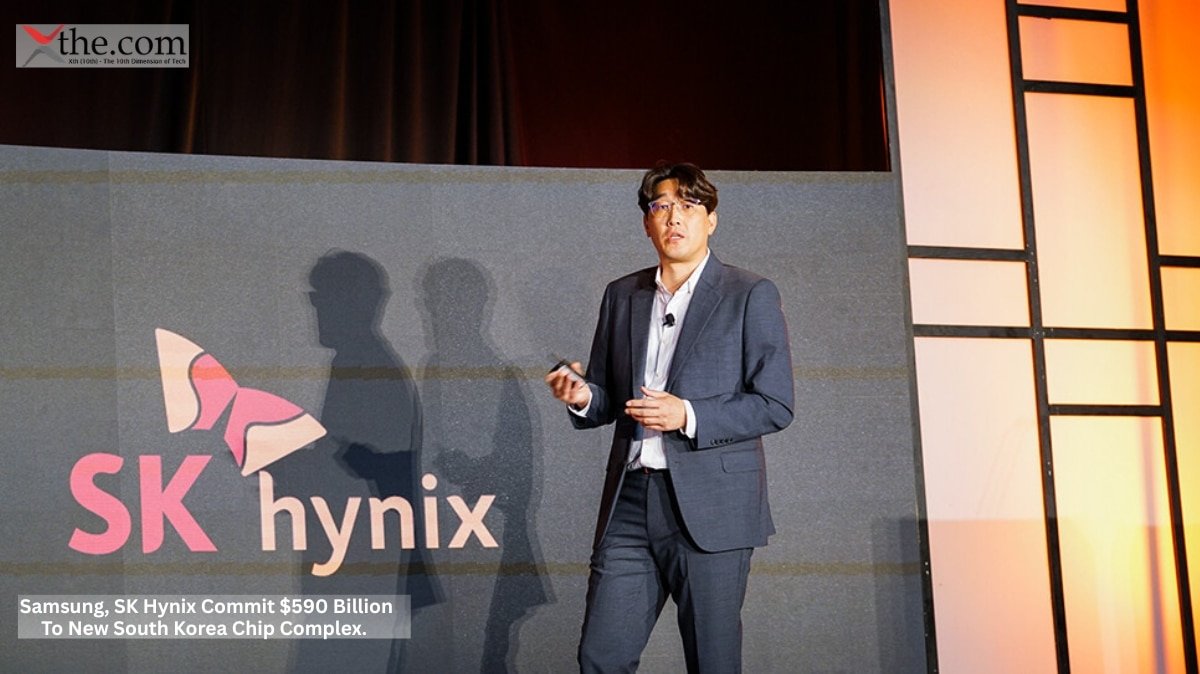
Nine hundred eleven trillion won. That’s the number South Korean officials announced on Monday, which comes out to about $590 billion. This is one of the largest industrial commitments by any government in recent years. The Samsung SK Hynix $590 billion chip plan isn’t just a business move. It’s a national effort, presented by President Lee Jae Myung and the chairmen of both companies at a Seoul briefing that also sent a clear message to chipmakers worldwide.
This announcement wraps up a remarkable week for South Korea’s two leading memory companies. It also comes as SK Hynix prepares to make another big move of its own.
A National Strategy Disguised As A Construction Project
If you look past the press conference, the plan itself is pretty simple, even if the numbers are huge. About 800 trillion won, or $520 billion, will go toward building four new memory chip plants in South Jeolla Province, far from Korea’s usual semiconductor hubs near Seoul. Samsung will build two of these plants, and SK Hynix will build the other two. Another 81 trillion won is set aside for an advanced packaging cluster in Chungcheong, and 30 trillion won will fund next-generation memory research over the next fifteen years.
This is the heart of the South Korea semiconductor investment 2026 story: a government co-investing directly alongside private chipmakers, a tactic Washington has only recently begun experimenting with through its stake in Intel. Industry minister Kim Jung-kwan said the government would shorten the path from permitting to construction, compressing a timeline originally projected for the mid-2040s into the mid-2030s. That is not an incremental adjustment. It is a decision to treat memory chip capacity the way a country treats its power grid or highway system: as infrastructure too important to leave to a normal regulatory clock.
President Lee called this effort a “great leap forward” based on three main areas: semiconductors, physical AI, and data centers. The way South Korea’s AI chip national strategy language matters here is that it signals that Seoul is no longer content to be the world’s memory supplier on the sidelines of an AI boom led by American chip designers and cloud providers. It wants the physical infrastructure of AI- fabrication plants, packaging centers, and the power and water systems that feed them- sitting on Korean soil at a scale that rivals can’t easily match. For readers trying to make sense of the headline figure itself, the short version of “Samsung SK Hynix $590 billion South Korea chip complex four fabrication plants 2026 explained” is this: two companies, four plants, one government, and a big bet that memory demand will keep rising over the next decade.
Four Fabs, One Sold-Out Market
The Samsung chip complex new fabs centerpiece deserves its own examination, because their timing shows what’s really driving this move. Memory chips have shifted from being basic hardware to becoming the main bottleneck in building AI systems. For example, Micron, the biggest U.S. memory maker, saw its quarterly revenue more than quadruple in a year, with profit margins jumping from 39 percent to almost 85 percent, and DRAM prices rising over 260 percent. Its stock has soared about 800 percent in the past year. SK Hynix and Samsung have seen similar growth, and right now neither can produce enough high-bandwidth memory to meet demand from Nvidia, Microsoft, and other major tech companies.
Samsung Electronics Chairman Lee Jae-yong said Gwangju, about four hours from Seoul, is the top choice for the company’s new cluster. SK Hynix Chairman Chey Tae-won was more cautious, saying his company is still choosing a site and ensuring the necessary infrastructure is in place. He also reminded everyone that these projects take time—building SK Hynix’s Yongin campus took nine years. “A chip factory requires massive land, power, water and talent,” Chey said at the briefing, pointing out the challenges this huge project will face.
The HBM Arms Race Behind The Numbers
No discussion of this plan works without addressing HBM memory South Korea expansion, because high-bandwidth memory is the actual product driving the entire announcement. HBM is made by stacking layers of regular DRAM and linking them with thousands of tiny vertical channels, which lets data move much faster than with standard memory. Every major AI accelerator chip, like those inside Nvidia’s GPUs, relies on this technology.
SK Hynix now controls between 56 and 60 percent of the world’s HBM supply, depending on which analyst you ask, and says it’s sold out through 2026 and into 2027. Samsung isn’t sitting back, though. It has started shipping HBM4 and has launched a “Super-Gap Roadmap” to regain its former lead. Samsung Chairman Lee said the company will invest in HBM factories requiring top-level processes, as well as in its current packaging facilities in Cheonan and Onyang. “HBM, which is indispensable for the training and inference of AI models, requires state-of-the-art technology for stacking semiconductor chips,” he said.
There’s also a market value angle to this rivalry. In June 2026, SK Hynix passed Samsung to become South Korea’s most valuable public company for the first time in over 25 years, thanks mostly to its lead in HBM. Meanwhile, Samsung reported 53.7 trillion won in first-quarter operating profit from its chip division alone, showing that even as it tries to catch up in HBM, it’s still making huge profits from the overall memory shortage.
Two Moves, One Week
This story also ties into events in the U.S. SK Hynix has filed with the SEC to raise about $29 billion by listing American depositary receipts on Nasdaq, with trading expected to start on July 10. If it reaches the top of its range, this offering would be bigger than Alibaba’s 2014 U.S. debut and among the largest share sales ever. The money will go directly to building new facilities: the first fab at the Yongin Semiconductor Cluster, an advanced packaging plant in Cheongju, and EUV lithography equipment.
These aren’t just two separate news stories happening at the same time—they’re part of a coordinated effort. SK Hynix is using both South Korea’s industrial policy and the world’s biggest capital market to solve one problem: it can’t build memory capacity fast enough. Listing on Nasdaq gives SK Hynix access to U.S. investors and lets people compare it directly with Micron, its main American competitor. The big investment at home provides land, permits, and government-backed infrastructure. One move brings in the money, and the other shows exactly where that money will go.
Building The World’s Largest AI Chip City
To really understand the scale, visualize this: this isn’t just a factory expansion. It’s more like building a whole new industrial city from scratch, focused entirely on making memory chips. Four new plants will be built in a province that doesn’t currently have any of Korea’s semiconductor supply base. There will also be a separate packaging cluster in Chungcheong and a materials and equipment hub in the southeast. On top of that, a separate 550 trillion won project—about $355 billion—will fund AI data centers built by SK Group, GS Group, and Naver. These centers aim for 8.4 gigawatts of capacity at first, and 18.4 gigawatts by 2035, supporting South Korea’s AI data center goals alongside the chip plants.
When you add up the chip plants, packaging hub, materials cluster, and data centers, it looks more like a self-contained AI industrial zone than just an expansion of current sites. South Korea, which is a bit smaller than Indiana, is trying to build the foundation for a global AI memory supply at home, aiming to do so in about 10 years rather than several decades.
What Could Slow It Down
A project this daring naturally draws a lot of attention, and analysts aren’t shy about pointing out the risks. Lee Jong-ho, a professor at Seoul National University, said clearly that a project this big needs careful planning, and from the outside, it looks like things are moving faster than they should. He’s not the only one with concerns. Chey Tae-won’s comment that the Yongin campus took nine years to build already casts doubt on the government’s faster timeline for South Jeolla, even before construction begins.
Industry experts keep mentioning three main challenges. First, the southwest region lacks sufficient power and water infrastructure for advanced chip plants, so South Korea’s grid will need a major upgrade to support both the new fabs and nearby data centers. Second, there’s a talent gap—these cutting-edge plants need lots of skilled engineers, but most of Korea’s semiconductor workforce is based around Yongin and Pyeongtaek, not the southwest. Third, memory chip markets are known for boom-and-bust cycles. Some specialists warn that the current AI-driven shortage could end sooner than the five-year plan expects, leading to oversupply and falling prices.
Investors replied to these concerns right away. On the day of the announcement, Samsung’s shares dropped as much as 4.86 percent, and SK Hynix fell nearly 6 percent before recovering most of the loss. South Korea’s Kospi index also swung from a 3.4 percent drop to closing down just 0.2 percent. In short, the market wasn’t completely enthusiastic. Investors see the $590 billion commitment as a big gamble that demand for AI memory will keep rising rather than level off after the current data center boom.
Where This Leaves The Rest Of The Industry
South Korea’s two big memory companies already control most of the world’s DRAM and HBM output, and this plan aims to increase that lead. Companies like Taiwan’s TSMC, Japan’s equipment makers, and U.S. rivals such as Micron will be watching to see how quickly South Korea can build new fabs in a region without the established supply chain of Yongin or Pyeongtaek. If the government’s faster permitting process works, the southwest could become the new hub for global memory production by the early 2030s. But if problems with power, water, and talent are as tough as some expect, it could take much longer to get these plants running, giving competitors more time to catch up.
What is not in question is the direction of travel. South Korea has decided that controlling the physical infrastructure behind artificial intelligence, not just the chip designs but the fabs, packaging plants, and power systems underneath them, is now a matter of national strategy rather than corporate balance sheets. Taken together, the announcement amounts to a South Korea semiconductor AI investment drive- Samsung, SK Hynix, new fab complex details, 2026 story that will keep evolving as ground breaks in the southwest. The next decade will determine whether the southwest of the country becomes the AI chip city its planners envision, or a warning story about building faster than the ground beneath the project can support.
Source: South Korea unveils $880bn chip and AI investment plan