



Seoul, South Korea
For the past 13 years, Micron Technology has traded at a 35% higher valuation than SK Hynix. This difference was not about technology, but about location.
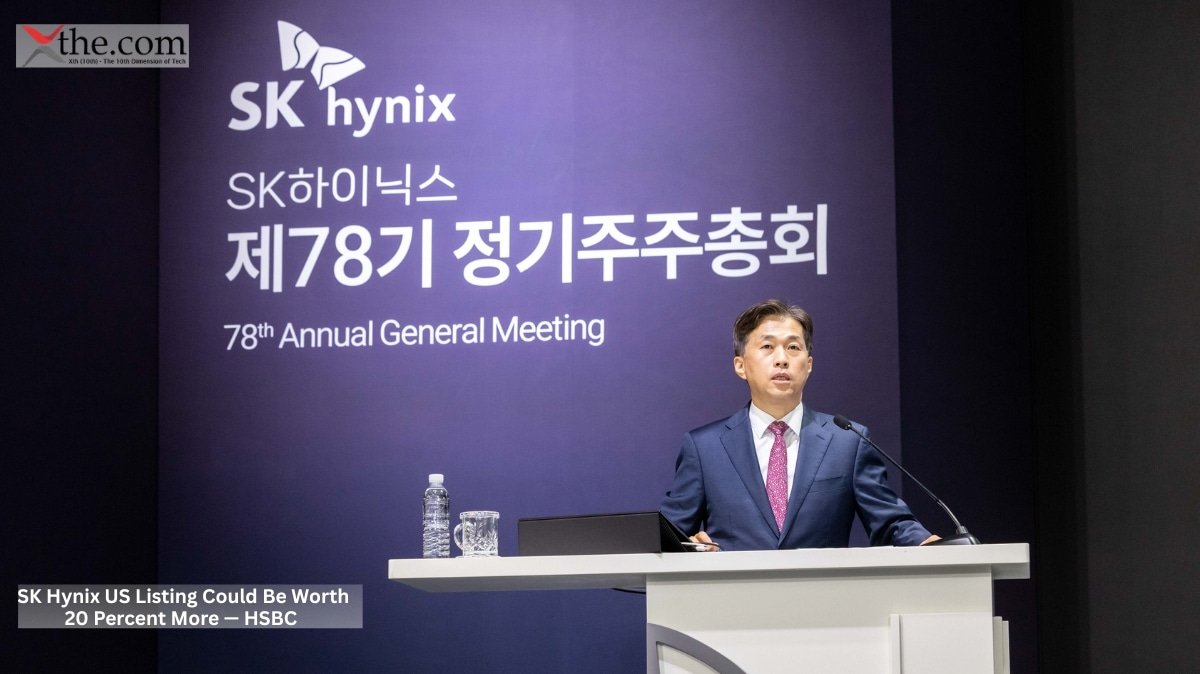
That structural disadvantage is about to end. The SK Hynix US listing 2026 set to debut on Nasdaq on July 10 is the most significant semiconductor capital markets event since Nvidia reached a trillion-dollar valuation. The South Korean memory giant plans to raise about $29 billion by issuing American Depositary Receipts at $166 each. If SK Hynix HSBC valuation analysts are correct, investors buying at that price are getting a discount. HSBC expects the listing to increase SK Hynix’s price-to-book ratio from 2.8 to 3.4, implying about 20% upside from the indicative listing price.
Why the SK Hynix IPO Nasdaq Move Is About More Than Capital
On the surface, the story is simple: a leading chipmaker needs funds to build more factories. SK Hynix plans to use the money to construct new production facilities in South Korea. However, the strategy goes beyond just financial consideration.
HSBC’s outlook for SK Hynix now highlights what the bank calls “more proactive shareholder-friendly initiatives and better accessibility to global investors.” In other words, the Korea Exchange has consistently undervalued one of the world’s key semiconductor companies, and the Nasdaq listing is meant to correct that.
The “Korea discount” is a well-known issue. Worries about corporate governance, being close to North Korea, and limited liquidity in Seoul’s market have kept even top Korean stocks undervalued. Over the past 13 years, Micron has traded at an average premium of 35% to SK Hynix. HSBC says this is due to better access to US investors and more shareholder-friendly policies, not better technology or market status.
That 35% figure deserves to sit with investors for a moment. SK Hynix has supplied the majority of the HBM memory AI demand 2026 requires, yet its home-market valuation has reflected a persistent institutional blind spot. US fund managers have been underweight Korean semiconductors not because the fundamentals are weak, but because accessibility has been poor. A Nasdaq ADR eliminates that friction overnight.
The HBM Premium: What SK Hynix HBM Chip Demand Really Means
High-bandwidth memory is not just another product. It is the most important bottleneck in AI infrastructure, and SK Hynix has a level of control over the supply chain that few semiconductor companies have ever reached.
Wall Street analysts have raised their price targets for SK Hynix, noting that its HBM capacity for 2026 is already sold out and that supply shortages are expected to continue into 2027. Every Nvidia H100 and Blackwell GPU requires HBM3E stacked memory placed directly next to the processor die, and SK Hynix supplies it. When major companies like Microsoft, Google, Amazon, and Meta compete for GPUs, they are also competing for SK Hynix’s products.
HSBC raised its price forecast for SK Hynix from 2.9 million won to 4 million won, citing strong HBM pricing and the impact of the Nasdaq listing as the main drivers. These two factors go hand in hand. AI infrastructure spending is driving demand, while the US listing brings in capital and greater recognition of the company’s value.
The company’s market value recently surpassed $2 trillion following a strong AI-driven rally, making it one of Asia’s most valuable semiconductor firms. This is not just speculation. It shows the strength of HBM3E pricing, long-term customer commitments, and a product roadmap. HBM4 development has already started, keeping SK Hynix ahead in memory technology for years to come.
SK Hynix Stock US Listing Premium: The Nasdaq Effect in Practice
The SK Hynix stock US listing premium thesis is grounded in structural market forces, not hype. Consider what Nasdaq index inclusion has historically done for stocks with sufficient liquidity and market cap: passive fund flows from index-tracking ETFs create systematic buying pressure that is entirely disconnected from quarterly earnings cycles.
If the $29.4 billion raise happens at the expected price, it would be one of the largest global listings, second only to SpaceX’s record share sale earlier this month. This size almost makes certain that discussions about index eligibility will start right away. If SK Hynix is quickly added to the Nasdaq-100, as SpaceX was, it would gain access to trillions of dollars in passive capital that currently does not invest in the company.
SK Hynix said the ADR listing will expand its investor base, “ultimately allowing its true corporate value to be properly evaluated,” and added that the move will “elevate our standing as a global company by broadening our touchpoints in the United States, the epicenter of AI technological innovation.”
These statements show that SK Hynix is aiming for more than just a one-time capital raise. The company wants to become a regular part of US institutional portfolios, joining Nvidia and Taiwan Semiconductor Manufacturing Company as a key memory infrastructure stock in every major AI investment strategy.
SK Hynix vs Samsung Market Cap: A Historic Reversal With Competitive Consequences
The SK Hynix vs Samsung market cap dynamic has already shifted in ways that would have seemed implausible five years ago. SK Hynix briefly overtook Samsung to become South Korea’s most valuable publicly traded company a reversal that does not reflect just AI tailwinds, but a deliberate strategic bet on HBM that Samsung has struggled to match at the same yield and performance levels.
That competitive gap matters enormously for SK Hynix Nasdaq IPO HBM AI chip demand valuation premium calculations. Samsung is still the world’s biggest memory chipmaker by volume, but in the AI era, volume is less important than margin, yield, and next-generation performance. SK Hynix leads in all three areas of HBM.
The US listing adds a new kind of competitive pressure. If SK Hynix achieves a valuation on Nasdaq similar to or higher than Micron’s, Samsung will have to reconsider its own approach to international capital markets. While it would make sense for Samsung to cross-list, its complicated governance and broad business structure make that much harder. For now, SK Hynix’s Nasdaq listing gives it a valuation advantage that Samsung lacks.
SK Hynix US Stock Listing 2026 HSBC Says Worth 20 Percent More Than Korea Share Price: The Risk Calculus
Events of this size in the capital markets always come with risks. Technology stock valuations have been under pressure as investors question whether AI infrastructure spending can continue to grow at its current pace. Memory is a cyclical business, and the same factors that pushed HBM prices up could reverse if large tech companies slow their spending sooner than expected.
There is also the execution question. ADR liquidity, particularly in early trading sessions, can create price dislocations that bear no relationship to fundamental value. Investors who chase the listing-day price action on the SK Hynix US stock listing 2026 HSBC says worth 20 percent more than Korea share price thesis may be buying into short-term momentum rather than the structural re-rating HSBC is describing.
The more disciplined HSBC actually recommends a more disciplined approach: buying at the $166 indicative price, which is 8 to 9 times forward earnings and much lower than Micron’s double-digit multiple. This difference is the main point. If US institutional investors value SK Hynix like Micron, given its stronger position in the HBM market, the 20% upside estimate could be conservative.xt
The July 10 debut date may change, but the overall trend is clear. SK Hynix’s HBM chip demand remains the primary supply constraint for AI hardware, and its Nasdaq listing turns that strength into an investment opportunity for global investors. HSBC’s 20% premium prediction is not the highest possible outcome; it is the starting point for what a careful re-rating could look like when the world’s top AI memory company is no longer limited to a market that has undervalued it.
Samsung is paying attention, and so are all the institutional investors who have had to buy Micron as a stand-in for a company they could not invest in directly. That barrier goes away on July 10, and the new capital will value HBM memory AI demand 2026 in a way the Korea Exchange never could.
Source: CNBC News