






Boise, Idaho
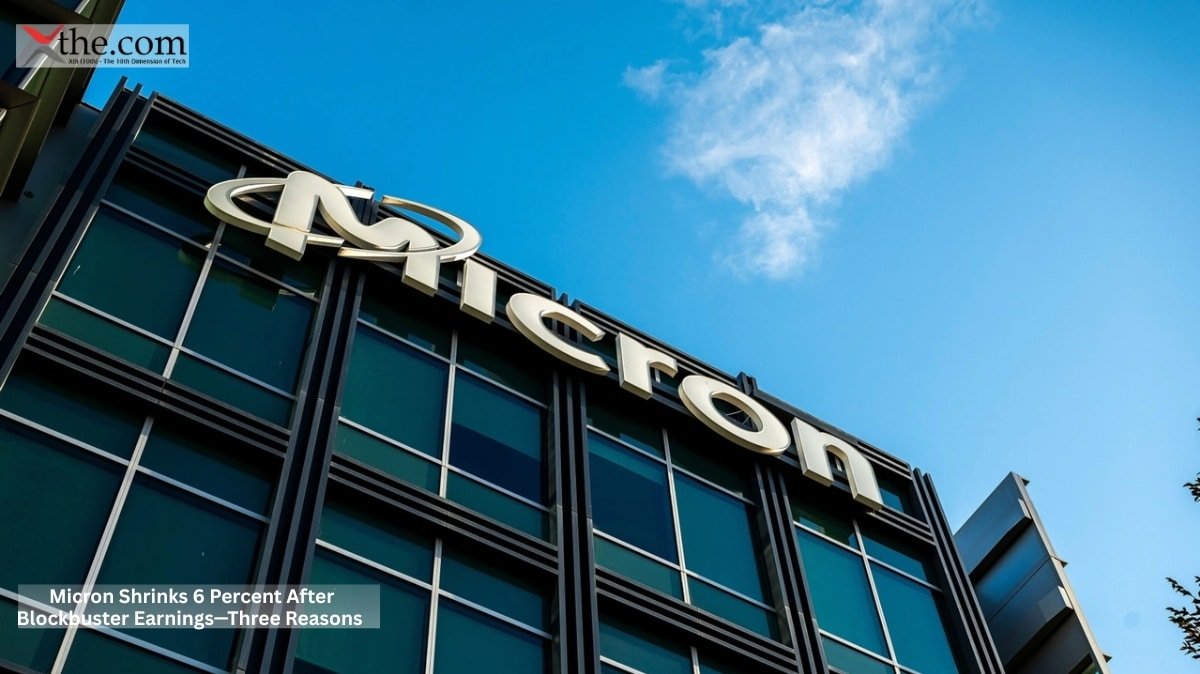
Micron Technology reported the kind of quarterly numbers that companies dream about. Revenue of $41.46 billion against analyst estimates of $35.84 billion. Gross margins expanded to 84.6%. A Q4 guidance figure of $50 billion that shattered the Wall Street consensus of $43.58 billion. The stock surged 15 percent in after-hours trading on June 24. Then, two sessions later, it fell nearly 7 percent. Micron stock drop 2026 has become the defining market paradox of the summer a company posting numbers that obliterated expectations, only to reward investors with a savage sell-off.
If you hold MU, SNDK, or WDC, this week should serve as a master class in the structural forces now working against the memory trade, even as the underlying business has never looked stronger.
Why “Buy the Rumor, Sell the News” Played Out in Textbook Fashion
The Micron earnings beat sell-off wasn’t a random event. It was arithmetic. Micron stock had already surged more than 270 percent in 2026 ahead of the June 24 earnings report. When a stock is at those levels during earnings week, the price already reflects a best-case outcome. Any result short of miraculous disappoints the marginal buyer. Any result that qualifies as miraculous simply confirms what the most aggressive bulls already priced in leaving no one left to push the stock higher.
After a 31 percent earnings surprise, the previous quarter still produced a nearly 20 percent one-week drop; the lesson was already written: guidance, not the earnings beat itself, drives the stock’s reaction. Micron Q3 confirmed it again. The afternoon after stellar numbers hit the tape, the stock opened the next session red. By Friday, June 26, MU stock falls after earnings had become the dominant market narrative. Micron’s stock price declined 6.69 percent on Friday, dropping from $1,213.56 to $1,132.33, with 86 million shares traded a volume surge that accompanied the decline.
Understanding the mechanics of the pullback matters less than understanding the three structural forces beneath it. These aren’t noise. They’re signals.
Reason One—Apple and Microsoft Are Looking for an Exit From Western Memory Suppliers
Apple confirmed the severity of the memory cost crunch when it raised Mac and iPad prices on June 25, unable to absorb the increase in memory costs. That headline, which rattled consumer tech investors, contained a sharper implication for memory chip stocks decline: the world’s most profitable consumer electronics company a buyer with extraordinary negotiating leverage cannot absorb these prices. That makes it an existential incentive to find alternatives.
Reports emerging from Silicon Valley and Cupertino this week pointed to both Apple and Microsoft actively exploring sourcing arrangements with Chinese memory producers—a move that would route critical DRAM NAND supply concerns 2026 directly around Micron, SanDisk, and SK Hynix. The memory shortage shaking Apple and Microsoft was described as an existential crisis for smaller players, and that framing cuts both ways. If the shortage persists, hyperscalers have every economic incentive to accelerate sourcing in China. If they succeed, Micron loses pricing power on standard DRAM contracts precisely when HBM remains constrained.
The irony is brutal. Micron’s pricing discipline—the same discipline that produced 84.6 percent gross margins—is now compelling its largest customers to fund the development of competing supply chains.
Reason Two—HBM Capacity Constraints Cap Near-Term Revenue Even as Demand Explodes
High-bandwidth memory is the product that defines Micron’s current valuation. HBM3E and HBM4 products are fully booked through 2027, with demand extending into 2028, and Micron secured $22 billion in strategic customer agreements, including $18 billion in cash deposits. That sounds like unambiguously good news. In one sense, it is. In another, it is precisely the problem.
When supply is already fully allocated through 2027, the company cannot generate incremental revenue from incremental demand. A hyperscaler that wants more HBM today cannot get it from Micron. CEO Sanjay Mehrotra disclosed that Micron can fulfill only 50 percent to two-thirds of customer demand in the medium term a structural supply deficit that continues to amplify pricing power. But investors pricing “Micron MU stock falls 6 percent after blockbuster earnings, three reasons investors need to know” into their search bars this week have already absorbed the implication: if supply is capped, revenue growth has a ceiling, and that ceiling was partially visible in the Q4 guidance beat itself. Wall Street had expected $43.58 billion. Micron guided $50 billion still constrained by what it can physically produce, not what it can sell.
A Chosun Biz report revealing that SK Hynix was slowing its next-generation HBM4 capacity expansion in favor of commodity DRAM sparked a broader tech-sector selloff and a 10 percent plunge in South Korea’s KOSPI index, heightening investor fears that the hyper-growth cycle for AI-specific memory hardware may be approaching a peak. Whether or not the HBM super-cycle has peaked is a question no analyst can answer with certainty. The market, however, has already moved.
Reason Three—AI Infrastructure Cost Fears Are Repricing the Entire Semiconductor Sector
The third force is the broadest and, arguably, the most consequential. The AI infrastructure buildout has generated staggering returns for Nvidia, Micron, and SanDisk, as well as for the semiconductor ETFs that hold them. But memory stocks’ June 2026 decline reflects growing investor anxiety: at some point, the cost of building AI infrastructure must translate into revenue. Alphabet and Nvidia two companies with the most direct exposure to AI capital spending sat out the broader megacap tech bounce this week. That is not coincidence.
Memory chip stocks came under heavy pressure Tuesday, extending a broad technology selloff on Wall Street as investors grew increasingly uneasy about the enormous sums being poured into artificial intelligence infrastructure. The concern isn’t that AI demand is fabricated. Micron’s numbers confirmed it’s real. The concern is that the pace of infrastructure investment cannot be sustained indefinitely without monetization. If Alphabet and Microsoft slow their data center buildout even marginally DRAM and NAND demand softens faster than any current model anticipates.
The “why memory chip stocks MU, SNDK, WDC are falling despite strong Micron Q3 earnings June 2026”question has a clean answer: when the fear shifts from supply scarcity to demand durability, the valuation multiple compresses even as earnings expand.
The Contagion Spreads to Sandisk and Western Digital
The SanDisk WDC stock drop June 2026 played out in sympathy with Micron, and the losses at both names were disproportionate to any company-specific deterioration. Option traders turned moderately bearish on SanDisk Corporation, with shares down 10.36 percent on June 26, despite no negative fundamental news from SanDisk itself.
The synchronized drop came just one trading session after a coordinated rally in which MU gained 9 percent, SNDK gained 9 percent, and WDC climbed 3 percent the entire memory complex trading as a single thematic unit on AI memory supercycle sentiment. These stocks move together because institutional positioning treats them as a sector rather than as individual companies. When the sector narrative wobbles, all three names pay the price regardless of underlying fundamentals.
For investors holding semiconductor ETFs with heavy memory weightings, this dynamic matters more than any individual earnings print. The sector beta amplified by extraordinary year-to-date returns means that position sizing and risk management now matter as much as fundamental analysis.
What Comes Next for MU, SNDK, and WDC
Micron’s business is structurally stronger than at any point in its 48-year history. The company’s market cap has surpassed $1 trillion, revenue has more than quadrupled year-over-year in fiscal Q3, and CEO Mehrotra has signed 16 long-term strategic customer agreements spanning three to five years with financial commitments totaling $22 billion. These are not the metrics of a company facing a cyclical peak. They are the metrics of a company that has embedded itself into the core infrastructure of the AI economy.
But the lesson of June 26 is that extraordinary metrics, priced in advance by a stock that has risen 700 percent over twelve months, generate selling pressure rather than buying interest when they arrive. The three structural headwinds Chinese memory alternatives, HBM capacity ceilings, and AI infrastructure cost anxiety will not resolve in a single quarter. Memory chip stocks’ decline may extend further before it stabilizes.
The investors who emerged from this week with the clearest picture are those who understand that memory stocks falling June 2026 represent a sentiment reset, not a fundamental reversal. The next entry point in MU, SNDK, and WDC will likely come when fear peaks—not when earnings do.