



Santa Clara, California
Your four-year-old laptop can now run software that usually requires a $1,500 graphics card without any hardware upgrades. This is possible thanks to technology in remote data centers that uses hardware you don’t own. Today, NVIDIA GeForce NOW streams games and professional workloads to screens that most IT buyers would have considered too weak just eighteen months ago.
NVIDIA GeForce NOW Stream Low-Latency Games: The Infrastructure Behind the Access
Many budget-focused tech users wonder why this works now when it didn’t five years ago. The answer lies in the server grid, not in your own device.
NVIDIA’s June 2026 platform expansion pushed the GeForce NOW infrastructure to support hundreds of edge locations globally, positioning compute nodes within roughly 100 miles of major population centers across North America and Europe. Each of those nodes runs RTX 5080 and RTX 5090-class server hardware. When a user in suburban Ohio opens a browser-based design application or launches a graphically intensive title, they are not routing a request to a distant hyperscaler hub. They are hitting a nearby low-latency network node that processes the frame, compresses it, and ships the result back to their display in a window measured in milliseconds.
NVIDIA developed its low-latency streaming technology, called LLS, with help from major internet providers like BT Group, Comcast, and T-Mobile. They use the L4S network standard, which means Low Latency, Low Loss, and Scalable Throughput, along with NVIDIA Reflex and Rivermax technology on the servers. As a result, GeForce NOW Ultimate’s 360 FPS mode reaches about 30 milliseconds of latency. In tests on a 10ms network with Overwatch 2, this was even faster than a PlayStation 5 Pro running the same game locally at 120Hz.
This result is worth noting. A cloud-delivered signal arriving faster than local rendering is not simply a marketing claim. It is the result of engineers removing inefficiencies at every step.
How Cloud Container Streaming Eliminates the Hardware Bottleneck
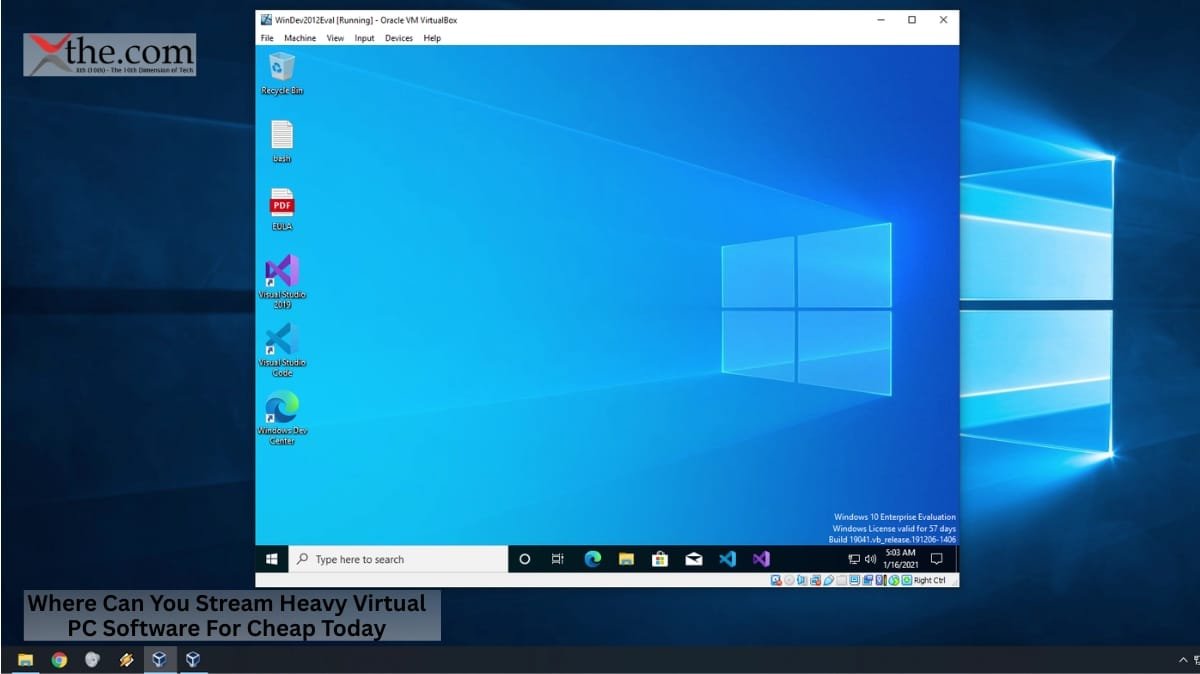
Affordable access is possible thanks to cloud container streaming. This means isolated virtual environments are created as needed, provided with dedicated graphics processing resources, and removed when the session ends. Each container acts like a private high-end PC, with its own GPU, RAM, and storage. The user’s device, whether it’s an old Android tablet or a $300 Chromebook, simply acts as a display and input device.
For gaming and software to feel responsive, input-to-display delays need to be under 100 milliseconds, and many users want even less than 20 milliseconds. This has always been a big challenge for networks and was the main reason cloud streaming was slow to catch on. The 2026 rollout of edge data centers within 100 miles of most cities has solved much of this problem for most homes. Now, GeForce NOW runs hundreds of these edge locations worldwide, cutting down round-trip times.
This has a clear benefit for small offices and freelance creatives. For example, a motion graphics studio that can’t afford a $4,000 workstation for a part-time contractor can now rent a cloud container as needed and pay only for the hours used. The same goes for students using simulation software, engineers testing CAD models, and researchers working with large visual datasets, all of whom operate without owning or maintaining expensive hardware.
NVIDIA GeForce NOW Stream Games, Low Latency Updates, and the June 2026 Rollout
The June 2026 update brought big changes. NVIDIA added new games to GeForce NOW, like NTE: Neverness to Everness, SpaceCraft, and the Gothic 1 Remake. They also improved the backend to support new game settings, better controller support, cloud saves, and upgraded graphics options for cloud play.
Tracking the NVIDIA GeForce NOW stream games’ low-latency updates through this cycle reveals a pattern that matters beyond the game list itself. NVIDIA has logged at least 15 day-and-date launches in the first five months of 2026 alone, compared with approximately 8 in the same period of 2025 an acceleration that reflects contractual negotiations NVIDIA has been pursuing with publishers since its 2024 infrastructure expansion. Publishers committing to simultaneous cloud releases signal that they regard the network as commercially reliable rather than experimental. That confidence is built on the low-latency network node architecture described above.
Tests on Metro Fiber show GeForce NOW Ultimate’s input latency averages between 25 and 40 milliseconds, which is fast enough for action RPGs, racing games, and most shooters. The experience feels natural for both solo and co-op play. On regular home Wi-Fi, latency is a bit higher, but NVIDIA’s system automatically connects you to the fastest server, even if it’s not the closest one, to keep latency as low as possible.
What This Means for the Consumer Electronics Retail Equation
Hardware retailers have quietly watched this development with attention. When cloud container streaming delivers graphics performance equivalent to a $1,200 desktop GPU over a regular 35 Mbps home connection, it’s harder to justify buying a mid-range GPU. GeForce NOW Ultimate uses RTX 5090 servers to deliver up to 4K resolution at 240 frames per second with ray tracing, which is more than most home desktops can handle without a big investment.
By June 2026, GeForce NOW supports more than 1,800 games from Steam, Epic Games Store, GOG, Ubisoft Connect, and Xbox PC Game Pass. This large library also serves developers who need to test software on different platforms. The ‘bring your own game’ model is important too: subscribers stream games they already own, so there’s no need to pay twice, which was a problem with earlier cloud services.
The subscription pricing makes this service even more appealing. The Priority tier costs less than $10 a month. Compared to buying a gaming GPU, which can cost $600 to $900, most light or moderate users will break even within a year.
The Road Ahead for NVIDIA GeForce NOW Stream Games
Because rendering happens in the cloud, even Linux systems and older devices can now deliver high-end performance. Members can use features like ray tracing, NVIDIA DLSS 4, and other RTX technologies without needing a powerful GPU at home. The June update also added native app support for Amazon Fire TV and Linux, bringing in devices that traditional PC gaming never reached.
The real question now isn’t whether NVIDIA GeForce NOW streaming works—2026 has already proven that. The question is how soon businesses, creative agencies, and schools will realize that cloud container streaming over a regular home or office connection is good enough for professional use. The network is ready, and there are enough low-latency nodes in most cities. Now, organizations just need to decide whether to keep buying hardware or let a nearby data center handle the heavy lifting.
If you want to optimize latency or check GeForce NOW server compatibility, NVIDIA offers a network testing tool right inside the GeForce NOW app.
Source: Nvidia Newsroom