






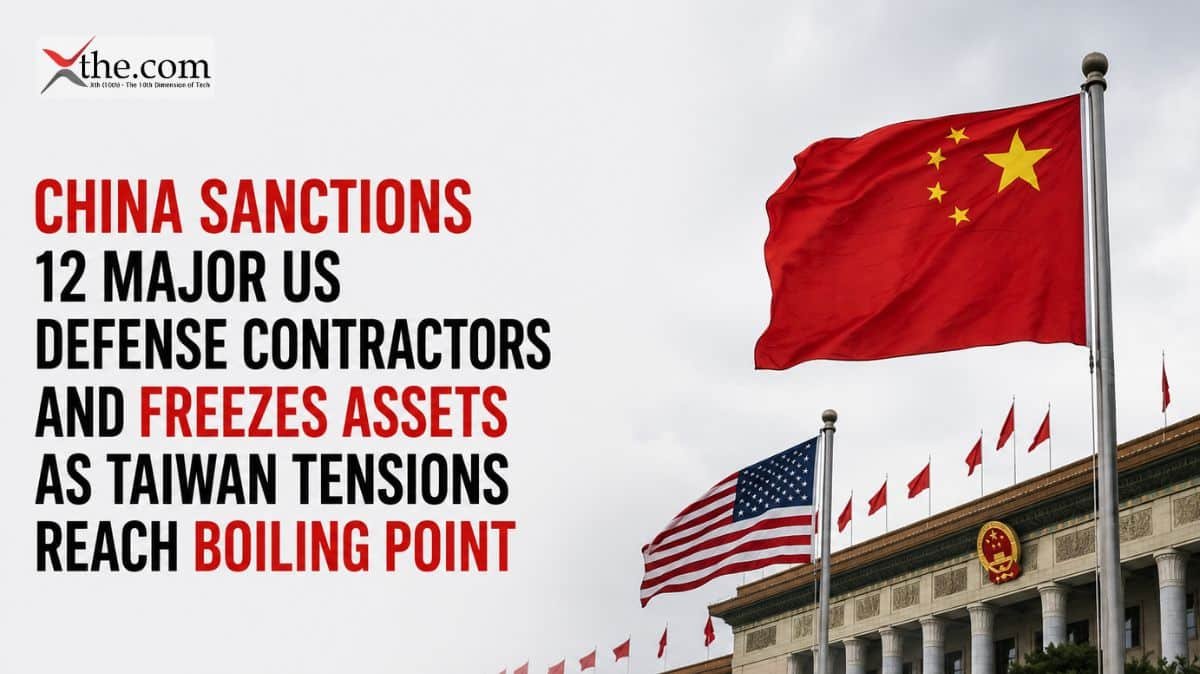
China’s Ministry of Foreign Affairs announced sweeping sanctions against twelve American defense contractors on Wednesday, freezing all assets held within Chinese jurisdiction and prohibiting any organization or individual in China from conducting business with the targeted firms. The move, described by Beijing as “necessary countermeasures against American arms sales to Taiwan,” represents the most aggressive economic retaliation between the world’s two largest economies since the 2022 semiconductor export controls.
The Sanctioned Companies
The list reads like a directory of America’s military-industrial complex:
- Lockheed Martin — F-35 fighter jet manufacturer
- Raytheon Technologies — Missile defense and radar systems
- Northrop Grumman — B-21 Raider stealth bomber builder
- Boeing Defense — Military aircraft and satellite division
- General Dynamics — Abrams tanks and nuclear submarines
- L3Harris Technologies — Communications and electronic warfare
- Huntington Ingalls Industries — Aircraft carrier construction
- Leidos — Defense IT and intelligence systems
- CACI International — Cybersecurity and intelligence
- Science Applications International Corp (SAIC) — Engineering and technology
- Amentum — Military base operations and logistics
- Vectrus — Army installation management
The sanctions freeze any property, securities, bank accounts, or intellectual property licenses held by these companies or their subsidiaries in China, Hong Kong, and Macau. Chinese citizens and businesses are barred from providing services, technology, or raw materials to these firms.
Immediate Financial Impact
While none of these companies generate significant revenue from Chinese military sales — US law already prohibits most defense exports to China — the sanctions bite in unexpected ways.
Boeing Defense faces complications through its commercial aviation division, which sells roughly 25% of its aircraft to Chinese airlines. While the sanctions technically target only Boeing’s defense unit, Chinese regulators have already signaled “heightened safety inspections” for Boeing 737 MAX and 787 deliveries — a clear retaliatory move against the parent company.
Lockheed Martin and Raytheon maintain small supply chain operations in China for non-military electronics components. These will need immediate relocation, costing an estimated $200-400 million in restructuring expenses. More critically, both companies source rare earth elements — 80% of which are processed in China — for precision-guided munitions. Alternative supply chains in Australia and Vietnam cannot scale quickly enough to prevent production delays.
Stock Market Reaction
Defense stocks initially dipped 2-4% on the news before recovering as investors realized the direct revenue impact is minimal. Lockheed Martin closed down 1.2%, Raytheon fell 1.8%, and Northrop Grumman declined 0.9%. Boeing, with its commercial exposure, dropped 3.4%.
Paradoxically, the sanctions may benefit these companies long-term. The Pentagon is expected to accelerate “friend-shoring” initiatives, directing additional funding to build domestic rare earth processing capabilities. The Defense Production Act has already been invoked to subsidize Lynas Rare Earths’ Texas facility, and additional grants for MP Materials’ California mine are likely.
Rare Earth Vulnerability Exposed
The sanctions highlight a critical American vulnerability: dependence on Chinese rare earth processing. Neodymium, dysprosium, and terbium are essential for F-35 fighter jets, Tomahawk cruise missiles, and precision-guided artillery. China processes 87% of global rare earths and has previously threatened export restrictions.
“This is a wake-up call we should have heeded a decade ago,” said Senator Tom Cotton, ranking member of the Senate Armed Services Committee. “We cannot build the weapons to deter China using Chinese materials. This is a national emergency disguised as a trade dispute.”
The Pentagon’s Strategic Materials Reserve currently holds only 6 months of rare earth supplies for defense production. Legislation introduced Wednesday would mandate a 2-year strategic reserve and $8 billion in subsidies for domestic mining and processing.
Taiwan Context
The sanctions follow the US approval of $380 million in new military aid to Taiwan announced last week, including Harpoon anti-ship missiles and early warning radar. China views Taiwan as a breakaway province and has vowed “reunification” by 2030 if necessary.
Chinese state media has intensified coverage of military exercises near Taiwan, with the People’s Liberation Army Navy conducting “blockade rehearsals” involving 68 vessels and 156 aircraft. While no shots have been fired, the exercises practice the exact quarantine scenario that would cripple Taiwan’s economy without triggering a full American military response.
Impact on US-China Trade
Broader US-China trade relations are deteriorating rapidly. Bilateral trade volume fell 12% in Q2 2026 compared to the same period in 2025. American agricultural exports to China — soybeans, pork, and wheat — have declined 18% as Chinese buyers shift to Brazilian and Argentine suppliers.
Tesla, Apple, and NVIDIA — American companies heavily dependent on Chinese manufacturing and consumers — face increasing regulatory harassment. Chinese customs officials have delayed Tesla Model Y shipments for “safety inspections” and opened antitrust probes against Apple’s App Store pricing.
What Americans Should Watch
- Gasoline Prices: If China restricts rare earth exports broadly, not just to defense firms, electric vehicle motor production and wind turbine manufacturing could face cost spikes. Oil prices are already elevated due to Middle East tensions.
- 401(k) and Investments: Mutual funds holding Boeing, Apple, or NVIDIA face headwinds. Consider diversifying into domestic-focused small-cap funds if US-China decoupling accelerates.
- Consumer Electronics: iPhone and MacBook prices could rise 8-12% if Apple is forced to accelerate supply chain relocation from China to India and Vietnam.
- National Service Debate: The sanctions have reignited discussions about reinstating selective service registration requirements and expanding domestic manufacturing apprenticeships.
The Bottom Line
China’s sanctions are largely symbolic in direct financial terms — American defense contractors do not sell to Beijing. But the move signals Beijing’s willingness to weaponize its economic leverage, particularly rare earth dominance, in ways that could disrupt American military production, commercial aviation, and consumer technology. The question is no longer whether US-China decoupling will happen, but how fast and how painfully.








