






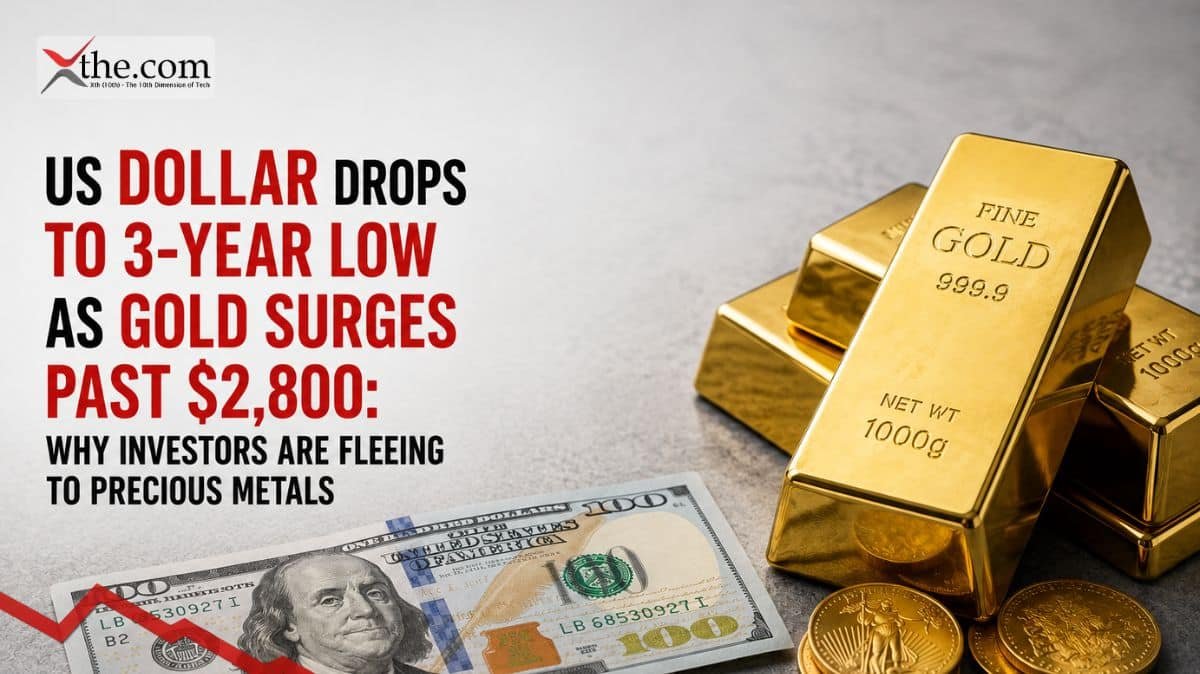
The US dollar index (DXY) fell to 98.4 on Wednesday, its lowest level since August 2023, while gold futures shattered records by climbing past $2,800 per ounce for the first time in history. The simultaneous moves — currency weakness and precious metal strength — signal deep unease among global investors about American fiscal health, political instability ahead of the November midterm elections, and the Federal Reserve’s increasingly uncertain monetary policy path.
Why the Dollar Is Falling
The dollar’s decline accelerated after the Bureau of Economic Analysis revised Q2 2026 GDP growth downward from 2.1% to 1.4% — well below the 2.5% consensus forecast. Consumer spending, which drives 68% of the US economy, grew at just 0.8% annualized, the weakest reading since the pandemic recovery. Credit card delinquencies have risen for 14 consecutive months, and auto loan defaults are at their highest level since 2010.
“The consumer is tapped out,” said Diane Swonk, chief economist at KPMG. “Savings rates have collapsed from 8% in 2021 to 2.3% now. People are borrowing to pay for groceries. That is not sustainable, and currency markets are pricing in a harder landing than equity markets acknowledge.”
Additionally, foreign central banks are diversifying away from dollar reserves at the fastest pace since the 1970s. China reduced its Treasury holdings by $78 billion in Q2. Saudi Arabia began accepting yuan for oil shipments to Asian customers. Even traditional American allies like Japan and South Korea have slowed dollar purchases, with the Bank of Japan intervening in currency markets to strengthen the yen against the dollar for the first time since 2022.
Gold’s Historic Rally
Gold’s surge to $2,820 per ounce represents a 34% gain since January 2026. The rally has been driven by a perfect storm of factors:
- Central Bank Buying: National banks purchased 1,200 metric tons of gold in the first half of 2026 — the highest six-month total on record. China, Russia, India, and Turkey are aggressively building gold reserves as alternatives to dollar-denominated assets.
- ETF Inflows: American investors poured $18.3 billion into gold ETFs in July and August alone. The SPDR Gold Shares ETF (GLD) saw its largest single-month inflow since the 2008 financial crisis.
- Real Yields Turning Negative: With inflation at 3.4% and 10-year Treasury yields at 3.84%, real returns on government bonds are negative. Gold, which pays no yield but preserves purchasing power, becomes relatively more attractive.
- Geopolitical Risk Premium: The Israel-Iran conflict, ongoing tensions in the South China Sea, and uncertainty about the November US midterms have all increased demand for non-sovereign stores of value.
“Gold is doing what it always does when trust in fiat currencies erodes,” said Peter Schiff, chief economist at Euro Pacific Capital. “$2,800 is not the ceiling. If the Fed is forced to cut aggressively while inflation remains sticky, $3,000 gold is a conservative target.”
Impact on American Consumers
A weaker dollar is not abstract — it hits wallets directly. Imported goods become more expensive. The trade-weighted dollar decline has already pushed gasoline prices up 8% since June, as crude oil is priced globally in dollars. European car imports, electronics from Asia, and even food imports from Mexico cost more.
For travelers, the dollar now buys 12% fewer euros and 18% fewer yen than it did in January. A week in Paris that cost $3,500 in January now runs $4,100. Study abroad programs, international business travel, and imported consumer goods all face price pressure.
However, American exporters benefit. Boeing, Caterpillar, and agricultural producers are seeing stronger foreign demand as American goods become cheaper in local currency terms. The trade deficit, which hit a record $78 billion in June, may narrow in Q3.
What Investors Should Do
Financial advisors are divided on whether gold’s rally is sustainable or a bubble.
The Bull Case: If the Fed cuts rates aggressively in September and October while inflation proves sticky, real yields will plunge further. Gold could reach $3,000 by year-end. Central bank buying shows no signs of slowing, and retail investor FOMO has not yet peaked — Google searches for “how to buy gold” are up 340% since June but remain below 2011 levels when gold last hit nominal records.
The Bear Case: Gold pays no dividends, no interest, and generates no cash flow. At $2,800, it trades at historically extreme valuations relative to global GDP and stock market capitalization. If the US economy stabilizes, the dollar recovers, and geopolitical tensions ease, gold could correct 15-20% rapidly.
Practical Advice:
- Do Not Put More Than 10% of Portfolio in Gold: Financial planners universally recommend gold as an insurance position, not a core holding. A 5-10% allocation through ETFs like GLD or IAU provides diversification without excessive risk.
- Avoid Physical Gold for Small Investors: Coins and bars carry 5-10% dealer markups, storage costs, and liquidity challenges. ETFs and sovereign gold bonds are more practical.
- Consider Gold Mining Stocks: Companies like Newmont (NEM) and Barrick Gold (GOLD) offer leveraged exposure to gold prices plus dividend yields of 2-3%. They outperform physical gold during rallies but fall harder during corrections.
- Do Not Time the Top: Dollar-cost averaging into a small gold position over three months reduces the risk of buying at a local peak.
The Bigger Picture
The dollar’s weakness and gold’s strength are symptoms of a deeper shift in global finance. For 80 years, the dollar has been the world’s reserve currency — the foundation of international trade, central bank reserves, and global debt markets. That position is not collapsing overnight, but it is eroding. Gold’s record price is a vote of no confidence in American fiscal management and political stability.
Whether this represents a temporary correction or the beginning of a structural realignment will define investment returns for the next decade. For now, prudent diversification — including a modest gold allocation — is the only rational response.








