






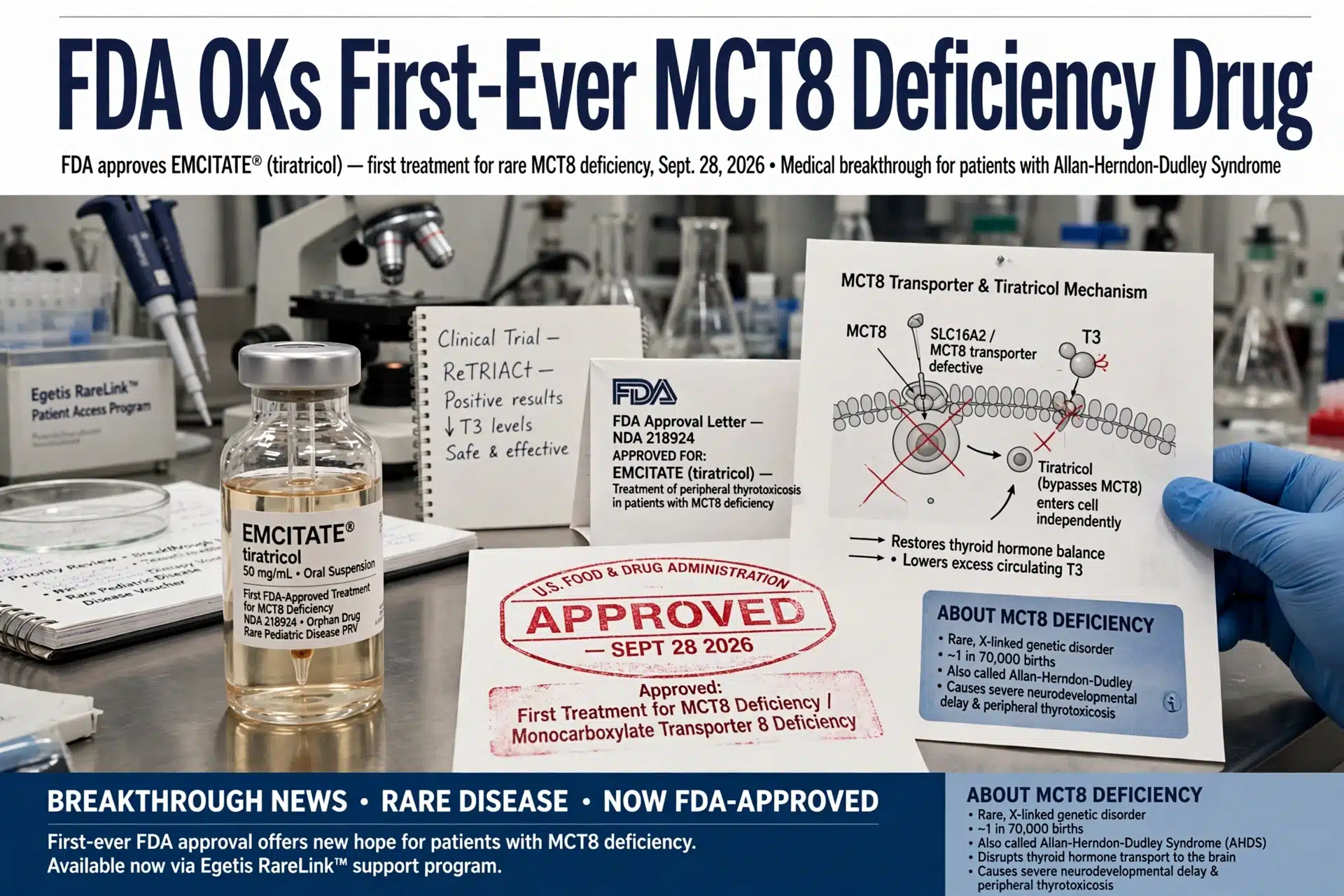
FDA Approves First-Ever Treatment for MCT8 Deficiency, Ending Decades of Watch-and-Wait
The Food and Drug Administration approved Emcitate, known generically as tiratricol, as the first treatment ever for MCT8 deficiency, a rare and devastating genetic disorder that leaves many affected children unable to walk or talk while flooding their tissues with dangerous levels of thyroid hormone. The approval, announced this week, ends a decades-long stretch in which families and physicians had no therapy at all for the condition and could only manage symptoms as they appeared.
Emcitate is approved for the treatment of peripheral thyrotoxicosis in both adult and pediatric patients with MCT8 deficiency, the FDA said, calling it the first therapy cleared to treat symptoms of the disease. The drug was developed by Egetis Therapeutics and carries the sort of narrow, high-need indication that has made rare disease treatments a growing focus of the agency’s approvals calendar. Here is what the disorder does, how the new drug works and what the approval means for the families who have waited for it.
What MCT8 Deficiency Is and Who It Affects
MCT8 deficiency, also known as Allan-Herndon-Dudley syndrome, is an extremely rare genetic condition caused by mutations in the SLC16A2 gene, which provides the instructions for a protein that transports thyroid hormone into cells. Thyroid hormone is essential for brain development and metabolism, but in this disorder the hormone cannot get where it needs to go. The result is a paradox that defines the disease: too little thyroid hormone activity in the brain, and far too much circulating in the body.
The condition is X-linked, which means it predominantly affects males, and symptoms appear in infancy. Children typically show severe developmental delay, low muscle tone, abnormal movements and intellectual disability; many never learn to walk or speak. At the same time, excess thyroid hormone in the bloodstream causes peripheral thyrotoxicosis, driving a rapid heartbeat, weight loss, irritability, sweating and failure to thrive that can strain the heart over years.
Because the disorder is so rare, diagnosis is often delayed, and families frequently endure years of unanswered questions before a genetic test identifies the cause. Advocacy groups estimate that the global population of patients is small enough that every approval reshapes the landscape of care for the entire community.
Why There Was No Treatment Before
For most of the time the syndrome has been recognized, care was purely supportive. Doctors managed the cardiac effects of excess thyroid hormone, worked with feeding and therapy teams, and monitored development, but nothing targeted the underlying transport defect. Standard thyroid hormone replacement, the obvious first thought, does not solve the problem when cells cannot take the hormone up properly, and in some patients it can even worsen the imbalance.
That vacuum left families with the hardest kind of medicine: watching. Pediatric endocrinologists followed lab values and heart rates, adjusting supportive care while parents navigated early intervention programs, physical therapy and communication devices. The approval of Emcitate gives that routine its first pharmaceutical component.
How Emcitate Works and Who Can Take It
Emcitate supplies tiratricol, a thyroid hormone analog that bypasses the defective transporter and helps lower the dangerously elevated T3 levels that drive peripheral thyrotoxicosis. By reducing the toxic excess of thyroid hormone in the body, the treatment targets the metabolic side of the disease, the part that keeps the heart racing and weight falling.
The FDA labeled the drug for peripheral thyrotoxicosis in adults and children with MCT8 deficiency, and its use comes with required laboratory monitoring to keep hormone levels in range. Because dosing is weight-based and the patient population includes infants, the agency laid out dosing guidance, lab testing schedules and pharmacy access details alongside the approval. Physicians will titrate treatment to each patient’s blood work, the standard approach for any therapy that touches thyroid hormone.
What the Approval Means for Families and Researchers
For patient families, the emotional weight of the moment is hard to overstate. Rare disease parents often describe the diagnosis as a list of things nobody can do; an approved therapy converts part of that list into something actionable. Advocacy organizations that spent years pushing for trials said the decision validates the small, determined teams that ran them, even when recruiting enough patients for a conventional study was impossible.
The approval also matters beyond this one syndrome. Regulators and investors have increasingly treated ultra-rare diseases as viable development paths, using smaller trials and surrogate endpoints when the biology is well understood. Success in MCT8 deficiency reinforces that playbook for the next generation of genetic transport disorders, several of which sit in early research pipelines now.
What Comes Next for Patients Starting Treatment
The immediate questions are practical: who manufactures and distributes the drug, what it costs, how insurers will cover an ultra-rare therapy and how quickly families can get access. Orphan drug designations typically come with incentives for the sponsor, including periods of market exclusivity, while patient assistance programs often bridge coverage gaps during the early launch period.
Clinicians will also be collecting real-world data as patients begin treatment, watching heart rate, weight, growth and hormone panels over months. Because the approved evidence base reflects what is possible in a tiny population, that post-approval experience will shape dosing practice for years. Pharmacy teams, meanwhile, are preparing the compounding and distribution workflows required to serve a patient community spread across continents but small enough that each pharmacy fill matters.
Families, meanwhile, are planning for a future that looked different a month ago: one in which the standard of care for MCT8 deficiency includes an actual drug.
Frequently Asked Questions
What is MCT8 deficiency?
MCT8 deficiency, also called Allan-Herndon-Dudley syndrome, is a rare X-linked genetic disorder in which a defective transporter blocks thyroid hormone from entering cells, causing severe developmental problems alongside toxic thyroid hormone levels in the blood.
What did the FDA approve?
Emcitate, whose generic name is tiratricol, approved for the treatment of peripheral thyrotoxicosis in adult and pediatric patients with MCT8 deficiency. It is the first therapy ever approved for the condition.
How does the new treatment work?
Tiratricol acts as a thyroid hormone analog that does not depend on the defective MCT8 transporter, helping lower the dangerous excess of thyroid hormone that drives the disease’s metabolic effects.
Who is eligible for Emcitate?
Patients of any age with MCT8 deficiency who show peripheral thyrotoxicosis, with dosing based on weight and regular laboratory monitoring to keep thyroid hormone levels within a safe range.