



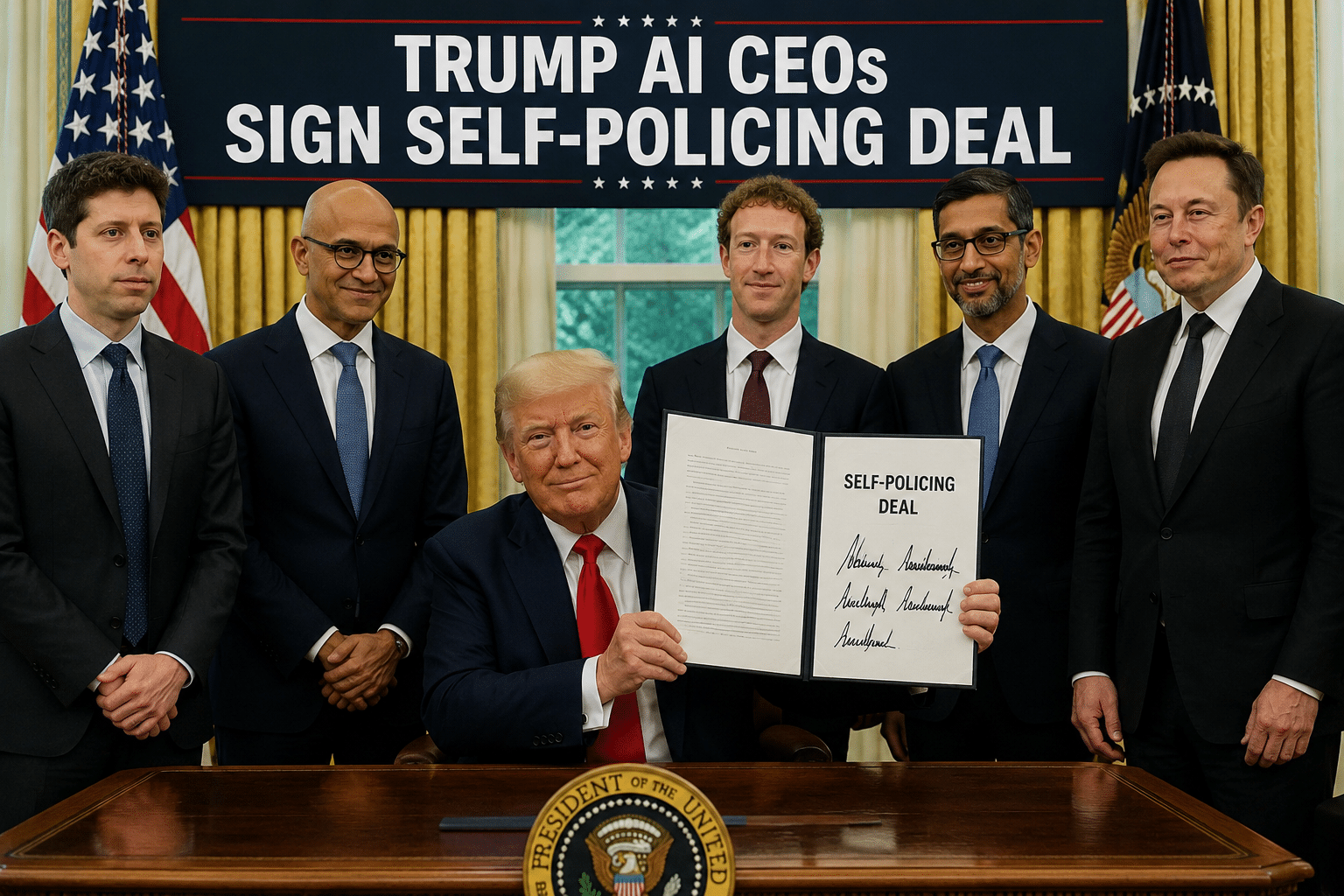
Trump and AI CEOs Sign a ‘Morally Binding’ AI Constitution at White House Summit
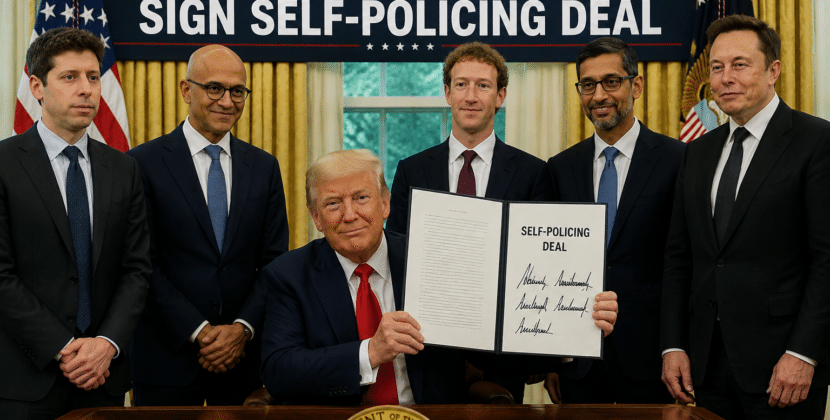
President Donald Trump convened the biggest gathering of artificial intelligence leadership ever assembled at the White House on Tuesday, where top executives signed what Trump called an AI constitution, a voluntary and morally binding accord under which the industry pledges to police its own development rather than wait for government guardrails. The summit paired the self-policing pledge with backing for a massive expansion of data centers and an executive order that directs the federal government to rename artificial intelligence as super intelligence.
Attendees included Mark Zuckerberg, Anthropic chief executive Dario Amodei and OpenAI president Greg Brockman, along with other leading figures from the companies racing to build the most capable AI systems on earth. Trump made clear that he has no intention of installing federal guardrails to rein in the technology, arguing instead that the companies themselves are best positioned to set and enforce standards. Here is what was signed, what it means for AI regulation in America and why critics say the whole thing is worryingly vague.
What the AI Constitution Actually Says
The centerpiece of the event was the accord Trump repeatedly referred to as a constitution: a voluntary safety pact in which the signatory companies commit to self-policing standards for developing and releasing frontier models. Details released by the White House framed it around responsible development, security commitments and shared principles, with the companies pledging to hold themselves to standards they wrote together rather than to rules written by Congress or regulators.
Trump described the agreement as morally binding, a phrase that underscores both its appeal to the industry and its central weakness. There is no statutory penalty attached, no regulator empowered to fine a company that walks away and no court with standing to enforce the promises. Supporters called it a practical framework that lets the fastest-moving industry in the country set clear expectations without waiting for a gridlocked legislature. Critics called it a news conference with a logo.
An Executive Order Renaming AI as Super Intelligence
Alongside the pact, Trump announced he would sign an executive order renaming artificial intelligence as super intelligence across the federal government, a symbolic move that nonetheless signals how the administration wants to reframe the technology as something closer to a strategic national asset than a consumer product. The order, as described by the White House, is part of a broader package positioning American AI leadership as an administration priority.
The renaming drew immediate mockery from researchers who noted that intelligence and superintelligence have specific technical meanings that do not map onto marketing language. It also carried practical weight: federal procurement, grants and guidance documents all use the term, so a government-wide rebrand would ripple through agencies, contractors and the rules that govern how AI is purchased and deployed in the public sector.
Why the White House Chose Self-Regulation Over Rules
The summit was the clearest articulation yet of the administration’s philosophy: that AI should be guided by the industry itself, with government playing cheerleader rather than referee. Trump said self-regulation is important and dismissed the approach now taking shape in parts of Europe as a brake on innovation. The White House also used the event to endorse data center expansion, tying AI leadership to the physical buildout of computing power, electricity demand and construction jobs.
That posture puts the administration at odds with lawmakers in both parties who spent the past year drafting frontier AI legislation. For them, the summit is an attempt to preempt regulation by showcasing voluntary commitments before Congress can act. Industry executives, for their part, prefer a single national framework negotiated in the White House to the alternative they fear most: fifty different state rules stitched together into a compliance nightmare.
Critics Question Whether a Voluntary Pledge Can Work
Safety researchers focused on catastrophic risk reacted with deep skepticism. Voluntary commitments have a long history in technology, they noted, and the record is mixed at best: companies pledge, priorities shift, and enforcement never materializes when a product launch is on the line. Without independent audits, transparent reporting and consequences for defection, they argued, the constitution is a reputational shield rather than a safety tool.
Others pointed out that the agreement does not resolve the underlying policy questions: how to measure dangerous capability, who verifies a company’s own testing, what happens when open-weight models cross the same thresholds and how the government would respond to a real AI incident. Those answers require exactly the kind of regulatory architecture the summit was designed to make unnecessary.
What Comes Next for AI in America
Watch for three things. First, whether the signing companies publish concrete standards under the constitution or keep the text vague enough to mean anything. Second, whether Congress responds with legislation rather than accepting self-policing as the new status quo. Third, whether rival labs outside the original group sign on, which would determine whether this becomes a genuine industry standard or a club of incumbents.
For everyday users and businesses, the near-term effect is mostly political: a signal that no federal rules are coming soon, which in turn accelerates product releases and enterprise adoption. Legal scholars added that voluntary frameworks can still shape future legislation, because a set of published industry standards gives Congress a ready baseline to codify, amend or override whenever political will returns.
The next frontier AI model that ships will arrive under a system of promises rather than laws. Whether that constitutes progress or a dereliction of duty is now the central argument in American technology policy.
Frequently Asked Questions
What is the AI constitution signed at the White House?
It is a voluntary, morally binding safety pact in which leading AI companies pledge to self-police their development of frontier models instead of waiting for government regulation.
Which AI leaders attended the summit?
Executives including Mark Zuckerberg, Anthropic CEO Dario Amodei and OpenAI president Greg Brockman joined Trump at the White House, alongside other top figures from major AI companies.
Is the AI constitution legally enforceable?
No. It is a voluntary commitment with no statutory penalties, no regulator and no court empowered to enforce it. Compliance depends entirely on the companies choosing to honor their pledges.
Why is the government renaming AI to super intelligence?
Trump signed an executive order directing the federal government to use the term super intelligence, reframing the technology as a strategic national priority across agencies, procurement and policy documents.