





Democrats Aim to Flip Trump Districts as 2026 Midterm Battle Map Expands
House Democrats are widening their 2026 battlefield into districts that Donald Trump carried, and their leader says the party is on track to win back the chamber. Speaking on Sunday, Minority Leader Hakeem Jeffries argued that Democrats are poised to repeat the House sweep of 2018 by targeting Republican-held seats in places Trump won, even as his party works around a fundraising disadvantage and a president who remains a dominant force in national politics.
The confidence arrives one month before voters decide control of Congress, and it is matched by fresh independent data. An AP-NORC survey released last week found voters deeply dissatisfied with Trump and his Republican Party heading into the midterms, with Democrats gaining ground on the issues voters care about most, including prices and health care. The same poll showed something else: deep doubt about both parties, a reminder that enthusiasm gaps cut in every direction.
Jeffries Makes His Case
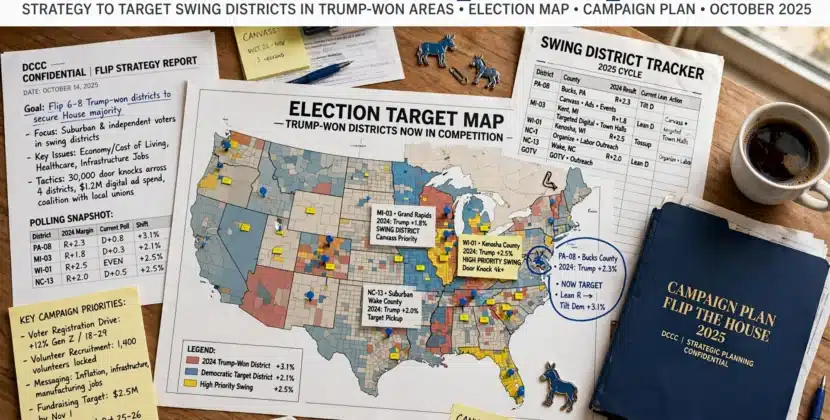
Jeffries’ argument rests on history and map arithmetic. The last time a president’s party held the White House in a midterm, the opposition flipped the House, and Democrats need only a handful of seats to take control. In his telling, 2026 mirrors 2018, when Democrats captured the chamber by running up margins in suburban districts that had voted Republican for years. Party officials have expanded their target list accordingly, moving resources into seats once considered safe.
Republicans answer that the districts Democrats are chasing were drawn to favor the GOP, and that Trump’s coalition still turns out for him in places where his name is on the ballot. Fundraising is the other counterargument: Democrats trail in the national committee race and in several marquee contests. Jeffries conceded the gap and argued that candidate quality, local issues and small-dollar enthusiasm can offset it, pointing to recent special elections where his party outperformed expectations.
What the AP-NORC Poll Found
The AP-NORC survey captured an electorate in a sour mood. Voters reported frustration with the direction of the economy even as they credited Democrats on specific pocketbook issues, and approval of Trump and congressional Republicans sat below the levels usually needed to defend a majority. Health care costs and everyday prices ranked among the top concerns, exactly the terrain Democrats have campaigned on since summer.
Yet the poll cut against both sides. Pluralities expressed dissatisfaction with Democrats as well, and independent voters, the swing constituency in most swing districts, remained uncommitted. Analysts noted that dissatisfaction with the party in power rarely converts automatically into votes for the other side; it has to be paired with a message that lands. That dynamic explains why Democrats are talking about Medicare, prescription prices and insurance premiums rather than national narratives that poll well inside the party but poorly outside it.
The New District Maps
This cycle also arrives with a rewritten map. Nine states have new House districts for the midterms after a redistricting wave that Trump himself spurred when he urged Republicans to redraw maps, while Democrats responded with moves of their own in states they control. The resulting lines are settled after roughly 440 days of court fights and legislator votes, giving both parties clearer targets and eliminating the limbo that complicated earlier planning.
Redistricting is not destiny. Toss-up districts created by overlapping party interests can still break either way, and several of the new lines pair incumbents against each other in primaries that drain campaign treasuries before the general election begins. Political scientists also caution that maps are only as stable as the courts allow, and a handful of challenges remain pending as early voting approaches.
Where the Races Are Being Fought
The battleground stretches from the Philadelphia suburbs to the deserts of Arizona and the Central Valley of California. Democrats are defending seats of their own while targeting Republican districts where the margin of victory was thin and the incumbent’s profile is low. Republicans, meanwhile, are pushing into Democratic-leaning seats anchored by high prices and crime as local campaign issues, betting that national mood alone will not decide every race.
Observers said turnout mechanics may matter more than persuasion in several of these places. Off-cycle elections reward organizations that can bank votes early, and both parties have invested in chase programs that identify supporters who skip midterms. The Brennan Center’s election integrity experts, appearing on C-SPAN’s Washington Journal on Monday, focused on the administration of the vote itself: rules changes, poll worker recruitment and the litigation that now accompanies almost every state’s process.
What Comes Next Before November
The closing month will be defined by three variables. First, whether voters’ anger at Washington lands on the party that controls it or scatters evenly. Second, whether Democrats can close the money gap in the specific districts that will decide the majority. Third, whether gas prices, inflation readings and any further escalation in the Iran war reset the agenda in ways neither party can control.
Both sides agree on one thing: turnout will decide it. The electorate that shows up in November will not be the same one that answers pollsters through the fall, and the party that best identifies its voters and drags them to the polls will write the result. For now, Democrats believe the terrain favors them, Republicans believe the map does, and the country will get its answer from a few dozen close districts spread across a handful of states.
Frequently Asked Questions
How many seats do Democrats need to take the House?
Democrats need only a small single-digit number of seats to flip the chamber, which is why the party is expanding its target list into districts Trump carried in 2024.
What did the AP-NORC poll say about the midterms?
The survey found voters deeply dissatisfied with Trump and congressional Republicans, while also doubting both parties, with prices and health care ranked among the top issues.
Which states have new congressional districts?
Nine states have new House maps for 2026 after a redistricting wave spurred by Trump’s call to redraw lines, settled after about 440 days of litigation and legislative votes.
When do the 2026 midterm elections take place?
Election Day is in November, with early and mail voting opening in many states through October, and the results will determine control of the House and Senate.