





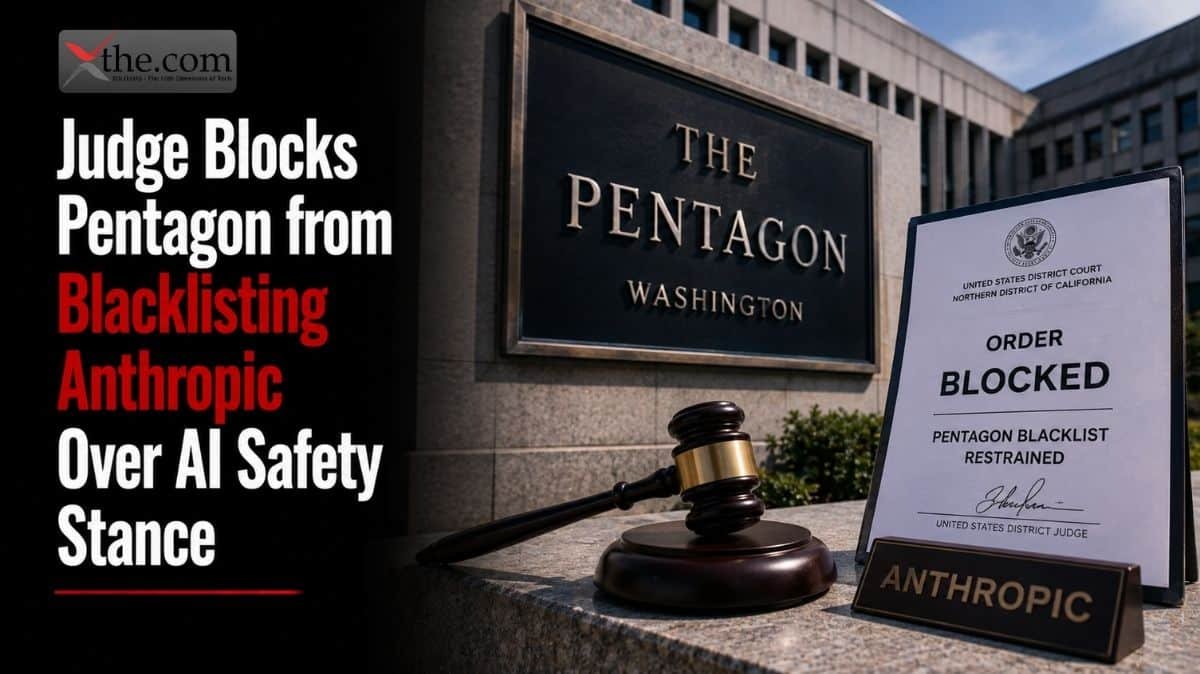
A federal judge has issued a temporary restraining order blocking the Pentagon from blacklisting Anthropic, the artificial intelligence company behind Claude, in a landmark case that pits government procurement power against corporate AI safety policies.
The ruling, handed down Tuesday by Judge Patricia Chen of the U.S. District Court for the District of Columbia, prevents the Department of Defense from adding Anthropic to its System for Award Management (SAM) exclusion list while litigation proceeds. The case has become a flashpoint in the ongoing debate over how far the government can go in punishing AI companies whose safety commitments conflict with military objectives.
What Happened?
The dispute began in July 2026 when the Pentagon announced plans to blacklist Anthropic from all federal contracts. The move came after Anthropic publicly refused to modify its AI safety guardrails for military applications, specifically declining to remove restrictions on its Claude models that prevent the generation of weapons-related content and autonomous targeting assistance.
Defense Secretary Mark Esper characterized Anthropic’s position as undermining national security. In a statement released August 1, the DoD said the company had demonstrated an “unwillingness to support the defense mission” and that its “ideological constraints on AI development posed a risk to operational readiness.”
Anthropic responded by filing an emergency lawsuit, arguing that the blacklist attempt constituted illegal retaliation for the exercise of First Amendment commercial speech rights and violated the Administrative Procedure Act by bypassing required debarment proceedings.
The Judge’s Ruling
Judge Chen agreed with Anthropic on multiple fronts. In her 47-page opinion, she found that the Pentagon had failed to follow the mandatory procedures required under the Federal Acquisition Regulation (FAR) for excluding a contractor. Specifically, the DoD skipped the required show-cause notice, the independent review board hearing, and the 30-day response period that companies are entitled to before debarment.
More significantly, Chen ruled that Anthropic likely had a viable First Amendment claim. She wrote that “the government cannot weaponize procurement regulations to punish companies for expressing policy preferences about the ethical development of artificial intelligence.” The judge noted that Anthropic’s public statements about AI safety constituted protected commercial speech under the Supreme Court’s Central Hudson test.
The ruling also cited the Administrative Procedure Act, finding that the Pentagon’s action was “arbitrary and capricious” because it lacked a rational connection between Anthropic’s safety policies and any actual deficiency in contract performance.
Why This Case Matters
This case has implications far beyond Anthropic. It establishes an early legal precedent for how the government can interact with AI companies that set ethical boundaries on their technology. Legal experts say the ruling could affect how other AI firms like OpenAI, Google DeepMind, and Meta approach government contracts.
Professor Sarah Mitchell of Georgetown Law Center, who specializes in government technology procurement, told TechCrunch that the decision “draws a clear line between legitimate government oversight and punitive action against companies that exercise moral judgment in AI development.”
The case also highlights a growing tension in the AI industry. As AI capabilities advance, governments worldwide are demanding more access to AI systems for defense and intelligence purposes. Companies face a choice between lucrative government contracts and the safety commitments they’ve made to customers, investors, and the public.
Impact on the AI Industry
For AI companies, the ruling provides a degree of legal protection. It suggests that the government cannot simply blacklist companies for refusing to modify safety features, at least not without following proper procurement procedures. This could embolden other AI firms to maintain strict safety standards even when pressured by government clients.
However, some defense technology experts warn that the ruling could slow the adoption of advanced AI in military applications. Dr. James Kowalski, a former DoD technology advisor, argued that “AI companies holding moral veto power over how the military uses technology creates a dangerous precedent.” He suggested that Congress may need to update procurement laws to address the unique challenges posed by AI.
What Happens Next
The temporary restraining order will remain in effect for 14 days, during which both parties are expected to argue for a preliminary injunction. If the judge grants the preliminary injunction, the case could take months or even years to resolve through full litigation.
Meanwhile, the Pentagon has announced it will accelerate its own internal AI development program, Project Guardian, which aims to build military-specific AI systems without relying on commercial providers. The program, initially budgeted at .8 billion, has reportedly received an additional 00 million in emergency funding.
Anthropic has stated it remains willing to negotiate with the DoD on applications that fall within its safety guidelines, such as logistics optimization, threat analysis, and intelligence processing. The company said it would only refuse applications involving lethal autonomous weapons systems or mass surveillance targeting civilians.
The Bigger Picture
This case reflects a broader global debate about AI governance. The European Union’s AI Act, which took full effect in August 2026, similarly prohibits AI companies from providing systems for certain military applications without strict oversight. China has taken the opposite approach, requiring AI companies to support state security objectives without exception.
For American AI companies, the Anthropic case sets a critical precedent. It affirms that commercial AI developers have the right to establish ethical boundaries, even when those boundaries conflict with government demands. As AI becomes increasingly central to both economic competitiveness and national security, these legal boundaries will only become more important.
The case is expected to be appealed regardless of the preliminary injunction outcome, potentially reaching the D.C. Circuit Court of Appeals and eventually the Supreme Court. Legal scholars anticipate it will become a foundational case in AI law for decades to come. The implications extend beyond the immediate parties. Defense contractors and AI startups working on government projects are closely monitoring the case, as its outcome could affect their own relationships with federal agencies. Companies that have invested heavily in government-specific AI solutions may need to reassess their strategies if the ruling establishes strong protections for AI safety commitments. Legal experts at Stanford Law School have called this the most important case at the intersection of technology and government procurement since the antitrust cases against Microsoft in the 1990s. The final resolution of this case will likely shape AI policy for a generation.
Sources: