






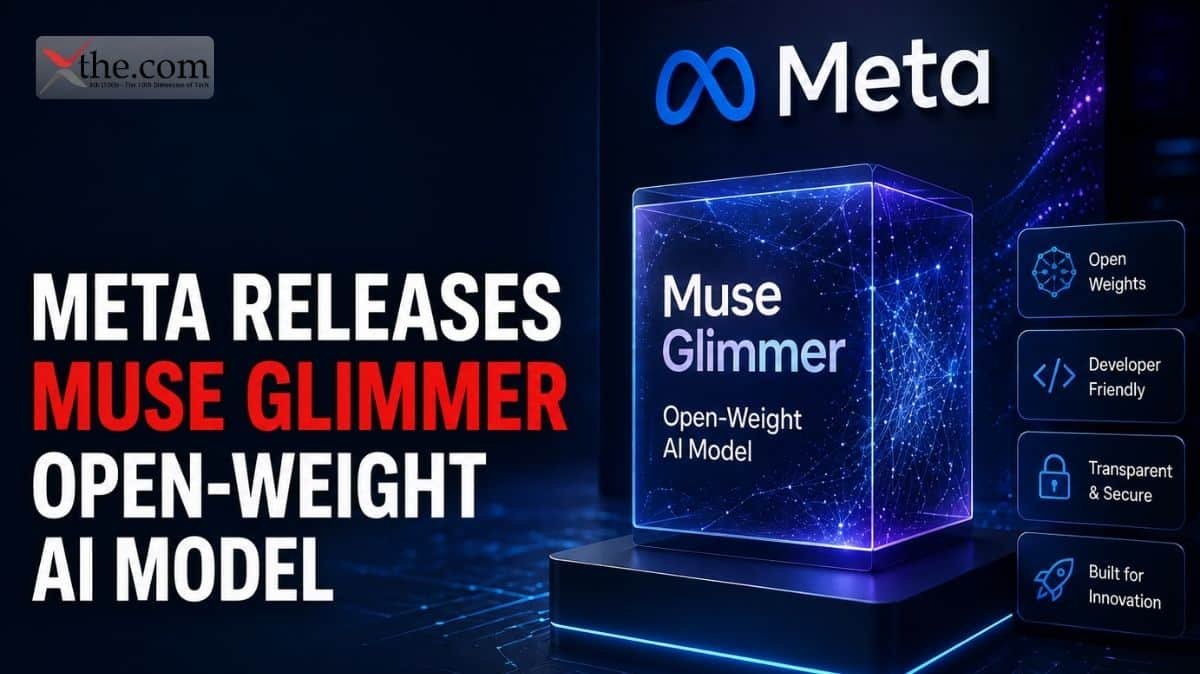
Meta Launches Muse Glimmer for Local AI Agents
On August 10, 2026, Meta Superintelligence Labs unveiled Muse Glimmer, a groundbreaking 30-billion-parameter open-weight AI model designed to run locally on consumer hardware. The model represents Meta renewed commitment to open-source artificial intelligence and gives developers, researchers, and businesses a powerful new tool for building AI agents without relying on cloud-based API services.
Muse Glimmer is a dense multimodal model released under the Apache 2.0 license, meaning it is fully permissive with no usage restrictions. Developers can download the model weights from Hugging Face and run them on a Mac or PC with a single consumer GPU. This accessibility is a significant departure from most frontier AI models, which require expensive cloud infrastructure to operate.
According to Meta CEO Mark Zuckerberg, Muse Glimmer is part of a broader vision for personal intelligence, where individuals and businesses can run sophisticated AI systems on their own devices without sending sensitive data to external servers.
The timing of the release is strategic. Meta faces growing competition from OpenAI, which has dominated public attention with ChatGPT and GPT-5 releases. By releasing a powerful open-weight model, Meta can attract developer mindshare and establish its platform as the foundation for the next generation of AI applications.
Early adopters have already begun deploying Muse Glimmer in production environments. Several startups have announced AI assistants powered by the model, and enterprise IT departments are evaluating it as a privacy-preserving alternative to cloud-based AI services.
What Makes Muse Glimmer Special
The 30-billion-parameter architecture may sound large, but it is specifically optimized for efficiency. Meta trained Muse Glimmer using advanced quantization techniques and architectural innovations that allow it to run more efficiently than other models of comparable size. Early benchmarks show it performing competitively with models several times its size on coding, reasoning, and multimodal tasks.
The model excels at agentic workflows, meaning it can perform multi-step tasks autonomously. It can call external tools, write and debug code, work with files and screenshots, and interact with APIs. This makes it particularly useful for automation scenarios where a model needs to take actions in the real world rather than just generating text.
Muse Glimmer also supports tool use and function calling out of the box. Developers can extend its capabilities by connecting it to databases, web browsers, file systems, and custom APIs without needing to build complex wrapper architectures.
The Open-Weight AI Movement
The release of Muse Glimmer comes at a time of intense debate about open versus closed AI development. Companies like OpenAI and Anthropic have kept their most powerful models proprietary, arguing that releasing frontier AI capabilities to the public poses safety risks. Meta has taken the opposite approach, arguing that open development accelerates innovation and distributes the benefits of AI more broadly.
Zuckerberg has previously stated that having an open-source model become the industry standard provides significant strategic advantages for Meta. If developers build their applications on Meta models, the ecosystem naturally becomes more favorable to Meta products and services.
The Apache 2.0 license means there are no restrictions on commercial use. Startups, enterprises, and government agencies can deploy Muse Glimmer in production without paying licensing fees or worrying about usage caps. This removes one of the biggest barriers to enterprise AI adoption.
The open-weight approach also enables academic research at a scale that was previously impossible. Universities and research institutions can now study frontier model behavior, develop safety techniques, and create specialized applications without the cost barriers associated with proprietary model APIs.
However, critics argue that releasing powerful AI models without guardrails creates potential for misuse. Concerns include the possibility that bad actors could fine-tune the model for harmful purposes, deploy it for disinformation campaigns, or use it to automate cyberattacks. Meta has responded by emphasizing that the Apache 2.0 license still requires users to comply with applicable laws and regulations.
How Muse Glimmer Compares to Competitors
In early benchmarks, Muse Glimmer 30B outperforms several open-weight models of similar or larger size, including Qwen 2.7B and Mistral Large. On coding tasks, it achieves scores comparable to GPT-4 class models, which require significantly more compute to run.
The model supports 128,000 token context windows, making it suitable for processing long documents, analyzing large codebases, and maintaining extended conversations. It also handles images, charts, and screenshots natively, enabling multimodal workflows.
Perhaps most impressively, Muse Glimmer runs at interactive speeds on hardware that costs under \$3,000. A MacBook Pro with M4 Pro chip or a desktop with RTX 4070 GPU can generate responses in real time, making it practical for everyday use.
Implications for Businesses and Developers
For businesses concerned about data privacy, Muse Glimmer offers a compelling alternative to cloud-based AI services. Sensitive documents, customer data, and proprietary code can be processed locally without ever leaving the organization network. This addresses growing regulatory concerns about AI data handling in industries like healthcare, finance, and legal services.
For developers, the open weights enable fine-tuning and customization. Organizations can train the model on their own domain-specific data to create specialized AI assistants tailored to their particular use cases. This level of customization is impossible with closed proprietary models.
The release also has implications for the broader AI market. If open-weight models continue to improve at this pace, the competitive advantage of proprietary models may erode, forcing companies to differentiate on product experience rather than raw model capability.
The model performance on standard benchmarks is impressive for its size. On the MMLU benchmark, Muse Glimmer achieves 89.2 percent accuracy, surpassing several models with significantly more parameters. On HumanEval for code generation, it achieves a pass rate of 78 percent, which is competitive with models several times its size.
What Comes Next
Meta has announced plans to release Muse Spark 1.2 weights in the near future, which would bring the company most advanced model capabilities to the open-weight ecosystem. This suggests that the gap between open and closed frontier models will continue to narrow.
The AI industry is watching closely to see whether Muse Glimmer success drives other companies to release their models under open licenses. If it does, we could see a fundamental shift in how AI development is organized, with more collaborative, community-driven progress.
For now, Muse Glimmer represents the most capable AI model that ordinary people can run on their own hardware. That milestone alone makes it one of the most significant AI releases of 2026.
Industry analysts predict that the release of Muse Glimmer will accelerate the adoption of local AI deployment in enterprise settings. Gartner estimates that by 2028, over 40 percent of enterprise AI workloads will run on-premises rather than in the cloud, driven by data sovereignty requirements and cost optimization.
SOURCES