





Los Gatos, California
Two of the world’s most closely watched tech companies will report earnings on the same afternoon this week, and their stories are closely linked. Netflix’s Q2 earnings for July 2026 land Thursday, July 16, just hours before Taiwan Semiconductor Manufacturing Company shares its own results. This schedule makes July 16 the most AI-focused earnings day of the year. TSMC makes the chips that power AI models, while Netflix shows what happens when those models are used in a media business earning tens of billions of dollars in annual revenue. Investors watching NFLX earnings Thursday are no longer simply asking how many people signed up last quarter. They want to know how artificial intelligence is changing Netflix’s production costs, advertising strategies, and subscriber retention.
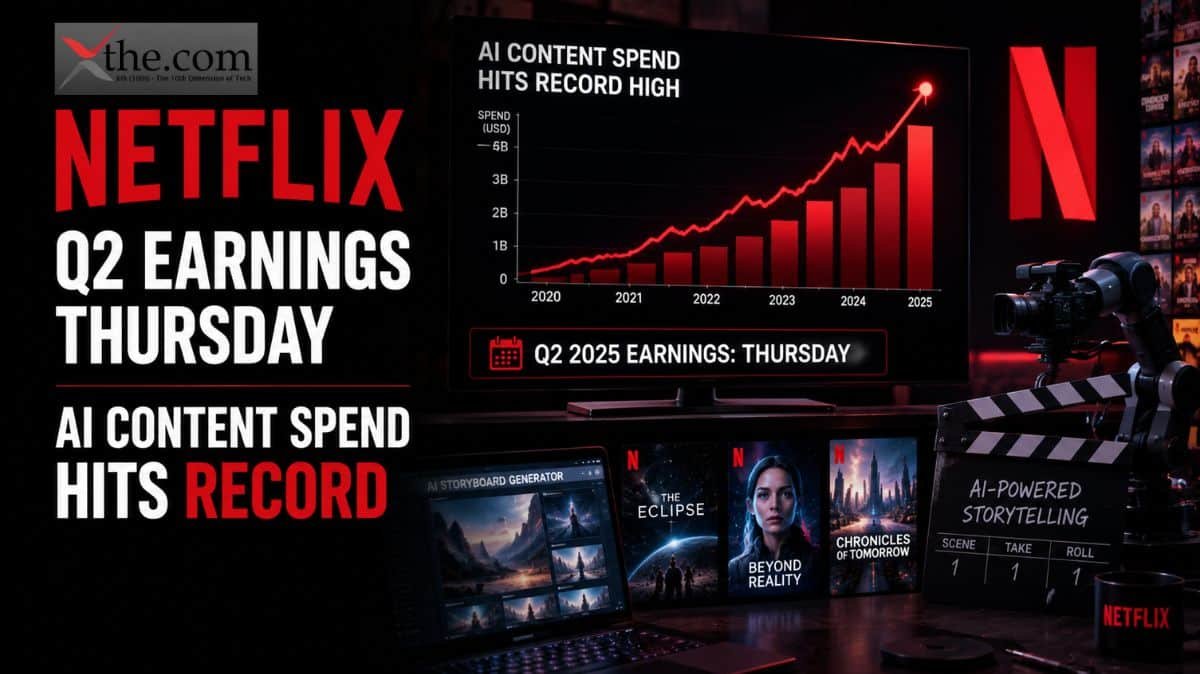
Netflix will announce its results after the market closes at about 1:01 p.m. Pacific time, followed by a live video interview with co-CEOs Ted Sarandos and Greg Peters, and CFO Spence Neumann. Wall Street has set up a demanding bar. Analysts project revenue near $12.57 billion for the quarter, roughly 13.5% higher than a year earlier, alongside earnings per share of approximately $0.79, up from $0.66 in the same period last year. Those numbers alone would make for a routine earnings preview. What makes this print different is the scale of Netflix’s AI content spending for 2026, shown underneath the topline figures.
The AI Production Story Behind the Numbers
Over the past two quarters, Netflix has moved artificial intelligence from a side project to a key part of its production process. The company’s reported $600 million partnership with InterPositive Technologies, which specializes in AI-assisted post-production, is one of Netflix’s biggest deals, second only to its $700 million purchase of the Roald Dahl Story Company. InterPositive’s tools do not create new footage. Instead, they help editors fix continuity mistakes, remove unwanted objects, and smooth out scenes that would otherwise need reshoots. This difference is important for investors who want to see real cost savings, not just hype around generative AI.
Netflix has also released VOID, its internal tool for physics-aware object removal in video, as an open source under an Apache 2.0 license. The company creates over 1,000 hours of original content annually, and even small per-hour reductions in visual-effects labor compound quickly at that volume. Netflix AI production content tools now touch scripting analysis, shot planning, visual-effects simulation, and the recommendation engine that forms what over 300 million households see when they use the app. Management expects content amortization to grow about 10% year over year in 2026, with most of the increase occurring in the first half of the year, unlike in 2025, when growth was focused in the fall.
Subscriber Growth Without a Headline Number
Here is where analysts face a genuine complication. Netflix stopped disclosing quarterly subscriber counts after the first quarter of 2026, a decision that shifts the market’s attention toward revenue per member and engagement hours instead of a single membership figure. Even without a hard number, Netflix Q2 2026 subscriber growth remains the quarter’s most-watched storyline, because it determines whether the password-sharing crackdown that boosted 2024 and 2025 results has fully played out. Paid memberships ended the first quarter above 325 million, and Netflix’s own estimates put penetration at under 45% of its addressable global household base, leaving room to grow even in mature markets like the United States and Canada.
This quarter, retention data is more important than new sign-ups. Investors want to see whether households that joined during the password crackdown are keeping their subscriptions at full price or switching to the cheaper ad-supported plan as budgets tighten. This issue ties directly into the second financial trend analysts are watching on Thursday.
Advertising Becomes the Real Growth Engine
Netflix ad-supported tier revenue has moved from a small experiment to a major goal with clear targets. Netflix expects advertising revenue to reach about $3 billion for all of 2026, which is double last year’s total. Management credits this expansion to more programmatic ad sales and a larger advertiser base. The company also wants the average revenue per member on the ad-supported tier to eventually match the ad-free plan, which will require selling enough ads to cover the growing number of subscribers on the lower-priced tier.
All of these changes are happening in a wider context. Netflix has kept its annual revenue forecast between $50.7 billion and $51.7 billion and has raised its free cash flow guidance for 2026 to about $12.5 billion, up from an earlier estimate of around $11 billion. The company is also sticking to its 31.5% operating margin target for the year, even as content amortization peaks this quarter and then slows later in 2026.
The Iran Wildcard and the Streaming-Versus-Cinema Debate
Geopolitical uncertainty often leads people to spend more time at home, benefiting streaming platforms like Netflix. When major world events change viewing habits, Netflix usually sees a boost as people choose the living room over the theater or office. Recent tensions around Iran have followed this trend, and some analysts have reported an increase in at-home viewing linked to global anxiety, even if it does not show up directly in the earnings report. This situation emphasizes a bigger debate in the entertainment industry. As AI helps create and deliver content more quickly and personally, streaming services gain an edge over movie theaters, which rely on large audiences showing up at the same time. Netflix’s algorithm can connect niche content, like documentaries or foreign-language series, with viewers that theaters cannot reach profitably.
What Thursday’s Print Will Actually Settle
Anyone building an NFLX Thursday July 16 earnings preview heading into the report should watch three figures closely: the advertising revenue run rate against that $3 billion annual target, the operating margin trajectory as content amortization peaks, and any forward commentary on how AI production tools are affecting the cost of the second-half content slate. Investors searching for a single Netflix Q2 earnings Thursday, July 16, 2026, AI content subscriber growth narrative will likely find one — but it may be a somewhat nuanced story than either the bulls or the bears currently expect, with cost discipline on the production side offsetting a fully mature password-sharing tailwind.
Thursday’s release will not settle the debate over how much of Netflix’s future growth comes from artificial intelligence versus old-fashioned hit-making. What it will do is give investors their clearest read yet on whether the company can keep expanding margins while spending record sums on both content and the AI tools changing how that content gets made. An NFLX Q2 2026 ad-supported tier revenue AI production tools investor preview built purely on Wall Street’s consensus numbers misses the more interesting question underneath them: whether Netflix’s AI bet becomes the template every other studio in Hollywood eventually copies, or a costly experiment the company quietly scales back the moment content costs stop falling. Thursday afternoon will start to answer that question, even if the full picture takes several more quarters to come into focus.
Source: Netflix Q2 Preview: Why Its $3 Billion Ad Bet Needs More Inventory