




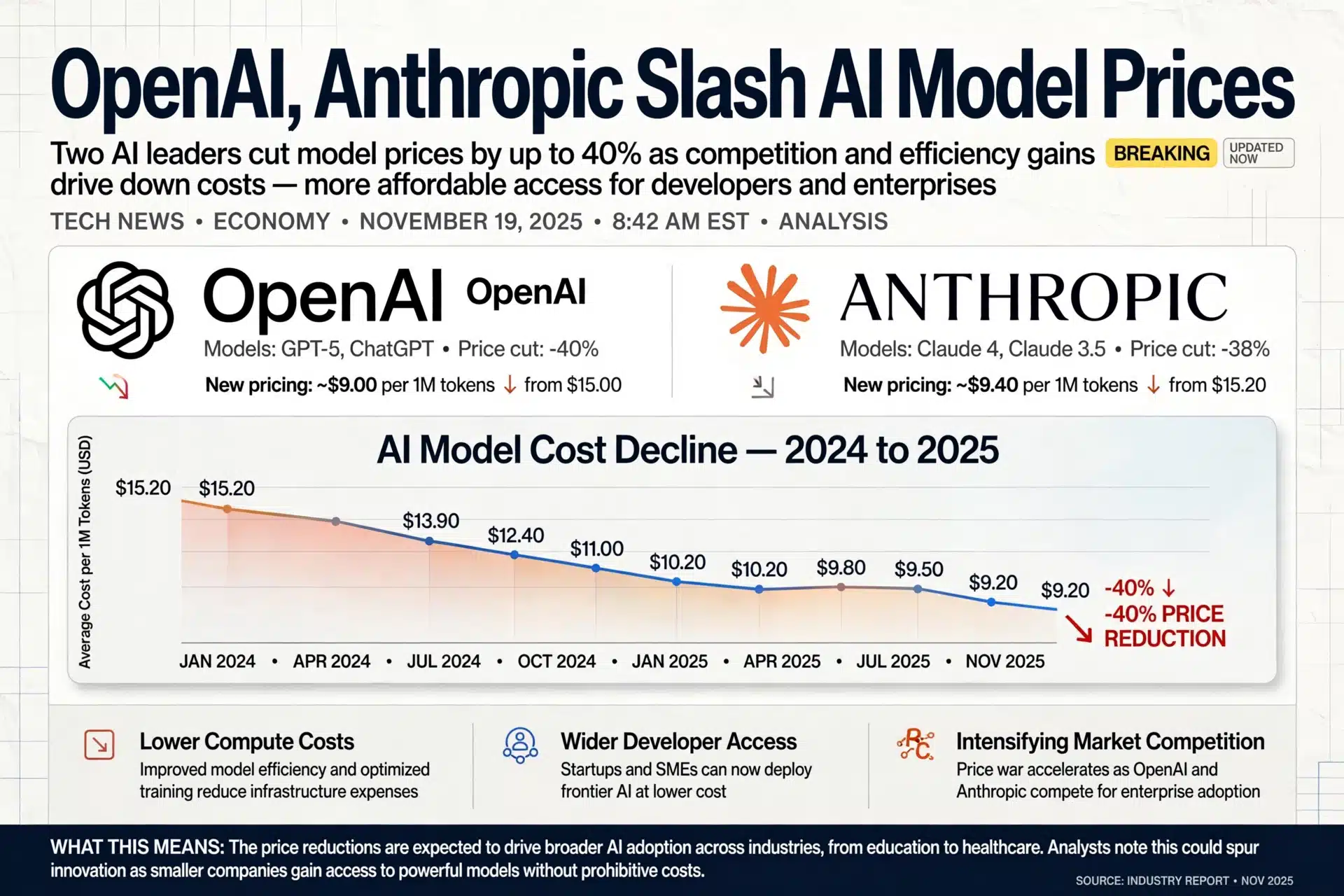
OpenAI and Anthropic Slash AI Model Prices Within 90 Minutes of Each Other as AI Price War Explodes
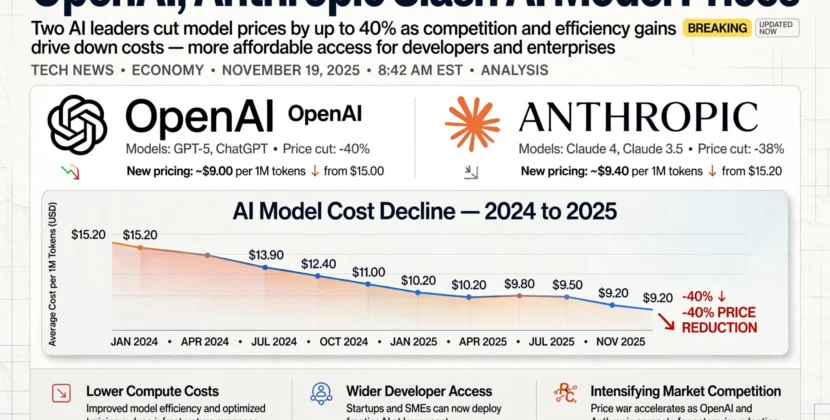
The artificial intelligence price war went into overdrive this week when OpenAI and Anthropic launched competing models within 90 minutes of each other on Tuesday, then knocked down API prices so aggressively that industry analysts say model access is fast becoming a commodity. OpenAI released GPT-6 Sol and GPT-6 Luna, two cost-cut enterprise models, minutes after Anthropic unveiled Claude Opus 5.5, and both companies framed the cuts as permanent rather than promotional.
The timing was not accidental. With Chinese labs like DeepSeek and Zhipu undercutting Western rivals and enterprise buyers demanding cheaper inference, the AI price war between OpenAI and Anthropic has turned list prices into a battleground. For American developers, startups and businesses wiring AI into products, the practical result is dramatic: the same frontier-class work now costs a fraction of what it did a year ago. Here is what changed, why it matters and whether the discounts will last.
What OpenAI Announced: GPT-6 Sol and GPT-6 Luna
GPT-6 Sol is positioned as a workhorse for complex developer tasks such as code reviews, debugging and data analysis, priced at $2.00 per million input tokens and $10.00 per million output tokens. That is a 50 percent price cut compared with GPT-5.6 Sol. For lighter, high-volume jobs like document summarization and data extraction, GPT-6 Luna costs just $0.10 per million input tokens and $0.50 per million output tokens, a reduction of up to 58 percent across previous tiers.
Both models build on the flagship GPT-6 Astra, which debuted earlier this month. OpenAI said the new models match or beat their predecessors on benchmarks at half the cost, and that GPT-6 Sol halves error rates on internal factuality evaluations. An OpenAI spokesperson confirmed the lower rates are permanent, crediting breakthroughs in inference processing and data caching for the savings.
What Anthropic Countered With: Claude Opus 5.5
Anthropic’s Claude Opus 5.5 arrived priced at $4.00 per million input tokens and $20.00 per million output tokens. On paper that is about 20 percent cheaper per token than Opus 5, but Anthropic says the model is roughly 40 percent less expensive to run overall because it needs fewer tokens to finish complex workflows. The company claims Opus 5.5 beats OpenAI’s previous-generation GPT-5.6 Sol on software development benchmarks at roughly one-third the operational cost.
The model is available immediately on Amazon Web Services, Google Cloud and Microsoft Azure. Before launch, Anthropic said Opus 5.5 was evaluated by independent research groups Frontier Design and METR, with an 85 percent reduction in containment-bypass attempts during internal testing compared with prior builds. The release landed days after Anthropic CEO Dario Amodei publicly urged the industry to moderate the pace of frontier model deployments, a debate that has split the technology sector all year.
Why This Is a Real Price War, Not a Promotion
Analysts say the simultaneous releases confirm that model generation is turning into a commodity input. “Token prices fall as consumption climbs, and value moves to the work around the model: integration, governance, and verifying what the model produces,” said Mitch Ashley of The Futurum Group, who argued that CIOs should now budget for the orchestration and control layer rather than treating any single model as the strategic bet.
The pressure is coming from every direction. OpenAI, Anthropic and xAI all cut API prices inside the same five-day window, while low-cost Chinese rivals continue to reset expectations. Fortune reported that the price war is driving down the price of AI and therefore driving down the industry’s ability to profit from it, raising the question of how long frontier labs can sustain losses to win enterprise share.
What the AI Price War Means for Developers and Businesses
For builders, the cuts change product math. Features that were too expensive to serve, like real-time document analysis, always-on coding assistants, voice agents and deep search over large document sets, now fit inside ordinary software budgets. Startups can prototype against frontier models without burning through a seed round, and larger companies can run more automated workflows per dollar.
The flip side is vendor risk. Teams that architect around the cheapest model today may face repricing, deprecation or mergers tomorrow, so experts recommend multi-model routing, caching strategies and clear cost dashboards per feature. Businesses negotiating annual contracts should also ask whether today’s permanent pricing is contractually guaranteed, because a permanent cut can still be reversed on notice.
Will AI Prices Keep Falling?
History says yes. Inference prices for equivalent capability have fallen every year since large language models arrived, driven by better hardware, distillation, caching and brutal competition. OpenAI’s own GPT-5.6 Sol was cut by 20 percent in August, and each new generation has shipped cheaper than the last.
But there is a floor. Training runs and data centers still cost billions, and investors want a path to profit before the next funding cycle. Expect continued cuts on mid-tier and high-volume models while frontier flagship pricing stays firmer, and expect Chinese competition and open-source releases to keep Western labs honest. For now, the winners are the developers and businesses shipping AI features while the labs fight over price.
Frequently Asked Questions
What did OpenAI and Anthropic announce this week?
OpenAI released GPT-6 Sol at $2 per million input tokens and GPT-6 Luna at $0.10, while Anthropic launched Claude Opus 5.5 at $4 per million input tokens. The two launches came within 90 minutes of each other on Tuesday.
Are the new AI prices permanent?
OpenAI confirmed its new rates are permanent rather than promotional, and Anthropic positioned Opus 5.5 as its new standard pricing. Analysts still recommend guarding against future repricing with routing and caching.
Which model is cheapest for heavy coding work?
GPT-6 Sol undercuts the prior generation by 50 percent at $2 per million input tokens, while Claude Opus 5.5 claims the lowest cost per completed task because it needs fewer tokens to finish complex workflows.
Does the price war affect ChatGPT or Claude subscriptions?
The announced cuts target API and enterprise pricing, which typically filters down to higher usage limits and cheaper consumer tiers over time, though subscription sticker prices have not changed yet.