





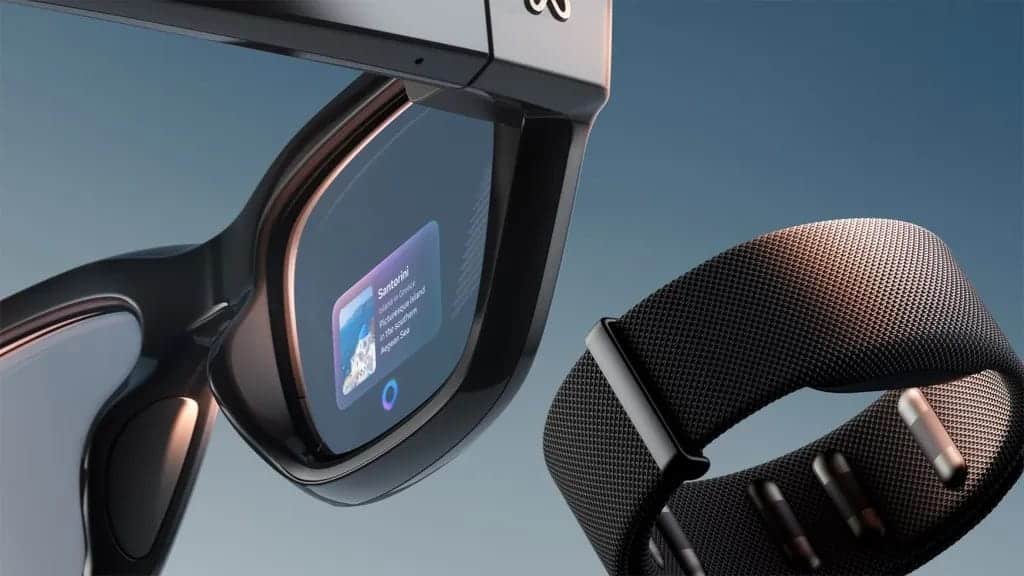
Google has submitted a patent application describing a technology that enables users to manage their wearable artificial intelligence devices silently, without voice commands or physical interactions. The technology investigates new ways to interact with devices through hidden movements, brain activity, and muscle contraction, enabling users to operate devices without being noticed.
This patent signals a broader movement toward more intuitive human-computer interfaces. As a result, interaction may rely less on traditional methods like touchscreens or spoken language. Such silent control could become increasingly natural as wearable AI devices integrate further into daily life.
Moving Beyond Voice and Touch Interfaces
The majority of existing AI-powered technologies rely on users to control devices via voice commands or touch input. The methods achieve their purpose, but they encounter challenges in situations that require people to remain silent and avoid using their hands.
The system described in Google’s patent enables users to interact with it silently, overcoming existing system restrictions. The system proves especially beneficial for use in public spaces, work environments, and all situations that require secure information handling.
The technology eliminates the need for visible input devices, allowing users to engage with systems in a more discreet and effective manner.
How Silent Control Could Work
The patent describes mechanisms that detect micro-level user inputs, such as muscle activity, small gestures, and other physiological signals. The AI systems use these inputs to execute commands by interpreting the data.
The system allows users to operate the wearable device using finger movements and wrist gestures to activate predetermined functions. In more advanced implementations, the system might interpret neural signals or bioelectrical patterns to understand user intent.
Google is investigating methods to convert these signals into dependable and precise control inputs.
Enhancing Wearable AI Usability
Wearable device design focuses on providing seamless access to its functions, but current input methods create barriers that reduce effectiveness. The introduction of a silent control method for wearable devices will allow users to operate them while continuing to perform tasks, thereby improving their functionality.
Users could manage notifications and control applications while accessing information without using screens or voice commands. The system creates a natural interface that supports ambient computing through its design.
Google designs its approach to develop wearable AI devices that users can operate through natural movements during their everyday life activities.
Privacy and Discretion Advantages
The main advantage of silent communication methods is that they bring better protection of personal information. Voice commands produce audible output that others can hear, while touchscreen operations display visible elements to nearby users.
Using silent control methods, users can operate their devices without generating noise, helping them keep their private information secure. This situation applies especially to professionals who handle sensitive information and to people who use public spaces.
Google develops new ways for people to interact, which will keep their personal information secure.
Potential Applications Across Industries
Your system enables silent device control, which can benefit multiple applications beyond consumer wearable technology. Medical professionals in healthcare settings can operate medical systems hands-free, enabling them to maintain concentration during procedures.
Workers in industrial environments can use equipment and access information while remaining protected and working productively. Accessibility applications will help users with speech and mobility disabilities in the same way.
Google’s patent demonstrates how silent control technology can be used in multiple fields.
Challenges in Signal Interpretation
Interpreting user input when it’s subtle or otherwise unclear requires extensive knowledge of the technology and is still very difficult to achieve accuracy with. The system must distinguish between user command inputs and ordinary body movement so that actions are reliable only when driven by the user’s specific intent.
The task requires advanced machine learning systems that can comprehend diverse situations while separating background noise from the actual input data. The system must operate with complete reliability, as any failure will result in undesired behavior.
Google is likely working on model improvements that will lead to better accuracy results and increased user trust.
Integration with AI Ecosystems
Existing AI services are cloud-activated and available on any mobile device, fully integrating with silent control devices. By design, users can interact with all features of a silent control via multiple input methods.
Google’s ecosystem of AI services, wearables, and other technologies will provide the necessary framework for developing these specific functions.
Once the integration is complete, it will create an environment that offers users a consistent user interface across multiple devices.
Competitive Landscape in Human-Computer Interaction
For the tech industry, developing new ways to interact is its leading competitive area. Companies are investigating various possibilities, including gesture recognition, brain-computer interfaces, and sophisticated sensors.
The newly patented Google Silent Control creates a new direction for future development. This means that the main focus will be on ways to interact without using sound or sight.
The evolution of these technologies will create more natural, less intrusive ways for users to control their devices.
From Patent to Practical Implementation
The technology requires assessment because its patent status does not confirm its future use in commercial products. The patent provides information about current research work and upcoming technological advancements.
The development of silent control systems for commercial use needs solutions to technical problems, the establishment of dependable systems, and the design of accessible interfaces for users.
Google’s research into this concept shows its commitment to developing new methods for users to interact with technology.
Conclusion: A Step Toward Invisible Interfaces
Google’s patent for silent control of wearable AI devices establishes a path toward more natural, invisible user interfaces. Google is developing a future system that enables users to control technology through nonverbal body language, allowing them to interact with products without speaking or touching them.
The development of this innovation will completely change how people use wearable technology, introducing a more human-like way of interacting with devices that protects user privacy and improves efficiency across different settings.
Source: Google Patents