






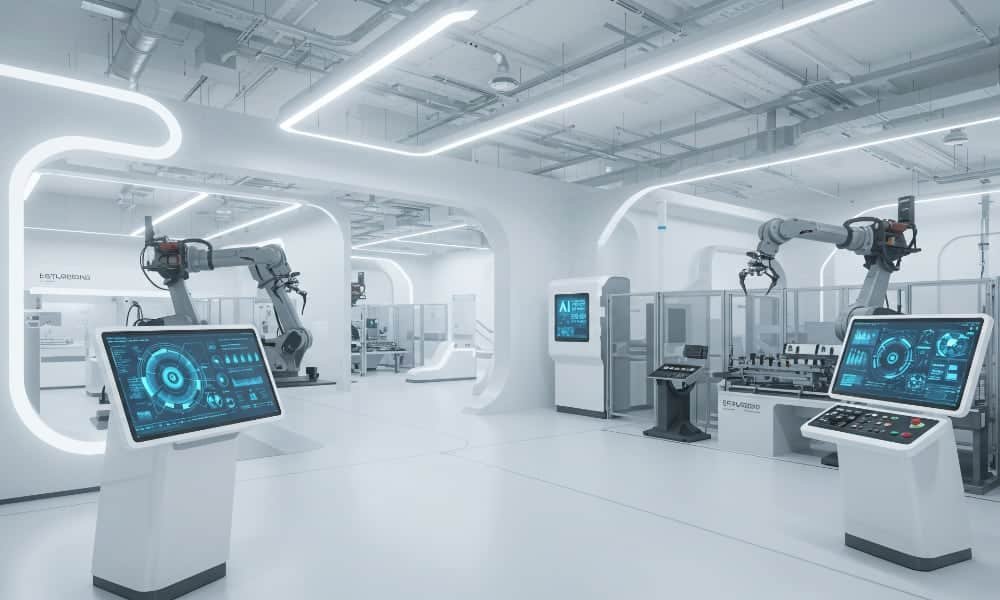
Cupertino Calif. A refurbished MRI machine in Texas failed its final inspection after 11 hours of manual testing. The defect was minor, just a measurement drift that couldn’t be seen by eye, but the delay cost the facility a full day of output. When this happens across hundreds of devices, the Apple Manufacturing Academy aims to solve this issue by embedding intelligence directly into the production process rather than relying on small tooling improvements.
A new patent linked to the Apple Manufacturing Academy points to a clear move into AI-driven supply chain enhancements. This shift has the potential to impact not just consumer electronics, but also healthcare, manufacturing, and refurbishment.
Reframing Production with Embedded Intelligence.
Traditional manufacturing keeps computation and execution separate. Machines do the work while outside systems examine the results. Even small delays can add to bigger inefficiencies over time.
The Apple Manufacturing Academy closes this gap by adding on-device learning to factory equipment. Systems can adjust in real time without needing cloud processing. This is especially important in high-precision industries where every millisecond counts.
For example, in a facility that refurbishes diagnostic equipment, embedded intelligence can spot problems during assembly rather than after the work is done. This reduces the need for rework and increases output.
This change redefines the AI supply chain. Factories move from linear workflows to adaptive systems in which each part contributes to ongoing improvement.
The Role Of Computer Vision In Precision Manufacturing
From inspection to prediction
Quality control has usually relied on human inspectors using basic imaging tools. With advanced computer vision, this is changing. Systems trained on thousands of defect patterns can now spot inconsistencies much more accurately.
This ability is even more important in medical imaging. AI-refurbished CT scanners and MRIs require almost perfect calibration, as even a small error can affect diagnostic precision.
When computer vision is built into the refurbishment process, facilities can shift from reacting to problems to predicting them. Machines can spot potential faults early, reducing downtime and boosting reliability.
Scaling Through Industrial Mac Mini
Hardware is key to efficiency. The industrial Mac Mini, powered by the M5 Ultra, is a small but powerful computer that can handle heavy workloads right at the factory.
Unlike regular industrial PCs, these systems work closely with Apple’s silicon, making it easier to run on-device learning models more efficiently. Factories can add AI features without needing major system changes.
For operators, the advantages are obvious. The systems take less space, use less energy, and work more efficiently.
Healthcare Manufacturing as a Tactical Entry Point
Using Apple silicon to power American medical imaging refurbishment
The intersection of AI, supply chain, and healthcare manufacturing yields a compelling use case. The long tail concept of using American silicon to power American medical imaging refurbishment is not theoretical. It addresses a real bottleneck in the US healthcare system.
Refurbishment centers usually have small profit margins and strict deadlines. Adding medical imaging AI to their processes can reduce testing time and improve accuracy.
Take a facility that handles fifty imaging devices each month. On level, if on-device learning cuts inspection time by just 20%, the overall effect on output and revenue is significant.
The Apple Manufacturing Academy helps make this possible by providing both the training and technology needed to set up these systems at scale.
Redefining Workforce Dynamics
People often worry that automation will take away jobs, but the reality is more complex. Adding AI supply chain technologies changes the types of work people do, rather than removing jobs altogether.
Technicians who used to do repetitive inspections now manage AI-powered systems. They review results, handle unusual cases, and ensure everything meets statutory standards.
This change means workers need new skills. The Apple Manufacturing Academy seems set up to fill this gap via training people in hardware integration and AI model management.
As a result, the factory floor becomes a place where human skills and machine intelligence work together.
Infrastructure Implications for US Manufacturing.
The impact of M5 Ultra
Processing power is key for on-device AI. The M5 Ultra provides the computing power to run complex models on-site, enabling instant decision-making.
This is especially important in manufacturing sites where network connections are not always reliable. With on-device learning, facilities can maintain performance regardless of work conditions.
Integrating Industrial Mac Mini at Scale
To use AI at many sites, companies need standardized software and hardware. The Industrial Mac Mini offers a modular solution, making it easy to set up similar systems in different locations.
Standardizing hardware makes maintenance easier, reduces training costs, and speeds of deployment.
For companies looking to modernize, this offers a practical way to deploy AI supply chain strategies without major disruptions.
Strategic Implications for Executives
The launch of the Apple Manufacturing Academy signals a broader shift in how companies handle manufacturing. AI is now part of the production process itself, not just used for analytics or forecasting.
Executives need to consider not only the cost of accepting these technologies, but also what they might lose by waiting. Facilities that don’t use computer vision and on-device learning could fall behind competitors who are more efficient and have fewer defects.
At the same time, investment decisions should include training, integration, and ongoing system management. This shift is equally about people and processes as it is about technology.
The Next Phase of Industrial Evolution.
Manufacturing in the United States is moving into a new era. AI supply chain enhancements, advanced chips like the M Series Ultra, and miniature systems like the Industrial Mac Mini are laying the groundwork for more flexible, resilient operations.
The Apple Manufacturing Academy is key to this change. It is not just a single project, but part of a larger plan to add intelligence throughout the production process.
Since industries like healthcare manufacturing use these models, the benefits will go beyond just efficiency. They will also improve quality, reliability, and even clinical outcomes.
Factories that used to rely on fixed processes will become dynamic systems that continue to improve as medical imaging, AI, and computer vision become standard tools. The gap between new ideas and real-world use will narrow.
The next big advantage won’t just be about size, but about being able to adapt in real time. The Apple Manufacturing Academy seems built to make this possible.
Source: UPDATE Apple Manufacturing Academy accelerates AI use in U.S. supply chains








