




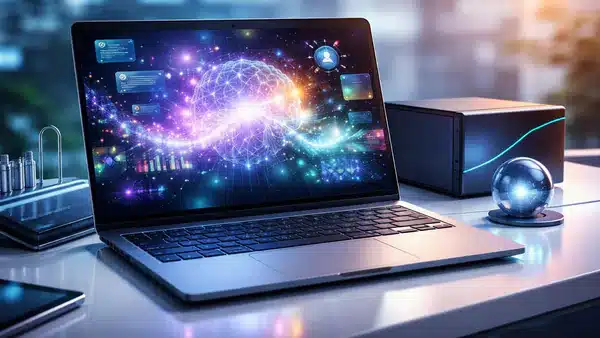
Mobile computing is evolving as Qualcomm AI chips set new standards for portable workstations. Older processors struggle to balance speed and battery life. Qualcomm’s new chips use a refined approach, assigning tasks to dedicated hardware. This allows laptops to run faster and last longer per charge. With better thermal efficiency and built-in neural processing, these chips transform laptops into true mobile productivity tools.
The Architecture Of Integrated Efficiency
These new systems use a system-on-chip (SOC) design that combines a CPU, GPU, and a specialized neural processing unit (NPU). Instead of having the main CPU handle everything, the NPU handles ongoing low-power tasks. This setup, called silicon partitioning, means the most power-hungry parts only turn on when needed. For example, during a video call, the NPU handles background blur and noise reduction. This makes the CPU cooler and helps the battery last longer.
Qualcomm AI chips use a variety of computing models to manage resources in real time. The hardware routes data to the optimal processing core for each task. Powerful cores handle demanding apps, while efficient cores handle browsing and editing. This control improves user experience and reduces fan noise. It also signals a move toward quieter, more user-friendly laptops.
Maximizing Battery Life Through Intelligent Power Gating
A key benefit of these new chips is advanced power gating at the transistor level. This lets the chip turn off power to unused parts in just microseconds. In regular laptops, even when the screen is dim, idle components still use some power, slowly draining the battery. Qualcomm AI chips stop this waste by putting non-essential circuits into a deep sleep state. Users can leave their laptops on standby for days and resume where they left off with minimal battery loss.
This efficiency allows laptops to last a full ten-hour workday on a charge. Older x86 processors slow down when unplugged to save power. In contrast, Qualcomm’s ARM-based chips maintain performance on battery or plugged in. This stability is key for professionals who need reliable performance for critical tasks.
Boasting Connectivity With Integrated 5G and Wi-Fi 7
Today’s work needs more than just fast processors. It also needs reliable, high-speed access to the cloud. These laptops have Snapdragon X-series modems built into the main chip. This saves space on the motherboard and uses less power for wireless connections. Users always stay connected with 5G support, enabling fast speeds even in busy cities. This also means traveling professionals don’t have to rely on public wireless networks.
Adding Wi-Fi 7 hardware makes these laptops ready for the next wave of networking. Wi-Fi 7 delivers lower latency and higher capacity by simultaneously using multiple frequency bands. This helps when moving big files or streaming high-quality video without interruptions. The laptops also have intelligent signal routing to keep connections stable as users move between access points. This smooth handoff is important for staying focused during research or group work.
Thermal Innovation And Fanless Potential
Qualcomm AI chips are very efficient, so they produce much less heat than older chips. This lets manufacturers create thinner, lighter laptops without fans. Without bulky heat pipes or fans, there’s no room inside for bigger batteries. Fanless designs also imply fewer moving parts that can break and no vents to gather dust. This makes the device more reliable over the long term.
For more powerful laptops that still need cooling, these chips use predictive thermal throttling. The system monitors internal sensors to detect heat buildup early and gently lowers speed as needed. This stops sudden slowdowns when the laptop gets too hot. As a result, users can work on long video edits or software builds without worrying about performance drops. Professionals can count on their laptops staying cool even during tough tasks.
Molding The Future Of Portable Workstations
Moving to dedicated mobile chips is more than a small upgrade it’s a big change for personal computers. We’re entering a liquid computing era where hardware adapts to what you are doing and where you are. Laptops are now as responsive as phones, but still as powerful as desktops. The focus is now on overall usefulness and battery life, not just top speed. This change makes computers better tools that better fit our needs, rather than forcing us to adapt to them.
As more professional software is designed for these ARM-based Qualcomm AI chips, the line between mobility and power will disappear. Soon, plugging in your laptop will be something you do only once in a while, not something you worry about all day. This new freedom will change how we set up home offices and company workspaces. One day, the idea of a laptop charger might look outdated. We’re heading into a time of uninterrupted logic, where output de-depends on our creativity. Now, our laptops can keep up with us, running gently and reliably for as long as we need.