





Austin, Texas
A warehouse robot might lift a 20-pound box all day, but still struggle with something a child does easily, like picking up a thin glass without dropping it. This gap has long challenged humanoid robots. The main issue is not strength, but reaction time. Even a split second between sensing contact and adjusting grip can lead to slips, broken items, and unstable movements.
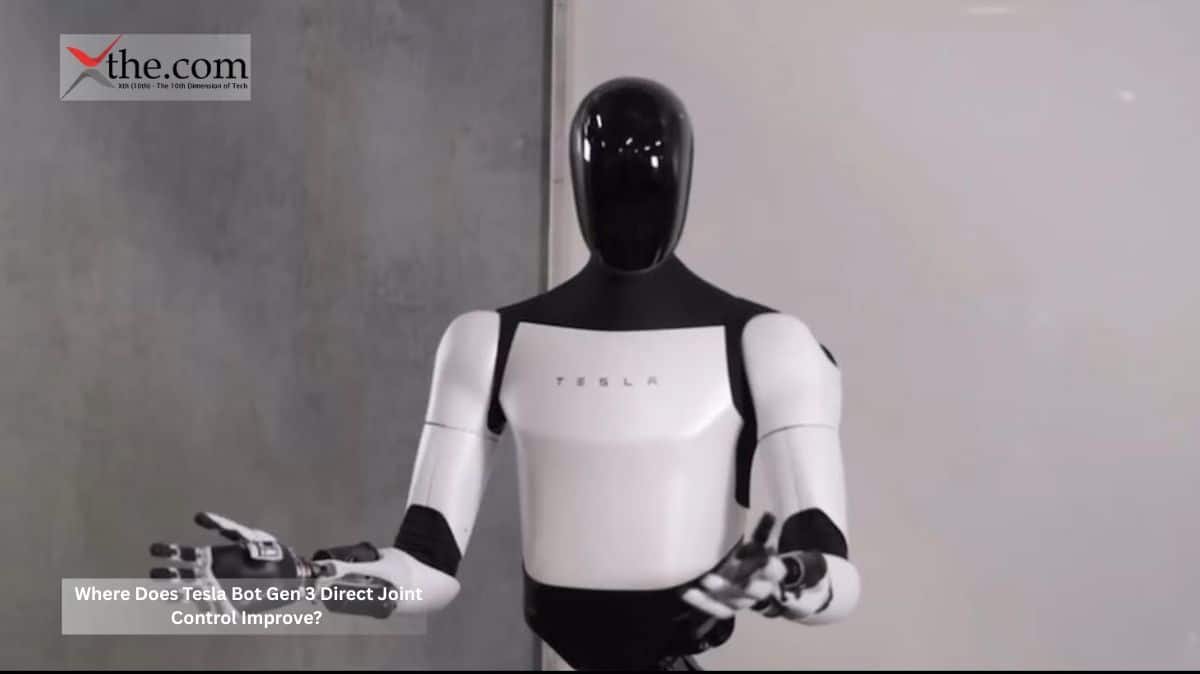
The new Tesla Bot Gen 3 is built to solve this problem. Instead of sending every movement decision to a central processor, Tesla has added more intelligence to the robot’s joints. This new joint control approach reduces delays where they matter most at the point of contact.
Why Tesla Bot Gen-3 Changes the Robotics Equation
Most humanoid robots use a layered control system. Sensors gather information, send it to a central computer, and then wait for movement instructions. This setup works in controlled environments, but delays occur when robots handle fragile or unpredictable objects.
Tesla Bot Gen 3 adds motor controllers closer to each link and actuator. Now, each joint can process feedback independently and make small adjustments instantly, rather than waiting for a command from the whole system.
This matters to warehouse operators, manufacturers, and automation engineers because it addresses one of the main barriers to widespread use of humanoid robots: reliably handling objects.
How Advanced Joint Control Works at the Limb Level
The key breakthrough is distributed processing.
When a robotic hand picks up a glass container, pressure sensors send out streams of tactile telemetry data. In earlier models, this information had to pass through several layers of processing before any corrections could be made.
With controllers placed near the actuator, processing happens right where the action is.
If the glass starts to slip, even just a little, the controller can quickly adjust the grip without involving the whole system. This local response significantly reduces decision time.
It’s like the difference between a driver reacting to the road in real time and a driver waiting for instructions from someone far away. Both can get the job done, but one reacts much faster.
The Role of Actuator Precision
Robots count on precise mechanical movements.
Better actuator precision lets each joint use just the right amount of force instead of guessing. These small constant corrections help keep the robot stable and save energy.
Picture a robot moving delicate electronic parts from one container to another in a warehouse. Too much force can break the products, while too little can cause drops. Higher actuator precision reduces the likelihood of these mistakes.
This feature is especially useful when robots work with people or handle expensive items.
Kinematic Pathing Becomes More Efficient
Motion planning is about more than just gripping things.
Robots are always figuring out where their bodies and arms should go and how to stay balanced. Good kinematic pathing helps them move more efficiently and avoid collisions.
With smarter joints, robots can make corrections while they move, not just after mistakes happen. If a robotic arm encounters unexpected resistance, each joint can adjust immediately to keep the movement on track.
This leads to smoother operation and fewer stops during repetitive tasks.
For industrial users, smoother kinematic pathing means more output and less downtime.
How Edge Inference Enables Real-Time Decisions
Agent France has changed many industries, such as self-driving cars and factory automation. Tesla seems to be using these ideas in humanoid robots, too.
With Agent France, data is analyzed near where it is collected rather than sent to a central processor. Joint controllers check local conditions and respond right away. Communication overhead across the robot’s body frees central processors to focus on broader objectives such as navigation, task sequencing, and environmental awareness.
By combining Agent France and local joint control, Tesla creates a layered intelligence system that works more like a biological body than older robot designs.
What About Tesla Optimus Gen 3 Mechanical Actuator Torque Specs?
Industry observers remain highly interested in the exact torque specs of Tesla Optimus Gen 3 mechanical actuator torque specs, as the output directly influences lifting capacity, dexterity, and energy efficiency. While detailed public specifications remain limited, the wider engineering direction suggests Tesla is concentrating on control quality alongside power generation.
In the past, robotics companies mostly competed on actuator strength. The emerging trend focuses on intelligent force application. Even modest torque figures can produce impressive results when paired with advanced actuator precision, high-resolution tactile telemetry, and distributed processing.
This alteration could matter more than just having high-performance numbers.
The Wider Impact On Warehouse Automation
Humanoid robots have shown impressive prototypes for years, but the real challenge is in making them work reliably within real-world situations.
The changes in Tesla Bot Gen-3 show that the industry is moving past demo robots towards machines that can handle real commercial work. Faster joint control, better tactile telemetry, improved actuator precision, smarter, smarter kinematic pathing, and local edge inference all help solve problems that once held back robots.
If this design approach continues to improve, future humanoid robots might not need a single central brain for every move. Instead, each part of the robot will have its own intelligence, allowing limbs to react, adapt, and work together in real time. This distributed method could be the breakthrough that takes humanoid robots from demos to real-world industrial work.
Source: Tesla Investor Relations