ROUND ROCK, TX —
Atomic Answer: Dell Technologies (DELL) has introduced the PowerEdge XE9812, a flagship liquid-cooled server designed specifically for the NVIDIA Vera Rubin NVL72 platform. By integrating rack-level power and thermal management, Dell enables enterprises to deploy massive real-time AI training clusters while maintaining operational stability in existing data center footprints.
The Dell PowerEdge XE9812 NVIDIA Vera Rubin 2026 platform is the only solution for businesses that need to train frontier models, offering two options: either build complete liquid-cooling facilities or select server systems that provide rack-level thermal control within their current data center spaces. The XE9812 platform enables businesses to choose between two options without having to discard their current infrastructure investments, as liquid-cooled AI training servers require the deployment of NVL72 systems to achieve competitive AI training capabilities.
The Thermal Problem That Defines Frontier AI Training
The server systems used in air-conditioned facilities cannot handle the heat produced by frontier model training when running NVL72-class workloads, which require specific rack configurations. The NVIDIA Vera Rubin NVL72 platform, which supports real-time AI training at large-scale operations, generates thermal output that exceeds the capacity of standard rack cooling systems before the cluster reaches its full operational capacity.
The cooling system for the Vera Rubin NVL72 rack power thermal management must operate at the rack level to support production-scale operations. The precision air conditioning units used in traditional data center cooling systems cannot provide adequate thermal removal at the locations where NVL72-density GPU clusters generate heat during training, as they manage room temperature across the entire raised floor.
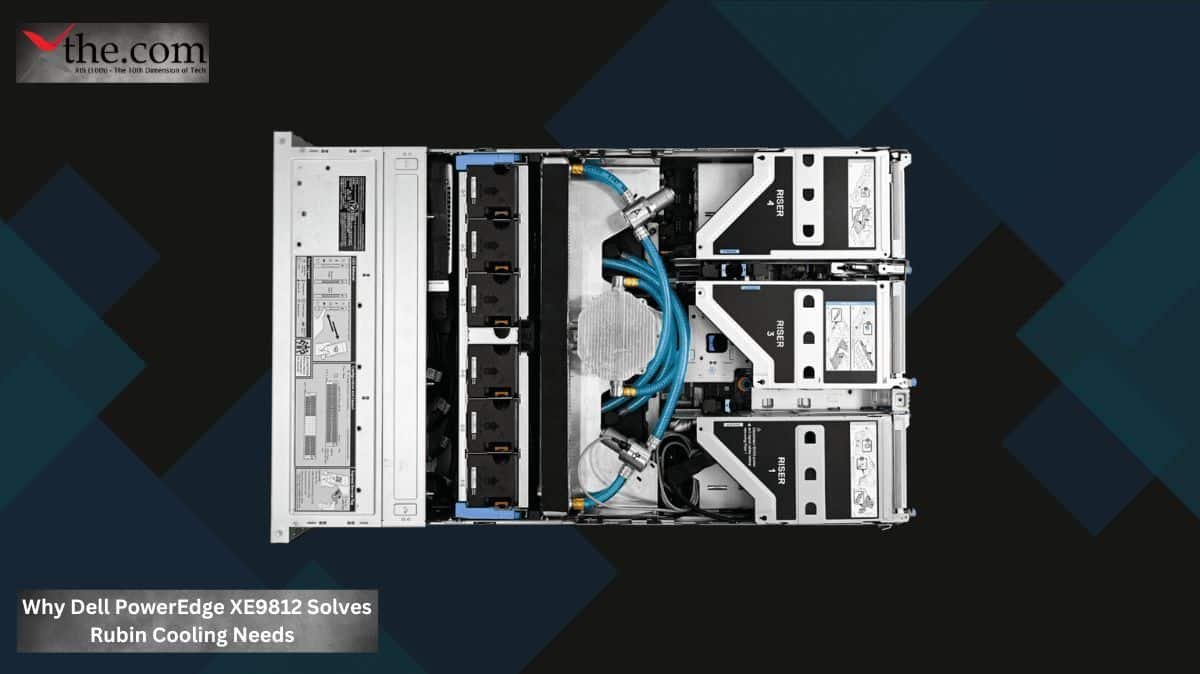
Dell PowerEdge XE9812 NVIDIA Vera Rubin 2026 addresses this by integrating liquid cooling directly into the server and rack architecture — moving thermal management from the room perimeter to the compute source, where heat is generated.
How Rack-Level Liquid Cooling Works in the XE9812
How does Dell PowerEdge XE9812 rack-level liquid cooling enable enterprises to deploy NVIDIA Vera Rubin NVL72 AI training clusters within existing data center footprints? This is the deployment question that data center architects need to answer before making infrastructure investment decisions. The XE9812’s liquid-cooling architecture routes coolant directly to GPU and CPU thermal interfaces through an integrated manifold system, extracting heat at the component level before it dissipates into the rack airspace.
The installation requirements for the Dell XE9812 CDU coolant distribution unit establish the complete requirements that must be met before XE9812 equipment installation. Coolant Distribution Units provide temperature-controlled liquid that servers use as they distribute it through building plumbing systems. This method requires less work than constructing a new liquid-cooled facility, but it requires specific site setup work that must be completed before equipment arrives.
The existing data center footprint requires CDU installation as the main building change, as the deployment of the Liquid-cooled AI training server NVL72 platform requires this equipment. The XE9812 system functions as an existing-footprint solution for enterprise data centers, as it does not require new construction.
The 2.6x ROI Case for XE9812 Deployment
The financial results of Dell AI Factory 2.6x ROI compute efficiency operations demonstrate that XE9812 serves as a justified capital investment rather than an uncertain experimental AI project. The ROI figure is derived from the computational efficiency improvements enabled by liquid cooling. The system enables GPU clusters to operate at maximum training throughput, unlike air-cooled systems, which restrict it through thermal throttling.
Why does Dell PowerEdge XE9812 deliver 2.6x ROI in the first year by compressing the timeline from AI pilot to full production for frontier model training? The answer lies in the alternative’s cost structure. AI training clusters that thermal-throttle under sustained load deliver fractional utilization of their theoretical compute capacity meaning the capital invested in GPU hardware generates proportionally less training throughput than the hardware specification implies. Liquid cooling removes the thermal ceiling that causes throttling, enabling the full GPU compute investment to continuously generate productive training output.
The 2.6x return on investment from Dell AI Factory is achieved through improved GPU utilization and benefits that accelerate AI system deployment from pilot testing to full operational capacity without requiring system improvements.
AI Pilot to Full Production Timeline Compression
The XE9812 deployment delivers its operational advantage through AI-driven compression of the pilot-to-full-production timeline, which differentiates it from standard methods of infrastructure development. Enterprises running AI training pilots on air-cooled infrastructure face a capability cliff when pilot workloads scale to production requirements the thermal profile of production-scale NVL72 clusters exceeds the capacity of air-cooled infrastructure, forcing a facility upgrade cycle before production deployment can proceed.
The engineered liquid-cooling system of XE9812 provides a complete solution for those without access to this equipment. A pilot deployment on XE9812 hardware operates under the same thermal management architecture as the full production deployment meaning the infrastructure that runs the pilot is the same as the one that runs production, without an intermediate upgrade step that compresses the timeline from pilot validation to production revenue generation.
AI pilot-to-full-production timeline compression at this scale provides enterprises with a competitive advantage that air-cooled pilot infrastructure users cannot achieve through their configuration-optimization methods.
Vera Rubin NVL72 Power Architecture and Facility Requirements
The thermal power management requirements of the Vera Rubin NVL72 rack system extend beyond its cooling system to its power delivery network, which provides energy to the entire facility. The NVL72-density GPU clusters require rack power at their specified levels, which requires special high-capacity power distribution systems to support both their computing requirements and their liquid-cooling systems for thermal management.
The Dell XE9812 CDU coolant distribution unit installation design process requires simultaneous execution with the facility power evaluation, as both are fundamental requirements for completing facility operations. Site preparation for the liquid-cooling manifold installation and power distribution system upgrades should begin after the organization makes its procurement commitment, rather than waiting for hardware delivery.
The Dell PowerEdge XE9812 NVIDIA Vera Rubin 2026 deployment teams that finish their facility work before the arrival of hardware equipment can operate their systems within a few days instead of waiting for several weeks. The first-year ROI calculation shows a substantial impact from this shift, advancing the start date for productive computing operations.
Enterprise Deployment Strategy for Q4 Shipments
The timeline for preparing facilities to support Q4 XE9812 shipments will begin now for enterprises planning to ship those products. The installation process for Dell XE9812 CDU coolant distribution units requires 8 to 12 weeks, as facility plumbing and power distribution improvements, as well as CDU commissioning work, depend on the specific facility setup and the contractor’s work schedule.
The deployment of the liquid-cooled AI training server NVL72 platform needs the site assessment process, CDU specification development, and facility preparation contracting to begin before hardware delivery. Enterprises that begin site preparation after making their procurement commitment will complete XE9812 cluster activation within days of receiving hardware, rather than waiting weeks after delivery.
The Dell AI Factory 2.6x ROI computing efficiency predictions depend on productive computing activities that start when users activate the system. Because every week after delivery requires facility preparation work, this work must be completed before delivery to maintain first-year ROI.
Conclusion
The infrastructure standard for enterprise AI training deployment in current data center spaces gets established by the Dell PowerEdge XE9812 NVIDIA Vera Rubin 2026 platform. The NVL72 platform enables liquid-cooled AI training servers to operate at the rack level, eliminating air-cooling restrictions that limit GPU cluster performance. The system supports continuous training operations, which are essential for frontier model development by using existing space rather than requiring new construction for different cooling systems.
The XE9812 proves an essential purchase for companies conducting frontier model training, as Dell AI Factory’s 2.6x ROI in compute efficiency delivers first-year financial benefits. The Dell XE9812 CDU coolant distribution unit installation represents the primary facility preparation requirement because it adds infrastructure while causing less disturbance than new liquid-cooled facilities. The XE9812 engineering specification requires Vera Rubin NVL72 rack power thermal management to operate at production scale, enabling enterprises to gain a competitive advantage through early infrastructure investment and accelerating the AI pilot to full production deployment.
As how does Dell PowerEdge XE9812 rack-level liquid cooling enable enterprises to deploy NVIDIA Vera Rubin NVL72 AI training clusters in existing data center footprints defines the infrastructure evaluation question, and why does Dell PowerEdge XE9812 deliver 2.6x ROI in the first year by compressing the timeline from AI pilot to full production for frontier model training drives the capital justification decision, the enterprises that complete facility preparation and activate XE9812 clusters in Q4 2026 will establish frontier AI training capacity that their competitors will spend the following year trying to replicate.
Enterprise Procurement Checklist
- Procurement Effect: Essential purchase for “AI Factory” deployments targeting frontier model training.
- Infrastructure Risk: Requires facility-wide liquid cooling infrastructure (CDUs/Coolant Distribution Units).
- Deployment Impact: Compresses the timeline from “AI Pilot” to “Full Production” for massive workloads.
- ROI Implications: Up to 2.6x ROI within the first year through improved compute efficiency.
- Operational Action: Begin site preparation for liquid cooling manifold installation to accommodate Q4 shipments.
Primary Source Link: Dell AI Factory with NVIDIA Delivers Proven Path to Enterprise AI ROI