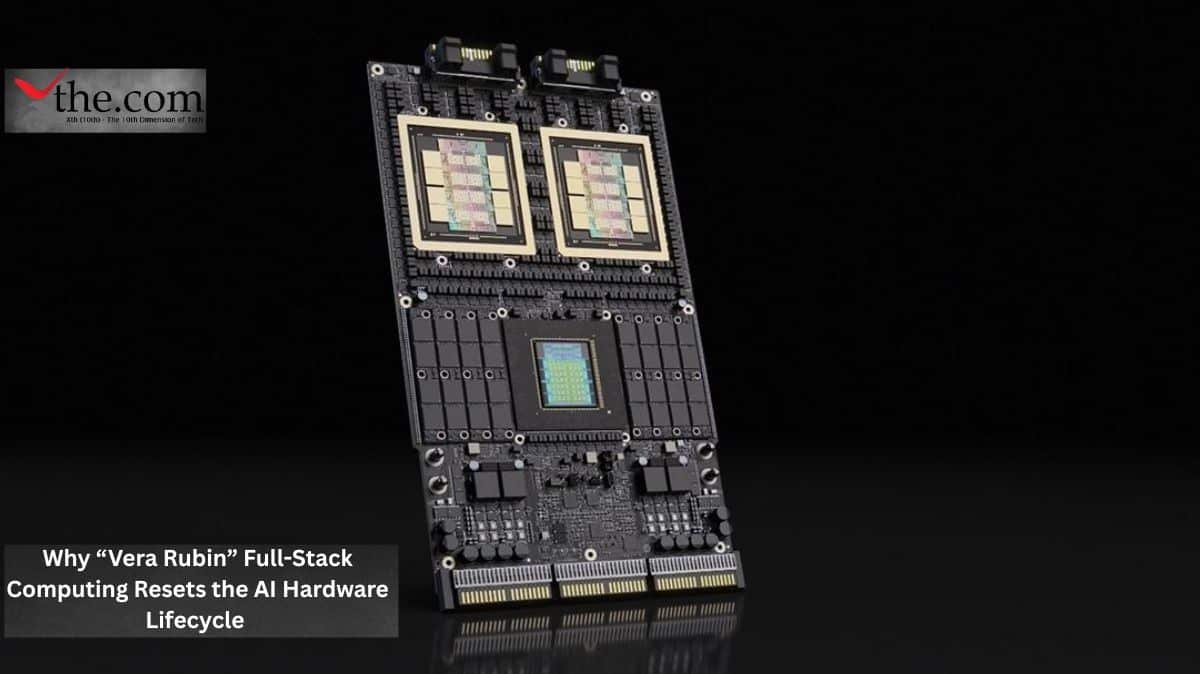
SANTA CLARA, Calif. —NVIDIA has announced the launch of its Vera Rubin Architecture, which has an innovative approach to building AI infrastructure for agentic AI workloads and large-scale autonomous computing environments. The unveiling of the Nvidia Vera Rubin platform 2026 marks a defining moment in enterprise AI infrastructure and signals the next stage of vertically integrated computing ecosystems. In essence, the Vera Rubin platform comprises the Vera CPU and GPU architectures, networking infrastructure, and storage accelerators, all packaged into a comprehensive AI infrastructure stack. Rather than concentrating solely on computational power, NVIDIA will build complete operational infrastructures that can sustain the autonomous AI environment. Indeed, there is a paradigm shift in enterprise computing, where individual hardware upgrades are no longer sufficient.
Full Stack AI Infrastructures Expansion
The emergence of Full Stack Computing represents one of the key breakthroughs for contemporary enterprise IT strategies. Before, organizations could replace their hardware independently: servers, storage solutions, and networking systems were all replaced separately.
But in the age of AI, there appears to be a demand for infrastructures that would allow to handle extensive data processing, orchestration, and decision-making. Such an environment can be achieved within Vera Rubin’s ecosystems via:
- AI-enabled computer architectures
- Powerful networks
- Storage acceleration technologies
- Orchestration software
- Deployable rack-level systems
All of these aspects are essential for efficient operation in large-scale enterprises. Importance of Vera CPU and Rack-Scale System Architecture
As one of the main components of the Vera Rubin Platform, the the Vera CPU operates alongside other components, such as powerful GPU architectures, to help manage vast autonomous loads.
The rise of the agentic AI supercomputer full-stack model reflects how enterprise infrastructure is shifting from isolated compute hardware toward integrated autonomous AI ecosystems.
Conventional IT systems suffered from communication issues between CPUs, GPUs, storage, and network solutions. This is something the new architecture seeks to improve.
At the same time, Rack-Scale systems have been receiving increasing attention in recent years. Their benefits include:
- Better coordination of AI loads
- Superior scalability capabilities
- Communication optimization
- Higher energy efficiency
- Increased real-time performance
The growing relevance of the Vera Rubin seven-chip rack-scale system demonstrates how future enterprise AI environments may rely on tightly integrated infrastructure stacks rather than fragmented server architectures.
Experts predict that rack-scale AI systems will become a common feature of enterprise data centers.
Usage of BlueField-4 for AI Infrastructure
The next key element in the Nvidia infrastructure strategy concerns the BlueField-4 networking and storage solutions. Such solutions have been developed to improve communication, security isolation, and data management in large AI environments.
As AI workloads grow in the enterprise environment, network and storage solutions are equally important as computing capabilities.
The following benefits can be obtained using BlueField-4:
- More efficient data transfer
- Isolation of workloads
- Less networking latency
- Better storage orchestration
- Greater infrastructure security
This transition indicates that enterprises need an interconnected ecosystem of hardware solutions, not only processors.
Expanding Agentic AI Supercomputers
Another key element of Nvidia’s approach to AI is the Agentic AI Supercomputer idea itself. Future AI solutions will be much more autonomous and therefore require technology infrastructure that enables them to continuously reason, coordinate, and execute workflows.
Conventional enterprise computing platforms have not been built for such kinds of autonomous operations.
Agentic AI will need:
- Multi-agent coordination at all times
- Extremely fast data processing
- Persistent memory handling
- High-speed networking technologies
- Orchestration tools
The broader impact of the Nvidia GTC 2026 hardware announcement is expected to accelerate enterprise investment into autonomous infrastructure ecosystems capable of supporting large-scale AI coordination. Vera Rubin was created just for such use cases.
Pressure on Traditional Server Vendors
With the emergence of new AI infrastructure systems, traditional server providers may face significant competitive pressure, as they will not be able to accommodate the coordination requirements of future-generation AI architectures.
Traditional infrastructure systems are typically characterized by fragmented layers that cannot efficiently scale to accommodate autonomous AI environments.
Some problems related to legacy infrastructures are as follows:
- Slow AI coordination process
- Limited rack-scale scaling
- Higher operational latency
- Decreased workload efficiency
- More fragmented infrastructure
In response, companies may focus their procurement activities on suppliers offering efficient, fully coordinated AI infrastructure. Industry observers are increasingly asking how Nvidia’s Vera Rubin seven-chip full-stack platform lock legacy server manufacturers out of next-gen AI data centers, especially as enterprises move toward vertically integrated rack-scale AI ecosystems.
Implications for Data Centers
The increased interest in Nvidia Vera Rubin platform technical specifications for 2026 clearly indicates that enterprises’ procurement needs change extremely quickly.
Nowadays, companies do not select AI hardware solely based on GPU capabilities; more importantly, they consider AI coordination, orchestration, network integration, storage coordination, etc.
Full-Stack Computing also creates economic impacts on data centers.
On top of that, the Vera Rubin Platform can promote the industrialization of AI infrastructure by turning data centers into autonomous computing ecosystems rather than server warehouses.
Future of Enterprise AI Infrastructure
With recent innovations, the future of enterprise AI competition appears to be shifting from single chips to complete ecosystems of operations.
Businesses that can combine compute, network, storage, orchestration, and AI acceleration on a single platform might enjoy significant strategic benefits in the long run as autonomous AI use worldwide continues to grow.
In addition, the current trend towards vertically integrated infrastructure solutions further solidifies Nvidia’s dominance in enterprise AI, as businesses increasingly prefer simplicity in deployment, scalability, and consistency.
Conclusion
NVIDIA’s Vera Rubin launch marks a pivotal point in the history of enterprise AI infrastructure. With its release, Nvidia is enabling the creation of an integrated AI ecosystem designed specifically for autonomous applications, thereby helping shape the future of enterprise computing infrastructure. As AI implementation grows across industries, scalable infrastructure ecosystems, rack-scale computing, and autonomous orchestration systems can become essential for enterprise IT. The growing importance of enterprise AI infrastructure ensures that full-stack computing will remain central to the development of future enterprise computing systems.
Source- NVIDIA Spectrum-X — the Open, AI-Native Ethernet Fabric