



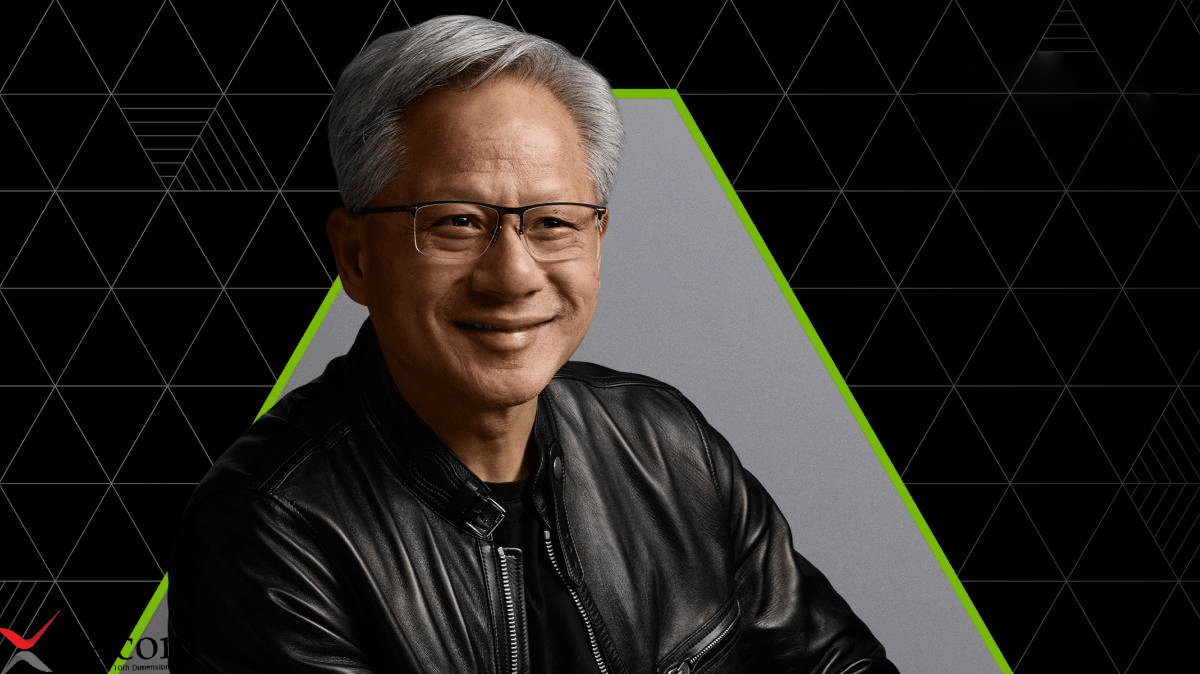
Huang’s keynote. Over 1,000 expert-led sessions and pioneering advances across the AI stack will anchor the world’s premier AI conference.  

NVIDIA announced that GTC, the world’s leading AI and accelerated computing conference, will be held March 16-19 in San Jose, California. Over 30,000 developers, researchers, business leaders, and AI-focused companies from more than 190 countries will gather to see how AI is becoming essential infrastructure for a new industrial era.  

GTC is at the center of the AI industrial era, said Jensen Huang, founder and CEO of NVIDIA. AI is now essential infrastructure. Every company will use it, and every nation will build it. From energy and chips to models and applications, every part of the stack is advancing together, visible at GTC.  

What to expect at GTC 2026 

Huang will deliver the keynote at the SAP Center on March 11 at 11:00 pm PT, covering NVIDIA’s latest advances in accelerated computing, AI factories, open models, agentic systems, and physical AI. The keynote sets the industry’s direction for the year. Watch live or on demand at nvidia.com; registration is not required.  

GTC covers every dimension of AI, from energy and semiconductors to infrastructure, models, and applications. Through keynotes, sessions, and demonstrations, attendees discover how unique technologies and collaborations are evolving each layer and empowering one of the largest infrastructure expansions to date.  

There will be over 1,000 sessions covering topics including AI factories, large-scale inference, robotics, digital twins, scientific computing, quantum technologies, and enterprise AI developments. GTC sessions will address building, scaling, and optimizing every layer of the AI stack, and how they intersect in production environments. Jensen Huang will lead a discussion on open frontier models and future developments, featuring industry leaders from A16Z AI, AMP coalition, Black Forest Labs, Cursor, Reflection AI, and Thinking Machines Lab.  

The GTC Live Keynote Program Show will feature industry leaders discussing accelerated computing beyond AI, the five-day stack, and the infrastructure projects and ecosystems necessary for global deployment. The event streams live online on Monday, March 16, at 8:00 p.m. PT, officially launching the conference. Featured speakers will include:  

  • Perplexity CEO Aravin Srinivas  
  • Featured speakers include Aravin Srinivas, CEO of Perplexity; Harrison Chase, CEO of Long Chain; Deepak Pathak, CEO of Skilled AI; Daniel Nadler, CEO of Open Evidence; and Arthur Mensch, CEO of Mistral AI.  

Hands-on training and certification (March 16 to 19): Developers and engineers can build important skills in AI, accelerated computing, networking, data science, and physical AI through nine full-day workshops, over six hands-on labs, and on-site certification, available throughout the conference dates. Self-paced courses, educator programs, and one-on-one training consultations are also available during the same period to help grow the workforce needed for expanding AI infrastructure.  

Startups, investors, and the AI ecosystem (March 16, 2019: Over 240 NVIDIA Inception startups will present technologies in physical AI, robotics, generative AI, and enterprise applications. Special startup and venture programs at the AI Day with top venture funds and NVentures. Sessions will take place throughout the event to connect founders and investors across all levels of the AI industry.  

Developer and research tracks (March 16 to 19): At GTC, developers can learn from NVIDIA engineers and partners and join the global community building the next generation of AI applications. Technical deep dives, Cuva sessions, and infrastructure workshops are scheduled daily, covering large-scale modern training, influence optimization, and cloud AI services across cloud, edge, and sovereign environments.  

More than 150 post-op presentations will highlight the latest research from the global AI community, including work on model innovation, robotics, systems architecture, and new AI applications. This event will turn downtown San Jose into an AI campus spanning 10 venues. Caesar Chavez Park will host a day-and-night market featuring food, entertainment, and live programming. The All In podcast will host interviews from the show floor on Wednesday, March 18th, and the student and community day on Thursday. March 19 will open GTC to the wider community at a discounted rate.  

Virtual programming with region-specific content will be available in the session catalog online from March 16 to 19, in parallel with the main event schedule.  

NVIDIA Financial Analyst Q&A for shareholders and analysts is scheduled for Tuesday, March 17, at 9:00 am PT, during the main conference. The webcast will be available at investor.nvidia.com. 

Source: NVIDIA CEO Jensen Huang and Global Technology Leaders to Showcase Age of AI at GTC 2026 

Enterprise AI is entering a new phase. Over the past two years, most of the focus has been on how quickly AI technology is advancing, with new models, features, and impressive demonstrations. This created an environment saturated with technical updates and product news, but now these are no longer the main barriers to adoption and value.  

Now the key question for leaders is not what AI can do, but how to use it to drive real change, improve decision-making, accelerate workflows, execute more effectively, gain new advantages, and even create new business models.  

This shift signals the need for resources that go beyond technology updates to address adoption and impact.  

That’s why we’re launching The Adoption Channel, a new OpenAI business blog that translates AI innovation into real business results. Here, leaders will find actionable insights on applying AI to solve operational challenges, make better decisions, improve efficiency, and gain lasting advantages. This channel is designed for C-level executives, AI transformation leaders, AI adoption leaders, and the teams guiding their organizations through the AI transition, helping enterprises thrive in an AI-native world.  

What You Can Expect Here 

  1. Where AI adds value and what success looks like: we’ll share clear ideas on business value. We will explain how leaders can spot opportunities. We will show what effective execution looks like in practice.  
  1. How organizations scale AI successfully: we’ll offer insights on what helps adoption grow, what can slow it down, and how top organizations move from testing to real change. Plus, how do responsibilities shift, and how do leadership and design adapt to build trust, control, and performance?  
  1. Separating Market Realities from Hype: We’ll offer a clear perspective on what matters, what is noise, and which trends are likely to impact business decisions.  
  1. Industry-specific perspectives based on real business needs: we explore these issues in different industries. We consider real constraints, systems, workflows, and regulations.  

To do this, we will share frameworks, decision tools, and operating patterns. We will give accurate, concrete examples. Most importantly, we will explain what leading organizations do differently. Our goal is to help leaders understand AI’s direction and decide what to do next.  

How We’ll Support You From Here 

Our writing will be clear, practical, and useful short for busy executives, yet detailed enough to support your decisions, with a focus on real-world implementation.  

If you are building, scaling, or guiding AI adoption in your organization, this resource is made for you. We provide practical guidance to help leaders drive effective change, seize AI opportunities, and build confidence as they navigate rapid workplace transformation.  

Welcome to Adoption News. Follow us to start building your advantages.  

Apple has introduced the new MacBook Air with M5, offering top performance and improved AI features to the world’s most popular laptop. The M5 chip includes a faster CPU and next-generation GPU, each with a neural accelerator, so MacBook Air can handle everything from creative work to advanced AI tasks.  

The laptop now starts with 502GB of storage, weighs as much as before, and uses a faster SSD with options up to 4TB. The new N1 wireless chip supports Wi-Fi 7 and Bluetooth 6 for easy, reliable connections wherever you are. MacBook Air keeps its thin, light, and strong aluminum build, features a sharp liquid-retina display, a 12-MP center-stage camera, up to 18 hours of battery life, immersive sound and spatial audio, and two Thunderbolt 4 ports that support up to two external displays with macOS Tahoe.  

The Apple MacBook Air is a great choice for students, creative professionals, and business users. The new MacBook Air with M5 comes in 13- and 15-inch sizes and four colors: sky blue, midnight, starlight, and silver. Pre-orders start tomorrow, March 4, and it will be available beginning Wednesday, March 11.  

The new MacBook Air with M5 brings incredible performance and even more capability to the world’s most popular laptops, said John Ternus, Apple’s Senior Vice President of Hardware Engineering. With M5, MacBook Air powers through a wide range of tasks from everyday productivity to creative workloads and is even faster for AI. Now featuring double the starting storage, Wi-Fi 7, and Bluetooth 6, in a sleek, durable design with long battery life. MacBook Air is the perfect laptop for anyone who values the unrivaled combination of performance and portability.  

Outstanding Performance with M5 for AI and More 

The M5 chip delivers strong performance across everyday and creative tasks. MacBook Air with M5 has a 10-core CPU, up to a 10-core GPU, and neural accelerators, providing up to 4x faster AI performance than the M4 and 9.5x faster than the M1. This makes it a powerful choice for both personal and professional AI use.  

The M5 chip features improved shader cores and a third-generation ray tracing engine, enabling faster gaming and 3D rendering. It also improves unified memory performance by 28% to 153 GB of bandwidth. Overall, the M4 means more seamless multitasking and quicker app launches. Overall, MacBook Air with M5 offers better performance than the previous models, including:  

  • AI video tasks run up to 6.9x faster on M1 and 1.9x faster on M4 than on M1.  
  • 3D rendering with ray tracing in Blender is up to 6.5 times faster than on a MacBook Air with a moon and up to 1.5 times faster than on a MacBook Air with M4.4  
  • Image processing in Affinity is 2.7 times faster than on a MacBook Air with M1 and up to 1.5 times faster than on a MacBook Air with M4.2.  
  • Web browsing is up to 50% faster versus PC laptops with Intel Core Ultra X7; demanding tasks are up to 3x faster.  

Double The Starting Storage And A Faster SSD 

The MacBook Air with M5 now starts at 512 GB of storage, as the previous models did. For the first time, you can configure it with up to 40 GB of storage, giving you plenty of room for big projects and games. The new SSD is priced the same as before, so you can open files quickly and work faster, whether you are a creator importing lots of photos or a student running AI tasks on your device.  

Tremendous Value for Upgraders With the World’s Most Popular Laptop 

If you are thinking about upgrading from an older MacBook Air, whether it has Apple silicon or an Intel chip, now is a great time. Along with the M5 fast chip, the new MacBook Air offers many exciting features. For example:  

  • A stunning Liquid Retina display: The 13.6″ or 15.3″ Liquid Retina display is bright at 500 nits and supports 1 billion colors. Everything looks vivid and detailed, and the text stays extra sharp.  
  • Exceptional Battery Life: You can get up to 18 hours of battery life, six hours more than the Intel-based MacBook Air with Fast Charging. You can work, create, or play all day without needing to plug in.  
  • Beautiful design and colors: The 13-inch MacBook Air is easy to carry for people on the move. The 15-inch version gives you more space for multitasking. Both are thin, light, and silent with a fanless design. They come in four colors:  
  • sky blue  
  • midnight  
  • Starlight  
  • Silver  
  • Advanced Camera, Mic, and Speakers: The 12-MP center stage camera with desk view makes you look your best and makes video calls more compelling. The three-mic array improves voice clarity. The sound system supports spatial audio and Dolby Atmos for a rich, three-dimensional experience while listening to music or watching movies.  
  • Wi-Fi 7 and Bluetooth 6 color the new Apple design and chip, delivering better performance and improved connection reliability.  
  • Flawless connectivity: the MacBook Air has two Thunderbolt ports for accessories. It supports up to two external displays, which is great for professionals and students who want more workspace. MagSafe provides dedicated charging and keeps your connection secure when plugged in.  

The power of macOS Tahoe. 

MacOS completes the MacBook Air experience with incredible features and built-in apps like Safari, Photos, Messages, and FaceTime, helping you get more done with macOS Tahoe. You can personalize your Mac with new color options for Folder App icons and widgets, thanks to Liquid Glass. Apple Intelligence brings powerful features and strong privacy, such as:  

  • live translation in messages for talking across languages  
  • smarter reminders that sort your tasks  
  • improve shortcuts that use Apple Intelligence to automate things like pulling info from a PDF and adding it to a spreadsheet  

Continuity features include:  

  • the iPhone phone app on Mac so you can make calls from your phone  
  • live activities, which show notifications in iPhone mirroring, so you can respond right from your Mac for video calls  

The new Edge Light effect provides even lighting for your face in any condition. 

Source: Apple introduces the new MacBook Air with M5  

Dell NativeEdge with Nokia Private Wireless lets businesses accelerate AI innovation by efficiently managing and connecting edge environments. The solution integrates Dell software and Nokia connectivity to meet enterprise edge needs.  

As AI adoption accelerates, businesses are looking for ways to unlock instant insights and value from data across a wide range of devices in their operational environments. Edge infrastructure, which brings computing power closer to data generation sources, enables rapid decision-making and more effective action-taking.  

Processing at the edge provides instant insights and efficiency gains for AI. Beyond computing and storage, secure device connectivity and management ensure reliable operations.  

Meet Dell NativeEdge and Nokia Private Wireless. 

Dell NativeEdge with Nokia Private Wireless offers complete management, orchestration, and connectivity tools for Edge environments. Key features include:  

  • Accelerate edge outcomes. Go-lone centralized management and orchestration—here ‘orchestration’ refers to automating and coordinating complex IT processes—streamlines device deployment, secure onboarding, and operational automation for rapid results.  
  • Easily connect all assets with a secure, high-speed wireless network built for demanding edge environments.  
  • Defend Every Layer: Zero Trust Security Safeguards Your Data, Applications, and Infrastructure to ensure uninterrupted, protected business operations.  

The platform bridges IT and OT, boosting collaboration and supporting digital transformation.  

How Private Wireless Connects Your Edge 

Dell and Nokia offer Digital Automation Cloud (DAC), providing secure, high-speed, private wireless for critical applications.  

The Nokia DSE provides the foundation for Private Wireless and supports Nokia applications and a wide range of devices from connected sensors to ruggedized industrial equipment for workers and machines. It brings 4G, LTE, 5G, and Wi-Fi technologies in a single on-premises solution that can also support a range of Nokia and connectivity-related applications, such as:  

  • device management  
  • network digital twin  
  • network security  
  • workers’ push-to-talk/video applications  

This flexibility ensures pervasive, reliable coverage across your entire operational footprint.  

NativeEdge: Edge Operations Software Platform 

Dell NativeEdge is a secure, easy-to-deploy platform that enables you to manage and scale edge operations across multiple sites from a central point.  

NativeEdge delivers a protected environment for running edge applications. Integration with Nokia DAC forms a comprehensive, robust platform for connected edge operations, merging communication and computing for reliable, secure operations. Visit the Dell NativeEdge website to learn more.  

Capture Insights To Provide Faster Decision Making & Improved Productivity 

Together, Dell NativeEdge and Nokia Private Wireless transform how businesses manage and connect edge systems, giving insight from all devices, sensors, and employees.  

  • Process data at the edge to enable faster decision-making and reduce delays.  
  • Use data to improve productivity, quality, and satisfaction.  
  • Protect your entire operational technology system from application connections.  
  • Scale edge computing easily as your business evolves.  

Accepting a Secure Data-Driven Future 

With Dell NativeEdge and Nokia Private Wireless, businesses accelerate Industry 4.0 and securely transform operations to unlock new data-driven opportunities.  

Centralized edge management the ability to control multiple edge locations from a single point—and secure wireless networking provide a strong foundation for accelerating AI projects. Industries such as manufacturing, retail, and energy can use this solution to collect, process, and act on data in real time, improving operations and outcomes. Are you prepared to transform your business operations and speed up AI innovation at the edge? Contact your Dell representative or visit our website to learn how Dell NativeEdge with Nokia Private Wireless can help your business prepare for the future of Edge Computing and AI.

Source:The Power of Small: Edge AI Predictions for 2026

News Summary 

  • AMD is expanding its Ryzen AI lineup with the new Ryzen AI 400 and Ryzen AI Pro 400 series processors, the first of which are designed for AI PC applications and Copilot+ experiences.  
  • OEM partners are launching new AI PCs, including enterprise notebooks and mobile workstations, powered by Ryzen AI Pro 400-series mobile processors.  
  • Ryzen AI 400 series mobile processors deliver up to 30% faster multi-threaded performance than competing processors. This enables professionals to tackle demanding tasks more efficiently than alternatives while maintaining all-day battery life.  
  • AMD now offers its broadest enterprise PC solutions via the AMD Pro platform, which enhances security, manageability, and resilience for AI PC deployments.  

At Mobile World Congress 2026 in Barcelona, AMD introduced new Ryzen AI 400 Series and Ryzen AI Pro 400 Series desktop processors as part of its expanded Ryzen AI portfolio. These processors offer strong on-device AI acceleration and next-generation performance, letting users run AI applications and large language models locally. They also handle demanding tasks, such as design and engineering, smoothly. AMD is also adding workstations to the Ryzen AI 400 series mobile line-up.  

With these new processors, OEMs can offer AI PCs for desktops, laptops, and mobile workstations built for modern workloads.  

Aizen AI400 series processors are the first to deliver Microsoft Copilot Plus PCI experiences for next-generation desktop AI PCs, featuring a neural processing unit with up to 3 AI compute cores. These processors enable users to run AI assistants and productivity tools directly on their PCs. This keeps sensitive data on the device and gives users more control, better performance, and improved privacy.  

The desktop PC is becoming an intelligent assistant, said Jack Huynh, SVP and GM of Computing and Graphics at AMD, with Ryzen AI 400 series processors. We are building strong AI acceleration for partners to build systems that help businesses and consumers achieve more.  

The World’s First Copilot Plus Desktop Processor For Next-Gen AI Applications 

AMD Ryzen AI 400 Series Desktop processors offer strong performance and smart features by combining Zen 5 CPU cores, AMD RDNA 3.5 graphics, and an AMD XDNA 2 NPU. This blend gives professionals, developers, and power users the speed and local AI performance needed for multitasking, collaboration, development, and data analysis.  

Ryzen AI 400 Series Desktop Availability 

AMD 5 desktop systems with Ryzen AI 400 processors from HP, Lenovo, and other OEMs are expected to arrive in Q2 2026, bringing next-gen performance and on-device AI for a transformed computing experience.  

Expanding Ryzen AI’s Leadership to Notebooks and Mobile Workstations 

As AMD’s commercial PC lineup grows, more OEM partners are launching notebooks powered by Ryzen AI Pro 400-series mobile processors. The Ryzen AI 9 HX Pro 470 delivers up to 30% faster multithreaded performance compared to the Intel Core Ultra X7-3581, giving users a competitive edge for demanding tasks. These systems pair strong power efficiency with all-day battery life, helping users outperform rivals throughout the day. With Ryzen AI Pro 400 series processors, industry-leading AI acceleration and Co-Pilot + PC features are available on mobile devices.  

As organizations adopt AI, Ryzen AI Pro 400 series mobile processors bring advanced AI to notebooks and workstations. The high-performance NPU delivers up to 60 TOPS for greater efficiency, boosting productivity to match professional pace.  

Ryzen AI Pro 400 series mobile processors power next-generation workstations with market-leading performance and support top independent software vendors (ISVs). These mobile workstations maximize CPU, NPU, and GPU resources for the most demanding engineering, creative, and technical workloads, clearly exceeding the performance of alternative solutions.  

Ryzen AI Pro 400 Series Mobile Workstation Availability 

Mobile workstations with Ryzen AI Core 400 processors will be available from Dell, HP, and Lenovo in Q2 2026.  

Strengthening Enterprise Security and Manageability with AMD Pro 

AMD Pro offers strong security, easy management, and trustworthy performance with hardware and software built to simplify IT operations and protect your investment. AMD is improving the Pro platform by enhancing both hardware and software, enabling enterprise IT teams to manage AI-enabled PC fleets more easily. New remote management features give IT administrators better visibility and control, letting them fix problems, restore systems, and keep business operating efficiently without needing to visit each desk.  

AMD systems, unlike some competitors, are compatible with a wide range of major commercial security solutions. This ensures easy integration into enterprise environments and enables organizations to protect device fleets with trusted tools, gaining a clear advantage over less compatible alternatives.

Source: AMD Gives Consumers and Businesses More AI PC Options with Expanded Ryzen™ AI 400 Series Portfolio 

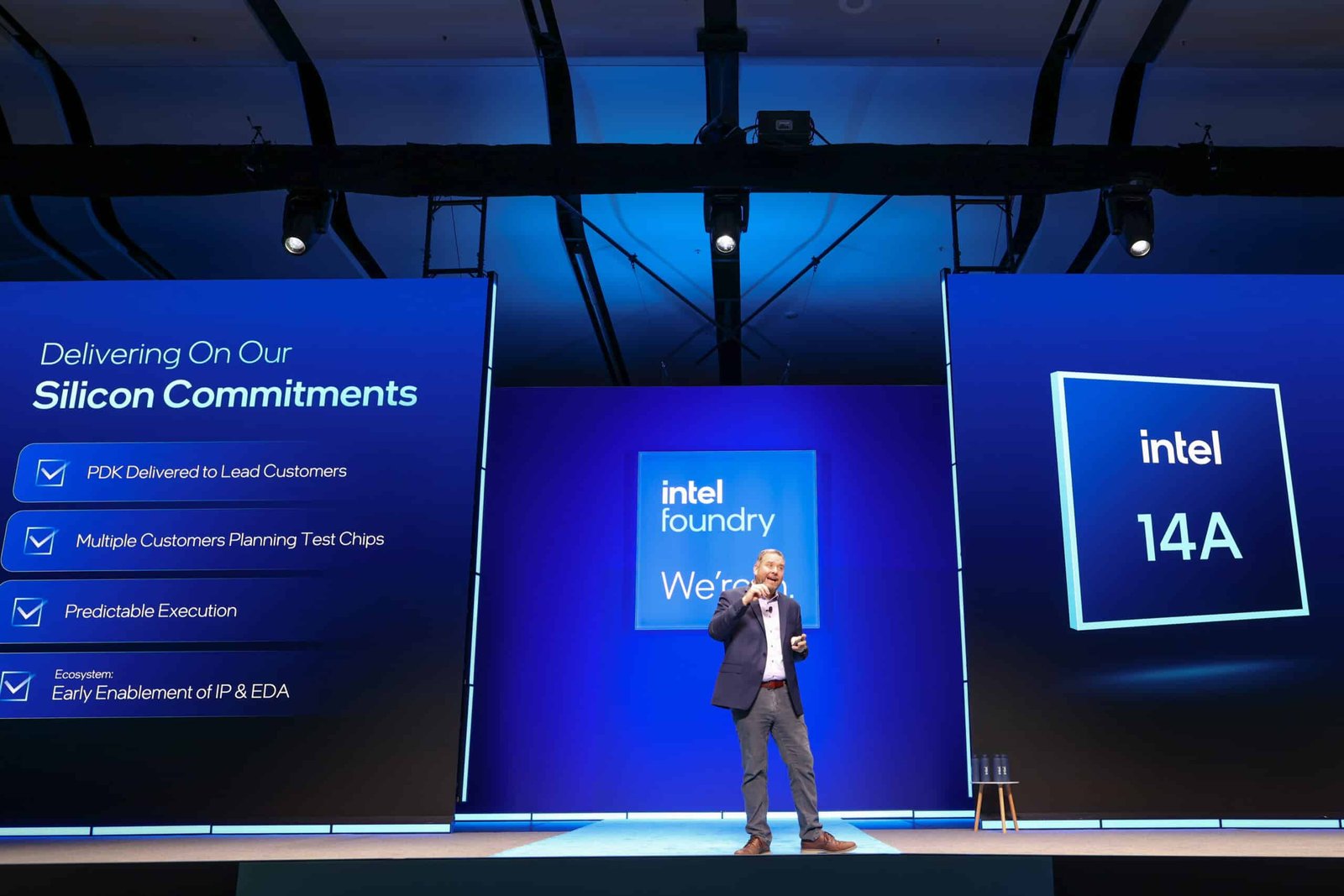
Intel Foundry is moving forward with its 14A 1.4nm process node to support US chip independence and secure domestic technology leadership.  

Intel is investing over $20 billion in Ohio to make AI and high-performance computing chips in the US using advanced EUV lithography.  

Important Details And Impact 

  • The 14A node targets high-performance computing and AI and aligns with Intel’s plan to deploy five nodes over four years.  
  • Intel plans to build a site in Licking County for up to eight factories, aiming to begin production by 2030.  
  • By building advanced factories in the US, Intel will directly reduce reliance on foreign supply chains, strengthening US sovereignty over critical AI hardware.  
  • Intel uses EUV and Foveros Direct 3D stacking to improve packaging.  
  • Despite delays and the need for external customers, the 14A project remains central to US competitiveness in chipmaking and is supported by the CHIPS Act.  

Intel’s 14A Node is a key product under development at Intel Foundry with a planned launch in 2027. As Intel collaborates with customers on the 14A design, clients can assess whether the new node meets their performance, efficiency, and market goals. Patrick Morehead from More Insights and Strategy, who regularly speaks with industry leaders, reports that two Intel customers are very satisfied with the progress of the node. Clients who have reviewed 14A note that it should deliver highly competitive capabilities for data center, PC, and mobile CHIPS—offering potential benefits such as enhanced performance, broader application scope, and early access to state-of-the-art technology.  

He also said I am anxious for Intel to release its 14a 0.5 PDK and start gathering feedback. Even without the PDK available, I’m already hearing very positive things, especially considering the progress with 18a as each new node builds up on the previous ones.  

Intel develops the 14A node using high-NA EUV to enable finer, more efficient chips. It leads the shift from low to high NA.  

By reducing the number of steps per wafer layer from 40 to fewer than 10, Intel simplified manufacturing and sped up product delivery.  

Customers emphasize security and adequate wafer allocation. Intel’s Twinscanexe:5200B processes 200 wafers per hour.  

“Process Roadmap Expands Beyond 5N4Y” 

Intel has strengthened its Process Technology roadmap by adding Intel 14A to its leading-node plan, along with several specialized-node updates. The company confirmed that its five-node in four years (5N4Y) plan is still on schedule and will increase the industry’s first backside power solution. Leaders at Intel expect to regain process leadership with Intel 18A in 2025.  

The updated roadmap includes improvements for Intel 3.0, 18A, and 14A process technologies. It also introduces Intel 3T, which uses through-silicon vias for 3D advanced packaging and will soon be ready for manufacturing. The roadmap also highlights mature process nodes, including the new 12nm nodes developed with UNC, as announced last month. These updates help customers create products that meet their needs. Intel Foundry plans to release a new node every two years, along with regular updates, so customers can keep improving their products using Intel’s latest technology.  

Intel expanded its ASAT lineup, adding FCBGA2D+ to existing FCBGA 2D, AM, IB, Foveros, and Foveros Direct offerings.  

Microsoft Design on Intel 18A Headlines Customer Momentum 

Reflecting this exciting momentum, customers are enthusiastically backing Intel’s Long-Term Systems Foundry strategy. In Pat Gelsinger’s keynote, Microsoft Chairman and CEO Satya Nadella shared the exciting news that Intel has selected a chip design to manufacture using the Intel 18A process.  

We are in the midst of a very exciting platform shift that will fundamentally transform productivity for every individual organization and the entire industry. Nadal has said: “To achieve this vision, we need a reliable supplier of the most advanced, high-performance, and high-quality semiconductors. That is why we are so excited to work with Intel Foundry and why we have chosen HF Design, which we plan to produce on Intel A-Process.”  

With the exciting support of Microsoft, Intel Foundry has won designs across several process generations, including Intel 18A, Intel 16, and Intel III. The company is also experiencing strong customer enthusiasm for its ASAT capabilities, especially advanced packaging.  

Bringing these successes together, Intel Foundry expects its lifetime deal value for wafers and advanced packaging to exceed $15 billion.

Source:   

Intel 14A Node Trials Signal Confidence From Early Customers

Intel Launches World’s First Systems Foundry Designed for the AI Era

Meta has introduced a new AI model, Segment Anything Model 2 (SAM2), that can identify and track any object as it moves through a video. It builds on the first SAM, which only worked with images. This upgrade creates new possibilities for editing and analyzing videos.  

SAM2’s ability to segment objects in real-time is a major technical advance. It shows how AI can handle moving images and distinguish between different objects, even as they enter and exit the frame.  

To put SAM2’s achievement in context, segmentation means figuring out which parts of an image belong to which objects, and AI can do this, making it much easier to process or edit complex images. A capability that was the key feature of Meta’s first SAM. It has been used to segment coral reef images, analyze satellite imagery for disaster relief, and even analyze cellular images to detect skin cancer.  

Built on these image-based abilities, SAM2 expands segmentation to video, a shift not possible until now. To launch SAM2, Meta released a database of 50,000 videos used to train the model, along with 100,000 additional videos. Real-time video segmentation also requires significant computing power, so even though SAM2 is free now, that may change in the future.  

Segment Success 

With SAM2, video editors can select and modify objects in a scene more easily than with current editing tools, without having to adjust each frame by hand. Meta also sees SAM2 changing the interactive video landscape. People can select and move objects in live videos or virtual spaces using this AI model.  

Looking further ahead, Meta believes Sam2 could be important for developing and training computer vision systems, especially for self-driving cars. These systems need to track objects accurately and efficiently to understand and navigate their surroundings safely. The same could speed up labeling visual data, giving these AI systems better training material.  

While much of the AI video hype centers around generating videos from text prompts, the kind of editing capabilities provided by SAM2 might play an even bigger role in embedding AI into video creation. Models like OpenAI’s Sora, Runway, and Google Vue get a lot of attention for a reason, but SAM2 offers a different type of impact.  

While Meta may lead for now, other AI video developers are working on their own margins. For example, Google is testing video abstraction and object recognition features on YouTube. Adobe’s Firefly AI tools also focus on photo and video editing, with features like content overfill and auto reframe.

Source: Meta’s new AI model tags and tracks every object in your videos 

OpenAI has launched a new series of AI models designed to handle intricate reasoning in science, math, and coding. These models are built to spend more time thinking before answering, which helps them solve tougher problems with greater accuracy.  

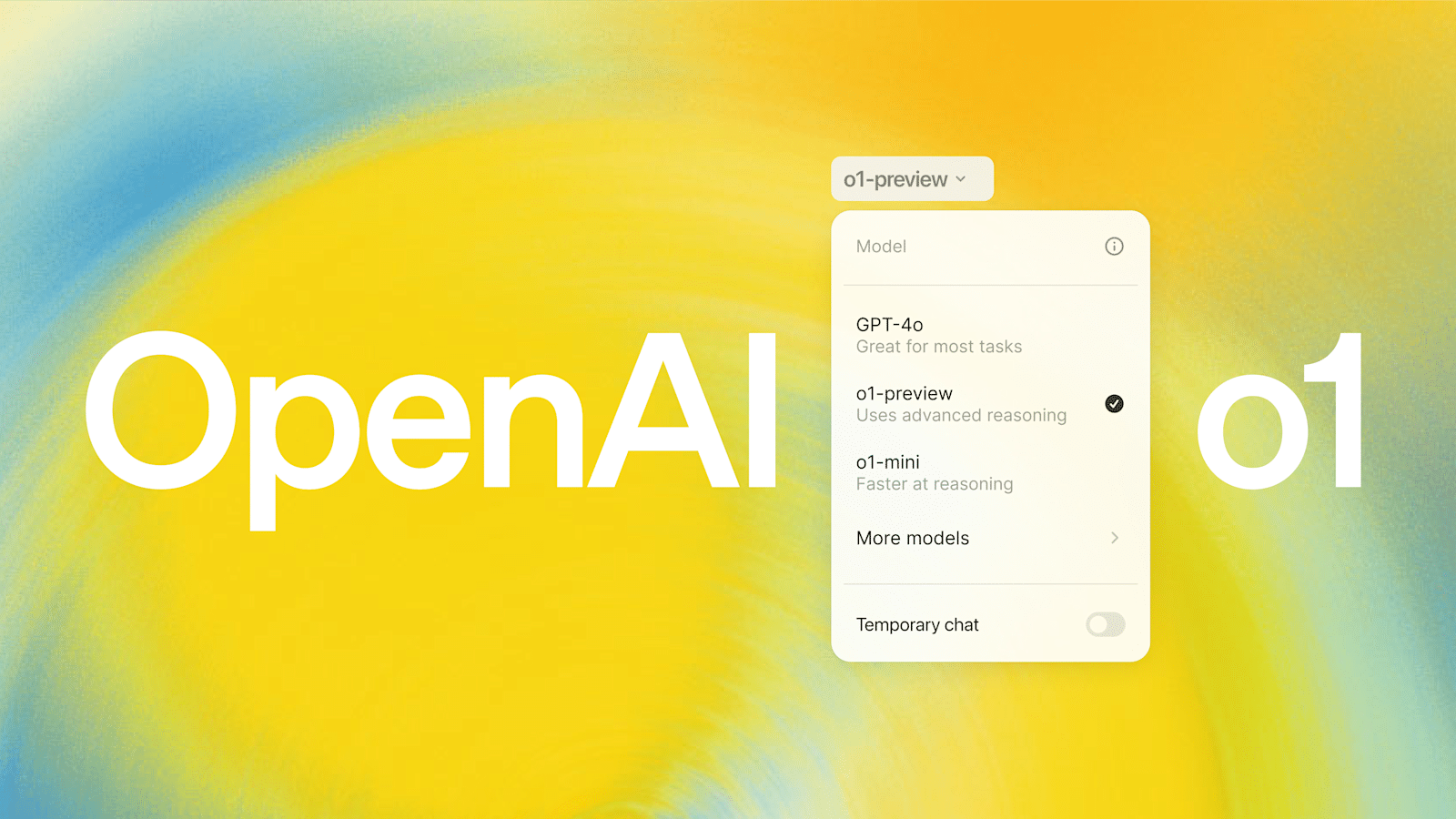
The first model in this series, OpenAI 01 Preview, is now available through ChatGPT and the API. This release is part of an expanded strategy to roll out models better suited for complex logical tasks. It signifies a significant milestone in AI development, as the model presents remarkable progress in scientific, mathematical, and programming tasks.  

Advanced Reasoning Abilities 

The O1 Review Model is trained to spend more time thinking through problems than earlier versions. This helps it try different strategies, spot mistakes, and improve its answers as it works in tests. The text model in the series performed well on tough academic benchmarks, sometimes matching PhD-level skills, especially in physics, chemistry, and biology.  

The O1 Preview model also showed significant improvement in solving math problems. For example, in an international mathematics Olympiad qualifier, the earlier GPT-4-O solved 13% of the problems, while O1 Preview solved 83%. In core forces coding competitions, it scored in the 89th percentile, demonstrating a significant improvement over past models and reflecting the company’s commitment to responsible AI development. These new safety measures ensure the model adheres to the right guidelines more effectively through leveraging its reasoning abilities. For example, during tests intended to bypass the model’s safety rules, known as jailbreaking, the O1 Preview model attained a high compliance score, markedly outperforming previous models.  

OpenAI also improves its internal safety processes and works with AI safety institutes in the US and UK. These groups now have early access to research versions of the O1 model, allowing outside experts to test and review it. OpenAI aims to make future AI systems safer before releasing them to the public.  

Applications And Target Audience 

The O1 Preview model is especially well-suited for professionals working on complex science, coding, and math tasks. For instance, healthcare researchers can use it to annotate cell sequencing data. Physicists can rely on it to generate formulas concerning quantum optics, and developers can use it to build and execute integrated workflows. Its reasoning abilities make it a helpful tool for any field that requires in-depth problem-solving.  

To help developers, OpenAI has also released O1 Mini, a smaller and more affordable version of O1 Preview. The O1 Mini costs 80% less and is designed mainly for generating and debugging complex code. It does not have as much general knowledge as O1 Preview, but it is still a strong choice for tasks that need accurate reasoning at a lower price.  

Availability and Access 

Starting today, ChatGPT Plus and Team users can access both the O1 Preview and O1 Mini models through the model picker in ChatGPT.  
 
The current limits are:  

  1. 50 queries per week for O1 Preview  
  1. 50 queries per day for O1 Mini  

But OpenAI plans to raise these soon.  

ChatGPT Enterprise and Edu users will get access next week. However, the API for these models currently lacks features such as function calls and streaming, though these may be added in future updates.  

OpenAI has also expressed plans to make the O1 Mini available to ChatGPT-free users in the future. To broaden access, OpenAI plans to offer the O1 Mini model to ChatGPT-free users in the future, making its cutting-edge reasoning capabilities available to more people. OpenAI plans to launch Addison updates to the O1 Series, including features like browsing, file and image uploading, and more. These updates aim to make the models more versatile and more helpful to a broader audience.  

Along with the O1 Series, OpenAI will keep improving its GPT models so users can access the latest AI technology. By launching these RISBIN models, OpenAI shows its goal is to advance AI in terms of capability, safety, and real-world use.  

OpenAI Launches New Academy To Support AI Innovation In Low- And Middle-Income Countries 

OpenAI has launched the OpenAI Academy, a new program designed to support programmers and companies working with artificial intelligence. The Academy’s main goal is to help these groups address important challenges in their communities, especially in low- and middle-income countries. With this effort, OpenAI aims to ensure that the benefits of AI reach a wide range of groups worldwide, facilitating sustainable development and economic growth.  

Enabling Local Innovators With AI 

Many countries with growing technology sectors have skilled programmers and companies working to solve community problems. But these regions often lack access to advanced AI training, resources, and infrastructure. OpenAI wants to provide these tools and support so local talent can make a difference in areas like healthcare, agriculture, education, and finance.  

The OpenAI Academy will provide programmers and companies with the resources they need to deploy AI to concrete solutions. Participants will get access to advanced AI tools, training, and support from OpenAI experts. This will help them build their skills, improve their AI projects, and solve problems in their communities.  

Academy Offerings: Training API Credits And Community Assistance 

OpenAI is committing significant resources to the Academy to help these innovators succeed. Key components of the program include:  

  1. Training and Technical Guidance: Participants will receive expert support from OpenAI to help them use AI effectively to solve complex problems.  
  1. API Credits: OpenAI is offering $1M in API credits to help developers and companies use its models in their projects. This will make it easier for more people to start working with AI, join forces on projects, and drive collective innovation. This will create a supportive environment where participants can learn from one another and develop new AI applications.  
  1. Contests and incubators column: The academic plans to partner with philanthropists to create contests and incubators that will further invest in organizations on the front lines of their communities. These contests will reward organizations for developing AI-based solutions that tackle urgent local challenges.  

By building a platform for partnership and development, OpenAI wants to increase the global impact of AI. The Academy’s goal is to ensure AI benefits reach everywhere, especially where they are needed most.  

Success Stories and Global Impact 

OpenAI has already helped AI developers and groups working for social good. For example, KOBI, which won the OpenAI prize at the Tools competition, created an AI tool to help students with dyslexia learn to read. iStem, a winner of the Turn.io chat for impact context contest, uses AI to make content more accessible to people with vision impairments in India. OpenAI supported these groups with API credits and technical support, helping them grow their projects and keep making a difference.  

These stories show how AI can help solve global problems, from better education to making things more accessible for marginalized groups. The OpenAI Academy aims to build on these successes by supporting even more programmers and institutions worldwide.  

Expanding Language Access For AI Development 

To make AI more accessible, OpenAI has made sure that AI resources are available in many languages. The company recently funded and released a professional translation of the massive metadata Language Understanding (MM value) benchmark into 14 languages, including Arabic, Bengali, Hindi, Swahili, and Yoruba. This helps more people use AI in their own languages.  

A Step Towards Global AI Inclusivity 

OpenAI’s new initiative is an important step toward making AI development increasingly inclusive. It makes sure that those who understand the unique cultures and challenges of their regions can tailor AI applications to meet local needs by supporting programmers and institutions across diverse regions. OpenAI plans to bring the benefits of AI to a larger audience, enabling communities worldwide to use technology for economic growth and to tackle challenges.  

The OpenAI Academy is ready to help innovators worldwide use AI to solve big challenges and create new chances for responsible growth and technology progress.

Source: OpenAI Unveils New Reasoning Model Series: OpenAI o1-Preview 

Project Kuiper is Amazon’s low-Earth-orbit satellite network. Its goal is to close the digital gap by bringing fast, affordable internet to communities without reliable access through traditional means.  

To get online with Kuiper, customers install a rugged outdoor antenna called a customer terminal that connects directly with satellites racing overhead. Past versions of this equipment were often too bulky, complex, or expensive, preventing LEO satellite networks from fully realizing their vision. Now, Kuiper aims to change the game.  

Project Kuiper targets tens of millions of customers, setting an early goal to build a customer terminal for under $500. Engineers met this in 2020 by inventing a compact, lightweight antenna. They’ve continued refining designs to make terminals even smaller, cheaper, and more powerful.  

Building on these advancements, Amazon recently shared the results of its ongoing work. Read on to discover more about the small, powerful antennas and the technology that makes them possible.  

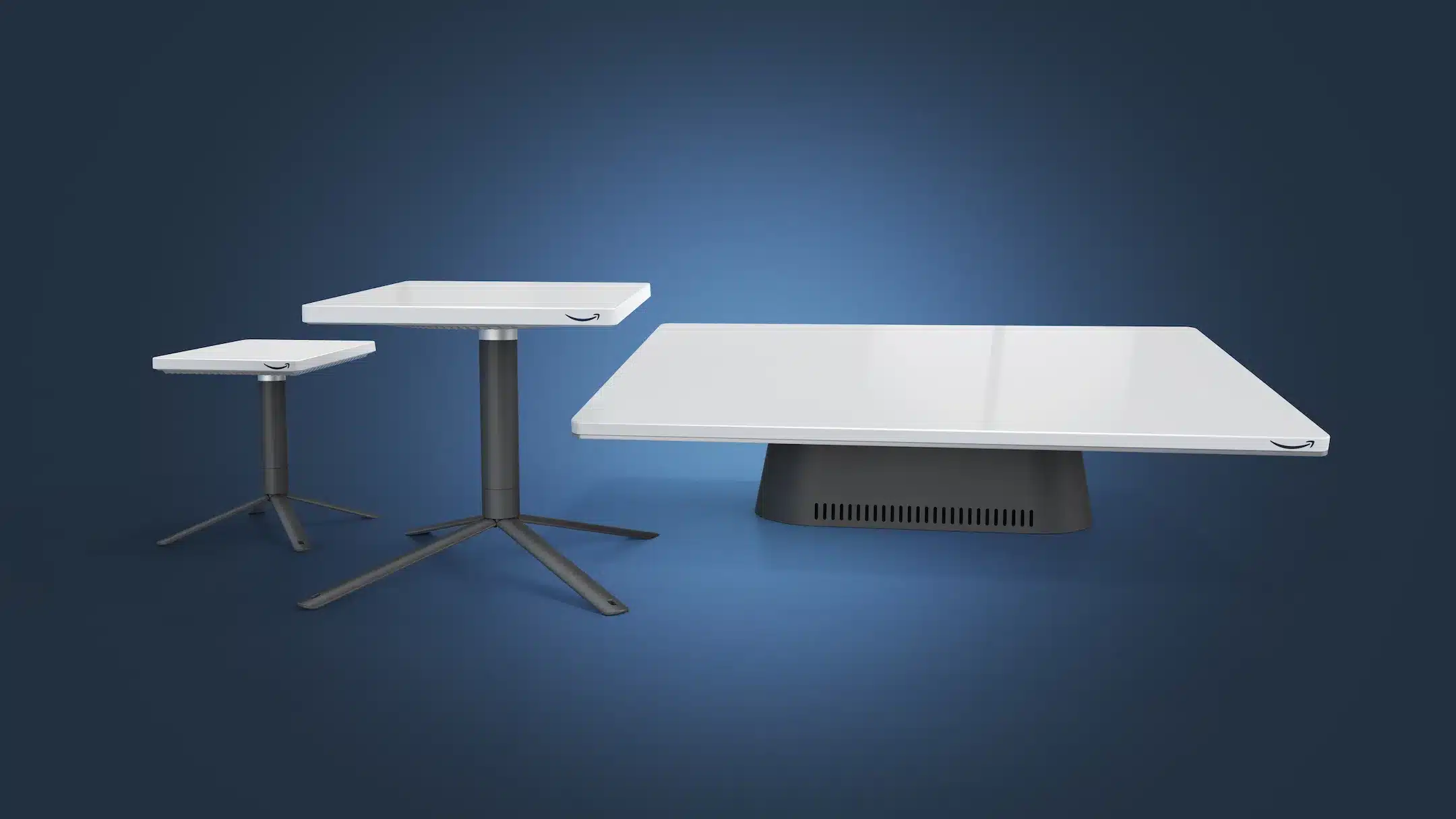
Continuing this momentum, at a satellite industry conference in Washington, D.C., Amazon provided a first look at three engineering models that will anchor its customer terminal portfolio.  

The standard customer terminal is for homes and small businesses. It is compact, less than 11 inches square, 1 inch thick, under 5 lb, and it will deliver up to 400 Mbps. Amazon expects to produce it for under $400.  

An Ultra-Compact Design To Help Connect Even More Customers 

The 11-inch-square design will be Project Kuiper’s smallest and most affordable customer terminal, weighing just 1 pound and offering speeds up to 100 Mbps. It offers portability and affordability, creating opportunities to serve even more customers worldwide. This design will connect residential customers who need an even lower-cost model, as well as government and enterprise customers pursuing applications such as ground mobility and the Internet of Things (IoT).  

Project Kuiper’s largest terminal meets demanding needs for businesses, government, and telecom users. It measures 19 by 30 inches and delivers speeds up to 1 Gbps.  

“Our mission with Project Kuiper goes beyond simply connecting the unserved and underserved it’s about delivering outstanding quality, reliability, and value,” said Rajiv Badyal, Amazon’s Vice President of Technology for Project Kuiper. “Every choice has pushed us to raise the bar for experience, and our diverse terminals prove our commitment.”  

Powered by Amazon Design Custom Chips 

Project Kuiper customer terminals are powered by an Amazon-designed baseband chip, code-named Prometheus. This chip combines:  

  • The processing power of a 5G modem found in modern smartphones  
  • The ability of a base station to handle thousands of users simultaneously  
  • The strength of a microwave backhaul antenna for robust point-to-point connections  

All of these features are combined into one custom chip.  

Format as: Powers Project Kuiper customer terminals, satellites, and ground gateway antennas enabling each satellite to process up to 1 terabit per second (Tbps) of traffic.  

Getting Ready To Offer Commercial Service 

Drawing from its history of mass device production, Amazon is leveraging this expertise as Project Kuiper designs and produces its customer terminals. To meet the anticipated demand, the team is expanding infrastructure to prepare for producing tens of millions of units.  

Following these preparations, Project Kuiper is getting ready to launch its first two prototype satellites on the first flight of the United Launch Alliance (ULA) Vulcan Center rocket. This mission will provide engineers with real-world data on how the systems operate in space and will allow them to test the full communications network simultaneously.  

Project Kuiper is expanding its operations to prepare for commercial services. For instance, the team has started building a dedicated satellite production facility in Kirkland, Washington, and plans to begin mass-producing satellites by the end of 2023. Project Kuiper aims to launch the first production satellites in the first half of 2024 and plans to offer this service to its earliest customers later that year. 

Source: Here’s your first look at Project Kuiper’s low-cost customer terminals 

After visiting 24 of the 63 US National Parks, I have learned how rewarding it is to explore the outdoors with family and friends and encountered challenges like finding the best trailheads or bathrooms.  

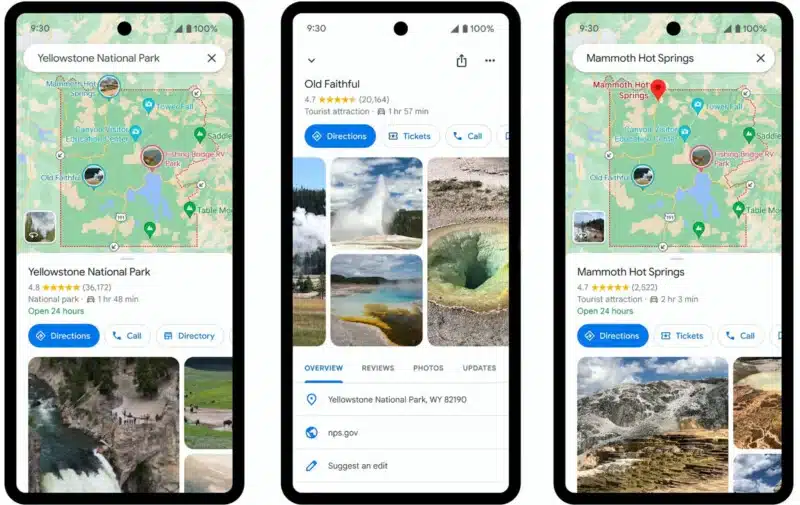
Google Maps added four updates to simplify planning your next park trip and help you find key information.  

Quickly See What A Park’s Must-Do Attractions Are 

Popular spots, such as attractions and trailheads, are now easier to find thanks to community input.  

Search for a park and view photo highlights. Tap for details and reviews to plan your trip quickly.  

See The Popular Trails From Beginning To End In Maps 

When you search for a trail, its route is highlighted, and you get community info on type and difficulty.  

Find Your Way Around With More Detailed Directions 

After selecting places and trails to visit, the maps will provide accurate directions. This month, park entrances will be highlighted, and maps will guide you directly to trailheads with hiking and biking directions.  

Take Google Maps Offline With You, No Matter Which Park You Visit 

Cell service can be unreliable in parks. Now, download offline maps to navigate without an internet connection.  

Planning your next adventure? Here are the top-rated national parks in the US based on Google Maps data:  

  • Great Smoky Mountains National Park  
  • Bryce Canyon National Park  
  • Glacier Bay National Park and Reserve  
  • Canyons of the Colorado National Park  
  • Rocky Mountain National Park  
  • Acadia National Park  
  • Badlands National Park  
  • Mount Rainier National Park  
  • Carlsbad Caverns National Park  
  • Grand Teton National Park  

These updates launch in April for all US national parks and will expand globally. Spend less time planning and more time exploring.

Source:  4 Maps updates to help you explore U.S. national parks