





News 

  • Amazon Web Services (AWS) and OpenAI are collaborating to build a stateful runtime environment powered by OpenAI models. This new tool will be available on Amazon Bedrock, so AWS customers can create generative AI applications and agents at scale.  
  • AWS will be the only third-party cloud provider for OpenAI Frontier. This platform lets organizations build, deploy, and manage teams of AI agents.  
  • OpenAI will use 2 GW of Trainium capacity on AWS to meet demand for a stateful runtime environment and other advanced workloads.  
  • OpenAI and Amazon will work together to create custom models that will power Amazon’s customer-facing applications.  
  • Amazon plans to invest $50 billion in OpenAI.  

OpenAI and Amazon have announced a multi-year partnership to speed up AI innovation for businesses, startups, and consumers worldwide. Amazon will invest $50 billion in OpenAI, starting with $15 billion now and an additional $35 billion in the next few months, subject to certain conditions.  

OpenAI and Amazon are partnering to bring advanced AI capabilities to both and are working together to develop a state-of-the-art runtime environment using OpenAI models. This will be available through Amazon Bedrock.  

Stateful developer environments represent the next step in using advanced models. They let models access resources such as compute, memory, and identity. With a stateful runtime environment, developers can retain context, preserve previous work, use multiple software tools and data resources, and access compute resources. These environments are built to support active projects and workflows.  

These stateful developer environments will be trained to run optimally on AWS’s infrastructure and integrated with Amazon Bedrock, Agent Core, and other AWS services, enabling customized AI applications and agents to run cohesively with the rest of their applications. The stateful runtime environment is expected to launch in the next few months.  

Bringing OpenAI’s most advanced enterprise platform to AWS customers 

AWS will be the only third-party cloud provider for OpenAI Frontier, making OpenAI’s most advanced enterprise platform more widely available as demand for AI grows across industries.  

Frontier enables organizations to build, deploy, and manage teams of AI agents that work across real business systems, with shared context, built-in governance, and strong security, all without managing the underlying infrastructure. As companies move from testing to production, the use of AI frontier makes it easy to quickly, securely, and at scale add powerful AI to existing workflows. Trainium powers growing Amazon customer demand.  

OpenAI and AWS are expanding their existing $38 billion multi-year agreement by $100 billion over 8 years. The expansion includes OpenAI committing to consume approximately 2 GW of Trainium capacity via AWS infrastructure, supporting demand for stateful runtime, frontier, and other advanced workloads. This agreement lowers the cost and improves the efficiency of producing intelligence at scale.  

With this agreement, OpenAI secures long-term capacity and works with AWS to use custom-built silicon chips alongside AWS’s broader compute ecosystem. This lets businesses use AI on demand without managing the underlying infrastructure.  

This agreement covers both Trainium 3 and the next-generation Trainium 4 chips, which will support a wide range of advanced AI workloads. Trainium 4, expected to be available in 2027, will offer much better performance, more memory bandwidth, and higher memory capacity to support more powerful AI systems at scale.  

Custom Models Available To Power Amazon’s Customer-Facing Applications 

OpenAI and Amazon will collaborate to develop custom models for Amazon developers to use in customer-facing applications. Amazon teams will be able to adapt OpenAI models for different AI products and customer-facing agents. These new models will add to the options already available to Amazon developers, like the Nova family, giving teams more tools to build and deliver at scale.  

OpenAI and Amazon share the belief that AI should appear in ways that are practical and genuinely useful to people, said Sam Altman, co-founder and CEO of OpenAI. Combining OpenAI’s models with Amazon’s infrastructure and worldwide reach helps us put powerful AI into the hands of businesses and users at real scale.  

We have lots of developers and firms eager to run services powered by OpenAI models on AWS. Our unique collaboration with OpenAI to provide straightforward runtime environments will change what’s possible for customers building AI apps and agents, Andy Jassy, president and CEO of Amazon, said. We continue to be impressed with OpenAI and what it is building, and we are excited not only about its decision to go big on our custom AI silicon (Trainium), but also about our opportunity to invest in the company and partner with it over the long term.  

About OpenAI 

OpenAI is an AI research and deployment company. Our mission is to ensure that artificial general intelligence benefits all of humanity.  

About Amazon 

Four principles guide amazon:  

  1. Customer Obsession rather than Competitor Focus  
  1. Passion for Invention  
  1. Devotion to Operational Excellence  
  1. Long Term Thinking  

Amazon strives to be Earth’s most Customer-Centric Company, Earth’s Best Employer, and Earth’s Safest Place to Work.  
 
Customer Reviews:  

  • 1-Click Shopping  
  • Customers’ Recommendations  
  • Prime Fulfillment by Amazon  
  • AWS  
  • Kindle Direct Publishing  
  • Kindle Career Choice  
  • Fire Tablets  
  • Fire TV  
  • Amazon Echo  
  • Alexa  
  • Workout Technology  
  • Amazon Studios  
  • The Climate Pledge  

These are among the innovations Amazon pioneered. For more information, visit amazon.com/about and follow @amazonnews.  

About AWS 

Amazon Web Services (AWS) is guided by customer obsession, pace of innovation, devotion to operational excellence, and long-term thinking. By democratizing technology for over two decades and making cloud computing and generative AI accessible to organizations of every size and industry, we turn big ideas into reality. Learn more at AWS.amazon.com and follow @AWSnewsroom.  

Forward-Looking Statements 

Communication contains forward-looking statements that are inherently uncertain and difficult to predict, including statements regarding:  

  • planned investments  
  • anticipated business activities  
  • The effect of conditions and expected benefits of the strategic partnership between Amazon and OpenAI, such as expected development of the stressful runtime environment, stressful development developer environment, and other developments  
  • performance scaling capabilities  
  • customization offerings or effects that will result from the partnership  
  • the applications, utilization, or effectiveness of artificial intelligence technologies  
  • accessibility of new features, models, and tools  
  • expected compute capacities, capabilities, performance characteristics, and delivery period of Trainium chips  

We use words such as “will”, “believe”, “expects”, “intends”, “anticipates”, “plans”, “future”, “potential”, “continue”, “look forward”, “opportunity”, “keep”, “design”, and similar expressions, as well as words referring to future outcomes such as “train”, “accelerate”, “achieve”, “coming”, “deliver”, “power”, “bring”, “collaborate”, “develop”, “bring”, “become”, “build”, “enable”, “deploy”, “provide”, “invest”, “use”, “meet”, “expand”, “support”, “run”, “lower”, “improve”, “offer”, “next generation”, and variations of such words to identify forward-looking statements. Actual results and outcomes could differ materially for a variety of reasons, including, among others:  

  • Fluctuations in foreign exchange rates and energy prices  
  • Changes in world economic conditions  
  • Tariff and trade policies  
  • Resource and supply volatility, including for memory chips and customer demand  
  • Spending inflation, interest rates, regional labor market limitations, and world events  
  • The rate of growth of cloud services and new and emerging technologies  
  • The amount that Amazon invests in new business opportunities and the timing of those investments  
  • The mix of products and services sold to customers  
  • Competition  
  • Management of growth  
  • International growth and expansion  
  • The outcomes of claims, litigation, government investigations, and other proceedings  
  • Data center optimization  
  • Variability in demand  
  • The degree to which we enter into and maintain and develop commercial agreements and proposed and completed acquisitions, as well as strategic transactions  
  • Other risks and uncertainties, including, among others, risks related to new products, services, and technologies  
  • Security incidents  
  • System interruptions  
  • Government regulation, decision, and fraud  

In addition, global, economic, and international conditions, as well as additional or unexpected circumstances, developments, or events, may give rise to or amplify many of these risks. More information about factors that could affect Amazon’s future business, product development, and financial results is available in Amazon’s filings with the Securities and Exchange Commission, including the most recent annual report on Form 10-K and subsequent filings.  

OpenAI and Amazon share the belief that AI should appear in ways that are practical and genuinely useful to people. Combining OpenAI’s intelligence with Amazon’s infrastructure and worldwide reach helps us put powerful AI into the hands of businesses and users at a real scale.  

Sam Altman, co-founder and CEO of OpenAI.
Source: OpenAI and Amazon announce strategic partnership 

OpenAI and Amazon announce strategic partnership

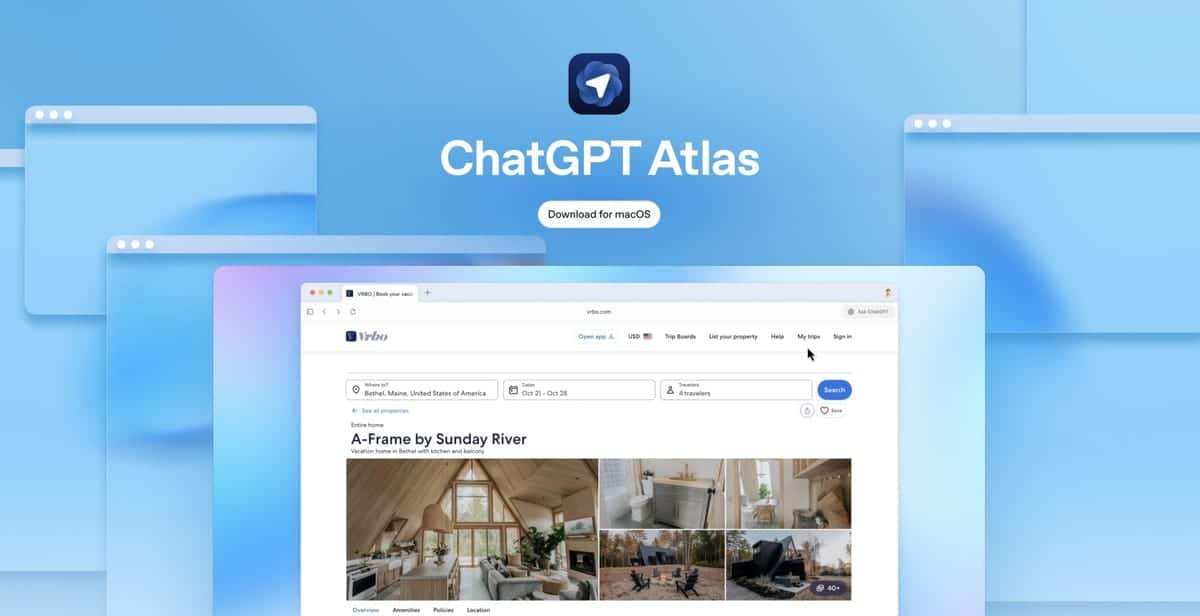
We are excited to share ChatGPT Atlas, a new web browser designed around ChatGPT.  

It gives us a rare moment to think about what it means to use the web. Last year, we added search in ChatGPT so you could instantly find timely information from across the internet, and it quickly became one of our most used features. Your browser is where all of your work, tools, and context come together. A browser built with ChatGPT takes us nearer to a true super-assistant that understands your world and helps you achieve your goals.  

With Atlas, ChatGPT is always with you as you browse, ready to help right where you are. It understands what you are trying to do and can complete tasks for you all without needing to copy, paste, or switch pages. Your ChatGPT memory is built in, so it can utilize past chats and details to help you accomplish new tasks.  

During lectures, I like using practice questions and concrete examples to really understand the material. I used to switch between my slides and ChatGPT, taking screenshots to ask a question. Now ChatGPT instantly understands what I’m looking at, helping me improve my knowledge checks as I go—Yogya Kalra, college student and early tester of ChatGPT Atlas.  

As you use Atlas, ChatGPT learns and becomes more helpful. Browser memories let ChatGPT remember information from the sites you visit and bring it back when you need it. For example, you can ask, “Find all the job postings I was looking for last week and create a summary regarding industry trends so I can prepare for interviews.” Browser memories in Atlas are optional, and you are always in control. You can view or archive them in settings, and deleting your browsing history also deletes any related browser memories.  

LGBT can also help you get things done in Atlas using agent mode. This mode is now faster and more useful because it works with your browsing content. It’s better at researching, analyzing, automating tasks, and planning events or booking appointments while you browse. Agent mode in Atlas is available now in preview for Plus Pro and Business users.  

ChatGPT Atlas is now available worldwide on macOS for free, as well as for Pro and Go users. Atlas is also in beta for business users and, if their plan administrator allows, for enterprise and Edu users. Versions for Windows, iOS, and Android are coming soon.  

You can download Atlas at chatgpt.com/atlas. Getting started is simple. Open Atlas, sign in to ChatGPT, and import your bookmarks, savedpasswords, and browsing history from your current browser.  

Works In Your Flow 

In Atlas, the new Tag page is your starting point. You can ask a question or enter a URL to get quick, helpful results all in one place. If you want more specific results, you can choose tags for search, links, images, videos, and news (where available).  

Built Around You 

ChatGPT can remember what you’ve looked at and suggest your next steps. This might mean:  

  • going back to previous pages  
  • exploring a topic for the finding  
  • related ideas  
  • automating regular tasks  

More Capability, More Control 

You control what ChatGPT can see and remember as you browse. You can clear specific pages, clear your entire browsing history, or use an incognito window to log out of ChatGPT temporarily. ChatGPT will remember important details from the content you browse to improve chat responses and offer smarter suggestions, like creating a to-do list from your recent activity or continuing to research holiday gifts based on products you’ve viewed.  

Browser memories are private to your ChatGPT account, and you can control them. You can see all your memories in settings, archive the ones you don’t need, and delete them by clearing your browsing history. Even with browser history enabled, you can choose which sites ChatGPT can access. If the toggle in the address bar is off, ChatGPT can’t see the page content and won’t create any memories from it.  

By default, we don’t use your browsing content to train our models. If you want to include this content, you can turn on “Include web browsing” in your data controls. Even if you opt in, web pages that block GPTBot won’t be used for training. If you enable training for chats in your ChatGPT account, it will also apply to chats in Atlas. This includes website content you attach to the Ask ChatGPT sidebar and browser memories that help inform your chats.  

Parental Controls work in Atlas 2. If a parent has set up Parental Controls for ChatGPT, these settings will carry over to conversations with ChatGPT in Atlas. We are also launching new Parental Controls in Atlas, including the option for parents to turn off Browser Memories and Agent Mode.  

Get Work Done for You 

At Atlas, you can now ask ChatGPT to take action and complete tasks for you directly in your browser.  

Earlier this year, we introduced the ChatGPT agent, and now it works faster and is built right into Atlas. You can give the recipe to ChatGPT and ask it to find a grocery store, add all the ingredients to a cart, and order them to your house. At work, you can ask ChatGPT to open and review past team documents, conduct new competitive research, and compile findings for a team brief.  

When you ask a question, ChatGPT might check if you want it to open tabs and click in your browser to finish the task. You can also start agent mode by clicking the button.  

Starting today, Agent mode in Atlas is available in preview for Plus, Pro, and Business users. It’s still early, and we may make mistakes on complex tasks, but we are working quickly to improve reliability, speed, and success with more complex workflows.  

We prioritized safety as we built ChatGPT’s agent capabilities in Atlas and added safeguards to address new risks that can come from access to logged-in sites and browsing history while taking actions on your behalf. For example:  

  • It cannot run code in the browser, download files, or install extensions.  
  • It cannot access other apps on your computer or file system.  
  • Will pause to ensure you are watching it take action on specific sensitive sites, such as financial institutions.  
  • You can use an agent in lockdown mode to limit its access to sensitive data and the risk of it taking actions on your behalf on websites.  

ChatGPT’s agent features still have some risks. Besides making mistakes while acting for you, agents can be tricked by hidden malicious instructions in places like web pages or emails. This could overwrite the agent’s intended behavior and might lead to stealing data from sites you’re logged into or taking actions you didn’t want.  

As outlined in the ChatGPT agent system card, they’ve run thousands of hours of focused red-teaming and have placed particular emphasis on safeguarding ChatGPT from such attacks, including designing safeguards that can be rapidly adapted to novel attacks. Still, our safeguards will not stop every attack that appears as AI agents grow in popularity. Users ought to weigh the trade-offs when deciding what information to provide to the agent and take steps to minimize their exposure to these risks, such as using the ChatGPT agent in locked-out mode in Atlas. We will continue to monitor and patch any vulnerabilities that we discover.  

This launch is a step toward a future where most web use occurs through agent systems. You will be able to hand off regular tasks and focus on what matters most.  

What’s Next? 

We continue to make Atlas better, and our roadmap includes:  

  • multi-profile support  
  • improved developer tools  
  • ways for app SDK developers to increase the discoverability of their apps on the Atlas website  
  • Owners can now add ARIA tags to improve how that ChatGPT agent works on their websites in Atlas  

This is only the beginning. We’ll be adding new features and improvements often. You can keep up with the updates in our release notes. Try it now at chatgbt.com/atlas.

Source: Introducing ChatGPT Atlas 

Apple has announced the iPhone 17e, a powerful and more affordable option in the iPhone 17 lineup. The new iPhone 17e runs on the latest A19 chip, delivering strong performance in routine tasks. It also includes the C1X cellular model, which is up to twice as fast as the C1 in the iPhone 16e. The 48 MP fusion camera delivers high-quality photos, next-generation portraits, and 4K Dolby Vision video with its optical-quality 2x telephoto lens. Users get the benefits of two cameras in one. The 6.1-inch Super Retina HDR display features Ceramic Shield 2, which is three times more scratch-resistant than before and reduces glare. MagSafe enables fast wireless charging and easy-to-use accessories, such as chargers and cases, when users are away from home. Cellular and Wi-Fi coverage satellite features, such as Emergency SOS, roadside assistance messages, and Find My Via Satellite, help them stay connected when it matters most.  

The iPhone 17 comes in three colors with a premium matte finish:  

  • Black  
  • White  
  • A soft new pink  

Pre-orders start on Wednesday, March 4, and the phone will be available beginning Wednesday, March 11.  
 
The starting model offers 256 GB of storage for $599, which is double the entry of storage of the previous generation at the same price and four times that of the iPhone 12. This gives users more room for:  

  • High-def photos  
  • 4K videos  
  • Apps  
  • Games  
  • More  

iPhone 17e combines powerful performance and features our users love at an exceptional value, making it a persuasive option for customers looking to upgrade to the iPhone 17 family, said Kaiann Drance, Apple’s vice president of worldwide iPhone product marketing. We know our customers want a product that will last, and the iPhone 17e provides exactly that with:  

  • A19 for incredible performance  
  • durable double the entry storage  
  • a smarter camera system  
  • augmented durability  

iPhone 17e is designed to stay fast, secure, and valuable for years to come.  

A Beautiful Design With Greater Durability 

iPhones keep their value longer than other smartphones, and the iPhone 17e is built to last. It has a strong yet lightweight aerospace-grade aluminum design and is splash-, water-, and dust-resistant with an IP68 rating. The ceramic shield to the front cover used across the iPhone 17 family is tougher than any other smartphone glass. An Apple-designed coating gives it three times better scratch resistance than the previous generation and helps reduce glare.  

The super-super Retina XDR display with OLED technology delivers an exceptional viewing experience. Whether users are streaming videos in Dolby Vision or playing games with up to 1200 nits peak HDR brightness, content is easy to see even on bright days. Face ID gives users a simple and secure way to unlock the iPhone 17E, make purchases, sign in to Apps, and more. The action button lets users quickly access favorite features like the Flash Light, Visual Intelligence, and more with a single press.  

Powerful Performance And Exceptional Efficiency 

iPhone 17e features the latest generation A19, built with advanced 3nm technology, providing powerful performance and exceptional efficiency, faster than iPhone 11. It handles everything from simple tasks like viewing photos to advanced Apple Intelligence capabilities like clean up. The four-core GPU with neural accelerators unlocks console-level gaming on the go, supporting demanding AAA titles and hardware-accelerated ray tracing for more realistic lighting and reflections. The upgraded 16-core Neural Engine is optimized for large generative models and, combined with neural accelerators built into each GPU, enables Apple intelligence and other AI models to run faster than on the previous generation.  

The iPhone 17E also includes Apple’s C1X cellular modem. C1X is up to twice as fast as the C1 in the iPhone 16E and equals the speed of the iPhone Air. It uses 30% less energy than the modem in the iPhone 16 Pro, helping to provide excellent all-day battery life.  

Excellent Battery Life, Fast Charging, And MagSafe 

The iPhone 17e offers excellent all-day battery life thanks to efficient Apple silicon, the C1X model, and advanced power management in iOS 26, with fast wired charging through USB-C. It can reach 50% charging in about 30 minutes. The iPhone 17e also supports MagSafe and G2 for fast wireless charging up to 15 W, compared to 7.5 W with G2 on the iPhone 16e. MagSafe chargers, stands, cases, wallets, camera accessories, and more attach easily to the back of the iPhone 17e, making it simple to use a wide range of accessories.  

An Advanced Camera System to Capture Daily Moments 

iPhone 17e takes gorgeous photos with excellent detail capture, including low light with Night mode. The 48MP fusion camera delivers optical quality 2x telephoto, giving users two cameras in one so they can get closer to the subject and easily frame their shot. Users can shoot sharp photos at up to 48MP resolution or capture in the 24MP default for incredible image quality at a file size perfect for storing and sharing.  

Portrait Mode Improves. Thanks to an advanced image pipeline, delivering remarkably natural depth and smooth bokeh that gracefully blurs the background while keeping subjects sharp. The advanced pipeline also enables text-generation portraits: iPhone 17e recognizes people, dogs, and cats and automatically saves depth information, allowing users to turn photos into beautiful portraits with background blur after capture and to adjust the focus point in the Photos app. The latest generation of HDR captures subjects with true-to-life skin tones and ensures bright highlights, rich midtones, and deep shadows throughout the image, while preserving fine details.  

The iPhone 17E takes stunning photos and records high-quality 4K Dolby Vision videos at up to 60 times 60 frames per second. It also captures video with spatial audio for an immersive experience with AirPods or Apple Vision Pro. It offers more ways to edit video sound with Audio Mix and Wind Noise Reduction. It uses advanced machine learning to automatically remove unwanted noise, resulting in cleaner audio and improved communication.  

iPhone 17E helps users stay connected and get help when needed. If users are outside cellular and Wi-Fi coverage, they can:  

  • text friends and family with messages via satellite  
  • Contact emergency services with Emergency SOS via satellite  
  • reach roadside assistance providers  

With Roadside Assistance via Satellite, the FindMy app lets users share their location via satellite, giving friends and family peace of mind while traveling off the grid. Crash detection can sense a severe car accident. Call emergency services if the user is unconscious or unable to reach their iPhone.  

The iPhone 17E comes with iOS 26, which features a new design, powerful Apple intelligence, and useful updates to everyday apps. The liquid glass design makes apps and the system experience more expressive, puts more focus on content, keeps iOS familiar, and adds new ways to personalize the iPhone.  

Apple intelligence lets users communicate in different languages with live translation in Messages and FaceTime on iPhone and with AirPods. Visual Intelligence now works on the phone screen, so users can search, ask questions, and take action on what they see, helping reduce distractions. Call Screening can filter calls from unknown numbers and ask the reason for calling, while Hold Assist can wait for the line until a live agent is available in messages. Users can now filter messages from unknown genders into a separate folder to keep the conversation list organized.  

iPhone 17e And The Environment 

Apple 2030 is the company’s plan to become carbon-neutral across its entire operations by the end of this decade, by cutting emissions from materials, electricity, and transportation. The iPhone 17E is made with 30% recycled content, including 85% recycled aluminum in the enclosure and 100% recycled cobalt in the battery. It is produced using 55% renewable electricity, such as wind and solar, throughout the supply chain. The iPhone 17E is built to be durable and repairable, offers leading software support, and meets Apple’s high standards for energy efficiency and safe materials. The paper packaging is made entirely from fiber and can be easily recycled.

Source: Apple introduces iPhone 17e 

Dell is making major investments in its Round Rock campus to boost AI factory production. The company hopes to double its revenue growth by 2027, driven by strong demand for AI servers and infrastructure. By focusing on Sovereign cloud, Dell is helping governments and businesses keep their data private, compliant, and secure. This sets Dell apart in the growing market for secure AI solutions.  

Multiple key factors are driving this expansion:  

  • Soaring AI demand: Dell expects to reach $ 50 billion in AI Server revenue by fiscal year 2027, with much of the backlog coming from Nvidia’s Grace Blackwell systems.  
  • Sovereign Cloud & security: By focusing on cloud-based software, Dell meets the need for secure local data management. This is especially important for sectors such as defense, healthcare, and public services.  
  • Planned expansion: Dell is following a China-plus-one strategy to boost domestic production. The company plans to move much of its manufacturing to countries like India and Mexico by the end of 2026 to reduce geopolitical risks.  
  • Broadened AI portfolio: Dell is adding AMD Instinct MI300X accelerators to its PowerEdge servers and growing its range of commercial AI laptops with neural processing units (NPUs).  

With this new strategy, Dell is becoming more than just a hardware supplier. The company is now a key infrastructure partner for governments and large businesses that want to build, deploy, and manage their own AI systems while complying with local regulations.  

Dell Technologies ended FY26 with record revenue of $113.5B, a 19% increase from last year. In Q4, revenue reached $33.4B, up 39%, and operating income rose 32% to $3.5B.  

AI infrastructure is still a key focus in Q4. Dell received $34.1B in AI orders, fast surpassing the full-year total from two years ago. The company ended the year with a $43B backlog, mostly made up of NVIDIA’s Grace Blackwell Systems. NVIDIA reported 73% revenue growth yesterday. Dell’s AI revenue grew more than four times year-on-year in Q4, and full-year AI server shipments totaled $25.2B. For FY27, Dell expects $50B in AI server revenue, signaling another year of strong growth.  

As Chairman and COO Jeffrey Clark noted, the enterprise segment of Dell’s 5-quarter pipeline grew the fastest in Q4, and the company’s AI customer base now exceeds 4,000. Enterprise demand is expanding beyond training to include AI inference, coding, automation, and financial modeling. Clark pointed to Dell’s use of AI agents to write software, not just assist developers, as an example of the heavy computing niche now seen in enterprise.  

Attach rates for AI server shipments are rising across storage, networking, and services such as installation, deployment, and ongoing support. CFO David Kennedy said these services set Dell apart with on-site engineers helping keep running smoothly, something competitors struggled to match at scale. Still, services revenue fell 2% in Q4 to $5.8B and dropped 4% for the year to $23.1B. The difference between the AI-driven services directory and actual services growth is worth noting.  

In the Client Solutions Group, Q4 revenue reached $13.5B, up 14%. However, this increase hides a big difference between commercial and consumer results. Commercial revenue rose 16% to $11.6B, thanks to strong demand from large enterprises, while consumer revenue stayed about the same. Many commercial devices are now 4 to 5 years old, so that the upcoming refresh cycle could bring more revenue not only from device sales but also from services and life-cycle contracts tied to a larger installed base.  

For FY27, Dell expects overall revenue to reach $140B, at the midpoint, a 23% increase. The main operational risk is the supply environment, as component costs keep rising and lead times are getting longer across the industry.

Source: Dell’s AI backlog hits $43bn as services revenue declines 

News Summary 

  • AMD is adding to its Ryzen AI lineup with the new Ryzen AI 400 series and Ryzen AI Pro 400 series desktop processors. These are the first processors designed for cutting-edge AI PC applications and support Co-Pilot plus PC features.  
  • OEM partners are launching new AI PCs, including enterprise notebooks and mobile workstations, powered by the AI Pro 400 series mobile processors.  
  • Ryzen AI 400 series mobile processors offer up to 30% faster multi-threaded performance than other processors, helping professionals finish demanding tasks more quickly while still enjoying all-day battery life.  
  • AMD now provides its widest range of enterprise PC solutions supported by the AMD Pro platform. This platform improves security, manageability, and resilience for large-scale AI PC deployments.  

At Mobile World Congress 2026 in Barcelona, AMD introduced new additions to its Ryzen AI lineup, calling the Ryzen AI 400 Series and Ryzen AI Pro 400 Series desktop processors. These processors offer strong on-device acceleration and next-level performance, letting users run AI applications and large language models locally. They also handle demanding tasks like design engineering and engineering with ease. AMD is also adding workstations to the Ryzen AI 400 series mobile lineup.  

With these new processors, OEMs can now offer next-generation AI PCs, including high-performance desktops, laptops, and mobile workstations built for today’s workloads.  

Ryzen AI 400 series processors are the first desktop AI PC chips to support Microsoft’s Co-Pilot Plus PC features, and they include a neural processing unit that delivers up to 100% of AI computing power. This lets users run AI-assistance and productivity tools directly on their PCs, keeping sensitive data on the device and offering better control, performance, and privacy.  

The desktop PC is evolving from a tool you use to an intelligent assistant that works alongside you, said Jack Huynh, senior vice president and general manager of the Computing and Graphics group at AMD, with the Ryzen AI 400 series. It is the world’s first-ever design to power the new Co-Pilot Plus experience on the desktop. We’re bringing beautiful AI acceleration that helps our partners build systems for both businesses and consumers to achieve more.  

The World’s First Co-Pilot Plus Desktop Processor For Next Gen AI Applications 

AMD Ryzen AI 400 Series Desktop processors are built to ensure scalable performance and smart features for professional tasks. They combine high-performance Gen5 CPU cores, AMD RDNA 3.5 graphics, and a dedicated AMD XDNA 2 NPU. This mix gives office professionals, developers, and power users the speed, efficiency, and local AI acceleration they need. Whether it is multitasking, collaboration, software development, data analysis, or AI-assisted work, these processors deliver consistent performance and on-device intelligence for today’s desktops.  

Expanding Ryzen AI Leadership to Notebooks and Mobile Workstations 

AMD’s Commercial PC lineup grows. OEM partners are launching more notebooks powered by the Ryzen AI Pro 400 series mobile processors. The Ryzen AI9 HX Pro 470 offers up to 30% faster multi-threaded performance than the Intel Core Ultra X7 3581, helping users work through demanding tasks faster. These systems also provide stronger power efficiency and all-day battery life, so productivity lasts throughout the day. With Ryzen AI Pro 400 series processors, AI acceleration and Co-Pilot plus PC features are now available in mobile devices.  

As more organizations use AI in their daily work, Ryzen AI PRO 400-series mobile processors bring advanced local AI features to commercial notebooks and workstations, with a high-performance NPU that delivers up to 60 ToPS of AI compute. These processors use one-device AI acceleration to improve efficiency. This helps businesses boost productivity while keeping the pace and responsiveness professionals need.  

Aizen AI Pro 400 series mobile processors will also be used in next-generation workstations, bringing the same high performance to professional systems and supporting independent software vendors (ISVs). These mobile workstations are built to speed up professional applications that use all available computing resources for demanding engineering, creative, and technical tasks.  

Availability of Ryzen AI Pro 400 series mobile workstations 

Mobile workstations powered by Ryzen AI Pro 400 series processors are expected to be available from OEMs, including Dell Technologies, HP, and Lenovo, starting in the second quarter of 2026.

Source: AMD Gives Consumers and Businesses More AI PC Options with Expanded Ryzen™ AI 400 Series Portfolio 

After nearly three years, Intel is returning to the desktop workstation with the anticipated Granite Rapids WS series, now called Xeon 600. The new series covers all of Intel’s bases for desktop workstations with the previous-gen Sapphire Rapids. WS/Intel split its products between two lineups: Zeon W2500 and Zeon W3500, but all Granite Rapids workstation chips will use the same Xeon 600 branding.  

Granite Rapids has been in the data center for about 1.5 years. During that time, AMD introduced its Zen 5-based Threadripper 9000 chips, leaving an open slot for Intel to release its next-generation workstation CPUs. Intel has eleven SKUs for Xeon 600, five of which will be available as boxed models for retail sale. Intel hasn’t provided a firm release date for the CPUs, but says the new W890 motherboards and systems from brands like Dell, Lenovo, Supermicro, and Puget will be available starting in late March.  

Compared to refreshed Sapphire Rapids WS parts, Intel claims Xeon 600 delivers up to 9% better single-core performance and up to 61% higher multi-threaded performance. The higher multi-threaded performance comes from much higher code numbers on 8.86 cores and the Xeon 696X with 64 cores.  

Like its data center counterpart, Xeon 600 chips use the Redwood Co. micro-architecture that debuted in Intel’s Meteor Lake mobile chips. Here, the core count is scaled up and, following Intel’s new split of Xeon CPUs into heterogeneous architectures, the Xeon 600 CPUs use only P-cores with hyper-threading.  

The full list of Xeon 600SK ranges from $499 for the 12-core Xeon 634 up to $7,699 for the flagship Xeon 698X. This split largely mirrors AMD’s approach with Threadripper 9000 chips, where the main range tops out at 64 cores, while the Threadripper Pro 9000 WX range reaches 96 cores.  

Short of the bottom three SKUs, some platform features are consistent across the Xeon 600-range X-Series SKUs:  

  • They are unlocked for overclocking.  
  • All octa-channel memory supports speeds up to 6400.  
  • You also get 128p CLE 5.0 Lens, CXL 2.0 Support, and an intense AMX accelerator in each CPU core, which now supports FP16 instructions.  

The chips support up to 40 TB of memory, doubling what’s available on AMD’s Threadripper 9000WX range and quadrupling support compared to the base Threadripper 9000 range. Even an A1 TB kit of DDR5 6400 RDIMMs costs about $28,000 right now, bringing support for MRDIMMs(multiplexed rank DIMMs).   

MRDI MMS are supported in the data center with Xeon 6 CPUs, but this is the first time we’re seeing them in workstation chips. MRDIMMs include two ranks of memory chips, each with a multiplexer chip. The multiplexer combines the bandwidth of both ranks, doubling the transfer rate. In the case of Xeon 600, with support for up to 8000 MT/s.  

MRDI-MMs use the same physical connector as RDI-MMs, so they fit into existing connectors if the CPU supports MRDI-MMs. MRDI-MMs are only relevant in HPC settings where memory bandwidth build is critical, so Intel isn’t supporting them across the full stack. They are only supporting the top 5 SKUs, starting from the Xeon 678X.  

Intel broadly claims a 9% improvement in single-core performance with the Xeon 600 series compared to the Xeon W2500 and Xeon W3500, according to Intel. These numbers come from Cinebench 2026 scores, as you can see. The disclaimers and configurations are included at the end of the gallery below.  

Looking at the spec workstation for Intel, it says the flagship Xeon 698X offers:  

  • a 17% improvement in AI  
  • 22% in the energy sub-category  
  • 61% in financial services  
  • 19% in life sciences  
  • 10% in media and entertainment  

compared to the Xeon W9-3595X. In the productivity category, the Xeon 698X boasted identical performance, while in product design, it showed an undisclosed regression.  

In specific apps, Intel says the Xeon 698X finished the Blender Junction Render 74% faster than the Xeon W-3595X and sped up AI-powered upscaling with Topaz Labs Video Upscaler by 29%. Intel attributes the latter speedup to the AMX accelerators in the Xeon 600-core chips. To that end, Intel is introducing Open Image Denoise 2.4, which it says is accelerated by FP16 instructions, Available in Xeon 600 AMX.  

In development, data analysis, and AI interpretation:  

  • 24% better linear algebra performance (as measured in algorithms in Intel’s form of NumPy/SCIPY)  
  • 18% faster large data set analysis with spec workstation 4s data science workload  
  • 16% faster AI inference with spec workstation 4s ONNX inference test  

In particular, Intel didn’t share any competitive benchmarks for Threadripper 9000 during a press Q&A session. Intel’s Jonathan Patten said, “We’re looking to be very competitive within the market, offering better performance per dollar for more value for the workstation spend. This is a very highly expandable platform. We have up to 4 TB of memory capacity, supporting two DI/MMs per channel. Our competitors do not. We have advanced instruction sets, AMX, as we mentioned a little bit, and our vPro technology, so we continue to offer a very competitive platform.”  

Hopefully, we’ll have those comparisons soon. Intel says Xeon 600 motherboards with the W890 chipset will launch in late March, as will workstations from OEMs like Dell, Lenovo, and Supermacro. We still haven’t learned about a firm release date, let alone a release window, for boxed Xeon 600 chips.

Source: Intel returns to boxed workstation CPUs with Xeon 600 — Granite Rapids WS delivers up to 86 cores, 4TB of memory, and 128 PCIe 5 lanes 

In mid-February, Amazon sellers received a policy update email, but most people just skimmed it or paid little attention.  

But overlooking it could be a big mistake.  

The updated Business Solutions Agreement, which takes effect on March 4, 2026, is one of the biggest changes Amazon has made to its seller contracts in years. Its impact goes far beyond just your automation tools.  

Let’s break down what’s changed, who needs to pay attention, and what steps you should take.  

What Did Amazon Actually Change 

The new BSA makes official what Amazon has been moving toward for some time: definite legal control over any AI or automated system that interacts with its marketplace.  

The main change is a new agent policy in Section 19. This policy creates a category called Agent for any automated software or AI system that uses Amazon services, such as Seller Central, advertising APIs, or third-party tools linked to your account. Now three rules apply to all of these systems.  

Every agent must identify itself as an automated system when it connects to Amazon. Each agent has to follow the agent policy at all times. Also, every agent must stop accessing Amazon right away if Amazon asks.  

The last rule is often called the kill switch provision. Amazon can tell any automated system to stop working on its platform. If your tools don’t shut down when told to, you could run into compliance issues.  

In addition, Section 4.2 now limits the use of Amazon materials or services for developing or improving AI and machine learning models. This includes reverse engineering, data mining, and creating source code or model parts. Amazon is making it clear that its platform is not meant for training outside AI systems.  

What Does This Mean for Your Tech Stack? 

If you use repricers, PPC automation, listing optimization software, or internal scripts that connect to Seller Central or Amazon APIs, all of these are now covered by this policy. The real question for most brands isn’t whether your tools are included, but whether your vendors have updated their systems to comply with the new rules.  

You should check that every third-party tool connected to your Amazon account can identify itself as an automated system when it logs in, and that you or the vendor can turn off access right away if Amazon asks. Some vendors are already prepared, but others are not. It is better to talk to them now than wait until there is a problem.  

So if you keep selling on Amazon after March 4, you are automatically agreeing to these changes. You don’t need to sign anything new. The agreement takes effect by default.  

The Generative Search Angle (Most people are missing this part) 

There’s another part of the Amazon BSA update that isn’t getting much attention, but it’s important for brands focused on generative search visibility.  

Tools like ChatGPT, Perplexity, and Gemini have always had trouble getting product data from Amazon, even before this update. Amazon used robots.txt rate limits and other technical blocks to stop AI crawlers from scraping product pages. The new BSA makes this official and shuts down any backdoors that could have been used to access data.  

Generative search engines don’t have direct up-to-date Amazon data at scale. When someone asks ChatGPT to recommend the best protein powder or compare running shoes, the answers come from sources beyond Amazon’s listings. This is more important than many brands think.  

If your product information is only on Amazon, you’re mostly invisible to the AI systems that are now influencing buying decisions before shoppers even open their browsers.  

How To Build Generative Search Presence Whenever Amazon Is Off-Limits 

We’ve been telling clients this for a while: Don’t rely on Amazon as your only source of product information online.  

Your DTC site or brand hub should have the most complete and detailed information about every product you sell. Include:  

  • Full spec tables  
  • Use cases  
  • Comparison content  
  • Buying guides  
  • FAQ sections that answer real customer questions  

Amazon’s listing rules won’t let you share all this there, so your own website is the best place for it.  

Schema markups are more important than ever. Structured data like product info, reviews, FAQs, and how-to guides makes it easier for a generative system to read, summarize, and reference your content. If you haven’t checked your DTC site’s schema recently, now is a good time to do so.  

Being on multiple channels helps, too, if your products are listed on Walmart, Target, specialty retailers, and Amazon. Generative systems can get a better sense of your products without relying on Amazon data. The more places your brand appears online, the more accurately AI can represent you.  

The main idea is that Amazon will remain on your primary sales channel, but your product information shouldn’t live only there. Relying solely on Amazon has always been risky, and this BSA update underscores that risk.  

Amazon AI Agent Compliance Checklist 

Most brands don’t need to panic, but a few actions are worth completing before the deadline:  

  1. Audit every third-party tool that accesses your Amazon account and confirm it meets the new agent requirements.  
  1. Contact your major vendors and ask directly whether they are compliant.  
  1. With the March 4 BSA update, verify that the Kill Switch capability exists for each tool, either on the vendor side or your own.  

If you use any internal information, scripts, or custom integrations, review them with someone who understands the new rules in Section 19. The definition of an agent is broad, so even standard fulfillment automation counts.

Source:Amazon’s New AI Rules Go Live March 4. Here’s What They Mean for Your Business 

Takeaways 

  • For the 2026 U.S. elections, we are using the same thorough measures we have relied on for years. We support free expression, encourage voter participation, and are transparent about AI-produced content.  
  • Like in past election cycles, we will keep blocking new political ads on our platforms during the last week of the campaign.  
  • We are still running our election operations center and focusing on protecting people from scams on our platforms, especially those that misuse images of politicians.  

This November, millions of Americans will vote in the U.S. elections. Every election is different, but Meta has built a thorough approach for our platforms. We support free expression, encourage civic participation, and offer strong transparency for political and social issue ads.  

As we prepare for the 2026 elections, we are explaining how our established policies and safeguards will operate on our platforms.  

Industry-Leading Transparency Around Political Ads 

Advertisers who want to run ads about elections, politics, or social issues must go through an authorization process and add a “Paid for by” disclaimer. We have kept these ads in our public ad library for seven years. Right now, our ad library has over 18 million U.S. entries.  

Restriction period column as before. We will block new political, electoral, or social issue ads during the last week of the US election campaign. Ads that have already shown at least once before this period can keep running. We do this because in the final days of an election, there may not be enough time to challenge new claims in ads.  

Political ads created or edited using AI: advertisers must tell us whether they use AI to create or change ads about social issues, elections, or politics. In certain cases, when they do, we add this information to the ad and our ad library. We are always improving our labeling so people can more easily spot ads that may have been edited or made with AI.  

Identifying Artificial Intelligence-Generated Content Beyond Political Ads 

Use industry standards and technologies, such as C2PA, to spot content created or altered with AI outside ads on our platforms. We label this content to keep things transparent. If we detect that the content was made by an AI tool, we show an AI info label and explain if the label comes from industrial signals or self-disclosure. People must use this label when posting organic content that includes photorealistic video or realistic audio that was digitally created or altered. If they do not, we may apply penalties.  

Continuing To Connect People with Information From State And Local Officials 

Voting Information and Election Day Reminders: As in the past years, we show notifications at the top of Facebook and Instagram feeds to connect people with local and state voting information, including during primaries. On Facebook, these notifications are now easier to understand because we show them the input the users choose a language and another language if they interact with content in that language. If someone has moved or we get their location, they can select “Change state” to get the correct government information.  

Search Engine Results: When people search for election-related ITAC terms on Facebook, we show results that link to state government websites for more information.  

Voting Alerts: On Facebook, we keep working with state and local election officials to send timely voting alerts about registering and voting to people in their communities. State and local officials have sent over 1 billion notifications through Voting Alerts on Facebook.  

Instagram stickers: On Instagram, we continue to highlight stickers on stories that guide people to official voting information before registration deadlines and Election Day.  

Empowering the community to add expanded context 

Last year, we launched Community Notes so people can add context to posts on Facebook, Instagram, and Threads that might be misleading or confusing. Unlike terrestrial third-party fact-checking, Community Notes are written and rated by contributors, not by Meta or a small group of fact-checkers. Notes can be added to most public content, including posts by Meta, our executives, public figures, and politicians. Contributors decide which content could use greater context. A note is only published if it reaches consensus, which means contributors who usually disagree on it. This helps reduce bias and improve the quality of published notes. Anyone in the US can sign up to be a contributor if they are over 18, have an account that is more than 6 months old and in good standing, and either have an authenticated phone number or use two-factor authentication.  

Combating Scams 

Focusing on protecting people from scams, including those that misuse politicians’ images, we consistently review and update our approach. Our policies do not allow ads that use images of public figures to scam or defraud people. We continue to invest resources to fight these fraudulent ads and are continually improving our enforcement, including suspending and deleting accounts, pages, and ads that break our rules.  

Fraudsters use elections to trick people into engaging with content that appears to be political campaigns. To help people spot and avoid these threats, we have created resources in our Scam Prevention Hub. We also use facial recognition technology to detect and stop celeb bait ads that use images of public figures to defraud people. We remove imposter accounts that are reported for impersonating others.  

Operational Readiness: We have invested over $30 billion in safety and security over the past decade, including efforts to protect elections on Facebook, Instagram, and Threads. We enforce our rules against voter interference, electoral violence, and false information about when, where, and how to vote. We remove content that breaks our rules as soon as we find it. We also remove content that could cause physical harm or disrupt elections.  

They are also continuing to expose and disrupt foreign influence operations, including those targeting elections, and have identified 200 networks of coordinated inauthentic behavior since 2017. Our Election Operations Center, which brings together subject matter experts across Meta, including our threat intelligence, data science, engineering, research, operations, and legal teams for real-time monitoring to tackle potential abuse flowing across our network, as we have since 2018. This is for elections around the globe, including the Brazilian presidential election.

Source: How Meta Is Preparing for the 2026 US Midterm Elections 

Microsoft is quietly building a new Canvas-style workspace for Co-Pilot, and leaked screenshots suggest it is a full-fledged AI-powered whiteboard.  

As posted on x by Windows enthusiast Walking Cat, the feature/app is internally referred to as Project Firenze; however, the leaked interface shows the name Co-Pilot Canvas.  

Co-Pilot Canvas appears to be a web-based environment where users can create and manage canvases drawn with digital ink tools and interact with content in a free-form layout, similar to the existing Microsoft Whiteboard app.  

The landing screen shows a prompt to create your initial canvas to start drawing and taking notes. Like the Microsoft Whiteboard app, Co-Pilot Canvas can automatically save your work.  

We found references to both development and production of Azure endpoints, which suggest Co-Pilot Whiteboard is being actively tested internally and is not a static mockup. There is also a generic-looking logo, but we are not sure if this is the final version.  

Despite no major updates recently, the Microsoft Whiteboard app remains a fully functional collaborative tool, so it is unclear whether Microsoft is replacing it with Co-Pilot Canvas.  

CoPilot Canvas Integrates AI Image Generation, Streaming, And Advanced Feature Controls 

As expected, Co-Pilot whiteboard will rely on AI as its main differentiator compared to the original Microsoft whiteboard. Seven developer-style options point to a system designed for instant AI interaction.  

One of the most telling switches is labeled “Create with AI streaming”, suggesting the canvas may support live generative responses as you draw or type instead of waiting for a completed prompt. Copilot Whiteboard may generate diagrams, layouts, or visual elements incrementally as you work, similar to brainstorming with an assistant that updates the board in real time.  

Another menu shows an image model selector with options such as GPT-4o Image Gen (default), GPT-4o Image Gen 1.5, and GPT Image 1.5, which are not the latest models. However, the presence of multiple selectable models shows that the Co-Pilot canvas can handle multi-modal generation directly in the workspace.  

Auto-naming for Canvas titles could be useful for collaborative work during or after a meeting. Co-Pilot Whiteboard may examine the content of a board and produce a meaningful name automatically.  

The Co-Pilot Canvas app also reveals a long list of AI-related configuration panels under developer mode, including:  

  • Debug gates/AI gates.  
  • Meeting summary  
  • One Shot Grounding  
  • Post grounding  
  • Intent detection  
  • Solve Math  
  • Delegate actions to Augloop and hand off actions  

These are not typical whiteboard features. They support agent-style behaviours in which the AI can reason over content, summarize discussions, interpret intent, and potentially trigger additional actions, which aligns with Microsoft’s strengths.  

Co-Pilot Canvas could bring AI to help with brainstorming on whiteboards. 

Today, most interactions with AI still take place in a chat box. Co-Pilot cameras may be placed closer to a visual workspace where users can collaborate, map, and execute ideas with Co-Pilot’s help.  

Although many modern canvas-style apps like Notion, Visual Pages, Figma, Miro, and Microsoft Whiteboards exist, Microsoft could be in a unique position to bring AI into the whiteboard environment because it has direct access to enterprises.  

Co-Pilot whiteboard could enable workflows where teams can:  

  • sketch  
  • draft documents  
  • generate images  
  • summarize discussions  
  • trigger actions  

Microsoft may also be considering portable workspaces with Co-Pilot whiteboard, since there are options to export and import .canvas files. This could allow teams to share AI-assisted canvases, as they do with documents today.  

That being said, everything about Project Forensic looks like an early developer toggle feature, and internal endpoints point to something in testing rather than something prepared for release.  

Microsoft has not made any public announcement about a possible replacement for Microsoft Whiteboard or any roadmap. We will update as soon as Microsoft makes Copilot Canvas official.

Source: Microsoft Copilot Canvas leak reveals an AI-powered Whiteboard with image generation, AI streaming, and more 

News summary 

  • Top operators and infrastructure providers such as Booz Allen, BT Group, Cisco, Deutsche Telekom, Ericsson, Maitreya, Nokia, ODC, SK Telecom, SoftBank Corp., and T-Mobile plan to use open, trusted software-defined wireless platforms.  
  • This commitment adds to NVIDIA’s ongoing work with industry and governments in Europe, Japan, Korea, the UK, and the US to push forward AI-native 6G innovation.  

At Mobile World Congress, NVIDIA announced a joint commitment with Booz Allen, BT Group, Cisco, Deutsche Telekom, Ericsson, Maitreya, Nokia, ODC, SK Telecom, SoftBank Corp., and T-Mobile to build the next generation of wireless networks using AI-native, open, secure, and trustworthy platforms.  

This effort demonstrates a shared commitment to making 6G infrastructure, which will serve as a foundation for future worldwide connectivity, open, intelligent, resilient, and able to drive innovation while protecting global trust.  

6G wireless networks will go beyond basic connectivity and become the backbone for physical AI. They will support billions of self-driving machines, vehicles, sensors, and robots, requiring much higher levels of security and trust. Older wireless systems were not built for these needs, so new challenges will arise as networks become more complex.  

To address these problems, NVIDIA is uniting the industry to develop AI-native software-defined wireless platforms based on open trusted principles by adding AI throughout the radio access network, edge, and core 16 network. We’ll need to provide:  

  • secure sensing and communication  
  • smart decision making  
  • support for interoperability  
  • supply chain resilience  
  • faster innovation  

AI is changing computing and driving the largest infrastructure expansion ever. Telecommunications is the next step, said Jensen Huang, founder and CEO of NVIDIA, with a global group of industry leaders in media building AI RAN to run telecom networks into AI infrastructure everywhere.  

Uniting On Openness And Trust For The AI-Native Software-Defined Era Of Connectivity 

6G will be AI-native and software-defined, allowing wireless networks to keep up with rapid innovation. Networks built on AI/RAN architecture will evolve through software, providing real-time intelligence and quick progress. This change will welcome a wide range of participants, including global operators, tele-technology providers, start-ups, researchers, and developers, all working together on open and programmable platforms.  

Alison Kirkby, Chief Executive of BT Group, said: “Connectivity is the backbone of economic growth, and with this cooperation, we are helping lay the foundations for a future ecosystem that is intelligent, sustainable, and secure by building on open and trustworthy AI-native platforms. We can simplify future technologies like 6G, making sure they build upon the strengths of today’s 5G networks while still unlocking powerful new capabilities at scale.”  

Tim Hottges, CEO of Deutsche Telekom AG, said: “Best network, best customer experience: that remains our promise. With an open, intelligent, and trusted 6G infrastructure, we are laying the foundation for the era of physical AI and bringing new value to our customers for industry and for society.”  

Arielle Roth, Assistant Secretary of Commerce for Communications and Information and Administrator at the National Telecommunications and Information Administration, said America’s 6G leadership will be critical to our nation’s global economic prosperity, national security, and global competitiveness. Today’s announcement demonstrates that the United States and our allies and partners around the world are leading in this next-generation technology. We look forward to the next steps from this International Industry Coalition as they advance and implement their common 6G vision.  

Jung Jai-hun, President and CEO of SK Telecom, said, “SKT is evolving telco infrastructure to serve as the foundation for the AI era, in which connectivity acts as a platform for intelligence and innovation. Together, we can build an open, trusted infrastructure that drives a global ecosystem of AI innovation.”  

Hideyuki Tsukuda, Executive Vice President and Chief Technology Officer of SoftBank Corp., said 6G will transform wireless networks into secure, software-defined infrastructure that supports the next wave of global innovation. SoftBank Corp. is driving this advancement with NVIDIA by advancing open and trusted platforms that enable interoperability, resilience, and steady evolution at scale.  

Inigo Palan, CEO of T-Mobile, said we are at a key moment. In the US, we’ve laid the foundation for advanced, AI-native 5 G networks, where intelligence lives within the network. As 6G becomes the backbone of the AI era, telecom will serve as the nervous system of the digital economy, enabling autonomous and intelligent industries at scale and unleashing new value for customers and enterprises alike. T-Mobile is proud to help define what’s next through deep ecosystem collaboration and sustained innovation.  

A Common Vision for 6G: Open Software-Defined AI-Native 

NVIDIA participates in global private and public initiatives to advance 6G innovation, contributing open-source software, accessible platforms, and joint research and development projects:  

  • In the United States, NVIDIA has joined the Future-G office-led OCUDU initiative, collaborating with government and industry partners to accelerate open, software-defined, and AI-native 6G architectures.  
  • NVIDIA is the founding member of the AI/RAN Alliance, which now has over 130 participating companies driving AI/RAN innovation.  
  • NVIDIA, along with Booth Allen, CISCO, T-Mobile, MITRE, and ODC, launched the AI-native wireless networks (AI-WIN project) in October, an all-American AI RN stack to accelerate the pack to 6G.  
  • In Korea, NVIDIA is collaborating with an industry consortium to help shape intelligent, secure, programmable 6G networks from the ground up.  
  • In the UK, NVIDIA is collaborating with the Department of Science, Innovation, and Technology to advance applied research, ecosystem development, and trusted AI-native network design.  
  • Across Europe and Japan, NVIDIA is actively engaged with public and industry programs created to strengthen open innovation, interoperability, and trusted infrastructure.  

Together, these joint efforts show a unified commitment, supported by like-minded governments, operators, and technology partners, to create secure, intelligent, and trusted worldwide connectivity for the next generation of wireless technology.

Source: NVIDIA and Global Telecom Leaders Commit to Build 6G on Open and Secure AI-Native Platforms