




Highlights 

  • Google has finished rolling out its February Discover Core update.  
  • For the first time, Google has publicly called a core update for a discovery core update.  
  • The rollout ended on February 27 after about 22 days.  

According to the Search Status Dashboard, Google’s February 2026 Discovery Core update finished rolling out at 2:02 a.m. PT on Feb 27.  

The rollout began on February 5 and lasted about 22 days, about 8 days longer than Google’s original estimate of up to 2 weeks.  

Google announced the update on the Search Central blog and noted that this was the first time it publicly labeled a Core update as a Discovery Core update.  

At launch, Google outlined three main goals for the update:  

  1. Show users more locally relevant content from sites in their country.  
  1. Reduce exaggerated or clickbait content.  
  1. Highlight more in-depth, original, and timely content from expert sources.  

The update first rolled out to English-speaking users in the U.S. Google plans to expand it to all countries and languages in the coming months but has not given a specified timeline.  

Insights From Third-Party Data 

Early third-party tracking gives a first look at what changed during the rollout.  

NewzDash released a scoreboard comparing the pre-update period, January 25-31, and post-update period, February 8-14, for the top 1000 domains and articles in the U.S., California, and New York.  

Earlier this week, we reported that the data revealed three main patterns.  

NewzDash’s data suggests that regional personalization increased. New York’s local domains appeared roughly five times more often in the New York field than in the California field, and the reverse was true for California’s local domains. The fields still share most of their top hundred items, but each state now gets a meaningful local layer on top of that national core.  

Newer domains are now getting top placements in the US. Unique domains in the top 1000 fell from 172 to 158. After the update, California saw a similar drop from 187 to 177. New York was the exception, with unique publishers remaining about the same, while publisher diversity shrank. Unique content categories increased across all three geographic views, while unique domains decreased. That suggests Discover is covering more topics but concentrating on top placements among a narrow set of publishers.  

News Dash also found that posts from institutional accounts on x.com rose from 3 to 13 in the US top 100 Discover placements. Most of these came from well-known media brands posting on X. News Dash has tracked x.com’s growth on Discover since November 2025, and this update appears to have accelerated the trend.  

Wider Context 

This Core update comes as Discover’s importance as traffic sources continue to grow.  

A study of more than 400 news publishers found that Discover’s share of Google-driven traffic almost doubled in two years, rising from 37% in 2023 to about 68%. At the same time, traditional web-search traffic to news publishers fell from 51% to around 27%.  

While this data does not show why Google changed Discover’s score, it does show that a Discover-only core update is important. When a platform sees so much traffic for publishers, any changes to content can have real effects on revenue.  

The roll-out is complete, so US sites can now compare their Discover performance in Search Console for both the pre-update and post-update periods. Google suggests waiting at least a week after a core update finishes before making any conclusions and recommends comparing data from before the update started. Publishers with strong regional relevance and clear topic focus may have benefited. At the same time, those without topic-level authority may have lost ground. Discover covered more topics in the post-update window, but fewer sites were appearing in top placements in the US and California. That combination is worth monitoring as more data comes in.  

The rollout lasted about 22 days, longer than Google’s 2-week estimate. As a result, some NewsDash data was collected while the update was still happening. Examining data from after the rollout finished could reveal different trends.  

What’s next? 

Google hasn’t said whether Discover will continue to get its own Core updates going forward. This was the first time Google labeled a core update as a Discover core update, so it’s too early to know whether this will become a recurring pattern.
Source: Google’s Discover Core Update Finishes Rolling Out 

Yesterday, we signed an agreement with the Pentagon to install advanced AI systems in classified settings. We also asked that these systems be made available to all AI companies.  

We believe our agreement includes stronger safe plots than any previous deal for classified AI deployments, even compared to Anthropic’s. Here’s why:  

Three main red lines guide our work with the Department of War and other leading AI labs; we generally share these.  

  • No use of OpenAI technology for mass domestic surveillance.  
  • No Use of OpenAI technology to direct autonomous weapons systems.  
  • No use of OpenAI technology for high-risk automated decisions (e.g., systems such as social credit).  

Some AI labs have lowered or removed their safety guardrails and now rely mostly on usage policies for national security deployments. Our approach delivers better protection against misuse.  

Our agreement protects these red lines with a broad, multifaceted approach:  

  • We keep full control over our safety systems.  
  • We use cloud deployment more clearly, OpenAI staff.  
  • We have strong contract protections.  

These measures add to the protections already in US law.  

We are committed to democracy because this technology is so important. AI development needs to work closely with the political process. We also know our technology brings new risks, and we want those defending the United States to have the best tools available.  

Our agreement covers the following points:  

  1. Deployment Architecture Cologne. This is a cloud-only setup that uses a safety system that follows these and other principles. We are not giving the Department of War any models without safety features, and we are not deploying our models on edge devices, which could be used for autonomous lethal weapons.  

Our deployment setup lets us independently check that these red lines are not crossed, including running and updating classifiers.  

  1. Our contract: The key terms are as follows:  

The Department of War may use the AI system for all lawful purposes consistent with applicable law, operational requirements, and well-established safety and oversight protocols. The AI system will not be used to independently direct autonomous weapons in any case where law, regulation, or department policy requires human control, nor will it be used to assume other high-stakes decisions that require approval by a human decision-maker under the same authority. Per DoD Directive 3000.09 (dated 25 Jan/2023, any use of AI in autonomous and semi-autonomous systems must undergo strict verification, validation, and testing to ensure they perform as intended in realistic environments before deployment.  

For intelligence activities, any handling of private information will comply with:  

  • The Fourth Amendment  
  • The National Security Act of 1947  
  • The Foreign Intelligence Surveillance Act of 1978  
  • Executive Order 12333  
  • applicable DoD directives that require a defined acceptance, as permitted by the Posse Comitatus Act and other applicable law.  
  1. AI Expert Involvement: Clear AI OpenAI engineers will work directly with the government, and clear safety and alignment researchers will also be involved.  

FAQs 

Why are you doing this? 

First, we believe the US military needs strong AI models to support its mission, especially as potential adversaries increasingly use AI in their systems. We did not sign a contract for classified deployment right away because we felt our safeguards and systems were not ready. We have worked hard to ensure that, when classified deployment occurs, it includes safeguards to prevent any red lines from being crossed.  

I’ve never been willing to remove important technical safeguards to improve performance on national security work. We do not think that is the right way to support the US military.  

Second, we wanted to ease tensions between the Department of War and U.S. AI labs. Constructing a better future will require real collaboration between the government and AI labs. As part of our agreement, we asked that the same terms be offered to all AI labs and that the government try to resolve issues with Anthropic. The current situation is not a good way to start this next phase of working together.  

Why could you reach a deal when Anthropic could not? Did you sign the deal? Wouldn’t they? 

From what we know, our contract offers better guarantees and stronger safeguards than earlier agreements, including Anthropic’s original contract. Our red lines are more enforceable because deployment is limited to the cloud. Our safety stack works as intended and has remained in OpenAI staff R-in mode throughout.  

We do not know why Anthropic could not make this deal, but we hope they and other lands will consider it in the future.  

Do you think Anthropic should be designated as a supply chain risk? 

No, and we have made our position on this clear to the government.  

Will this deal enable the Department of War to use OpenAI models to power autonomous weapons? 

No. Based on our safety stack, our Cloud-only deployment, the contract language, and existing laws, regulations, and policies, we believe that this cannot happen. We will also have OpenAI personnel in the loop for additional assurance.  

Will this deal enable the Department of War to use OpenAI models to conduct mass surveillance on U.S. persons? 

No. Based on our safety stat, the contract language, and existing laws that heavily restrict DoW from domestic surveillance, we believe that this cannot happen. We will also have OpenAI personnel in the loop for additional assurance.  

Do you have to deploy models without a safety stack? 

No, we keep full control over the safety stack we use and will not deploy without safety guard rails. Our safety and alignment researchers will also be inward and help improve our systems over time. We know some other AI labs have reduced model guardrails and rely mainly on usage policies, but our layered approach delivers better protection against misuse.  

What happens if the government violates the terms of the contract? 

As with any contract, we could end the agreement if the other party breaks the terms. We do not expect this to happen.  

What if the government changes the law or existing D.O.W. policies? 

Our contract clearly refers to the current laws and policies on surveillance and autonomous weapons. Even if these laws or policies change in the future, our systems must still comply with the standards set out in the agreement.  

How do you address the arguments Anthropic made in their blog post (opens in a new window) about their discussion with the DOW? 

In their post, Anthropic lists two red lines. We share those two and add a third: automated, high-stakes decision-making. Anthropic explained why they did not think these red lines would be upheld in the contracts they saw from the Department of War at that time: “We think these red lines would be upheld in our contract.”  

  • Mass Domestic Surveillance. In our discussion, it was clear that the Department of War sees mass domestic surveillance as illegal and did not plan to use our technology for this. We made sure our contract clearly states that this is not allowed under lawful use.  
  • Fully autonomous weapons. Our contract only allows cloud deployment, which cannot power fully autonomous weapons that require edge deployment, which is not permitted.  

Along with these protections, our contract includes extra safeguards such as our Safety Stack and OpenAI technical experts who are involved throughout.

Source: Our agreement with the Department of War 

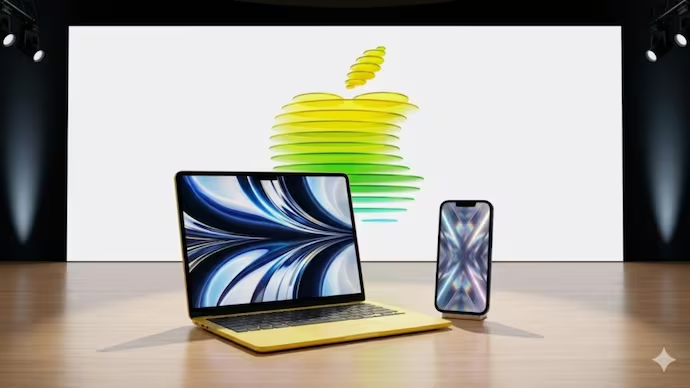
Apple has announced it will start revealing new products on X (formerly Twitter) on Monday, March 2. CEO Tim Cook posted a big week ahead. It all starts on Monday morning. He also used the hashtag #AppleLaunch, suggesting several announcements are planned before the event on March 4.  

Apple has not shared official details about what it will launch, but reports say several products are close to release. These may include the iPhone 17e, new MacBook Pro models, and a MacBook Air with the M5 chip. There are also rumors of a cheaper MacBook that might use an iPhone-level processor instead of a standard M-series chip.  

What to expect from Apple’s March for Special Experience event? 

According to a report by 9to5Mac, Apple’s March 4 event will be invite-only, with media gatherings expected in cities including New York, London, and Shanghai. The report indicates there may not be a traditional keynote presentation. Instead, Apple is likely to make product announcements online across the week.  

Here’s a closer look at the devices Apple might introduce:  

iPhone 17E 

The iPhone 17E will likely follow Apple’s approach of giving its budget phones the latest hardware. After the iPhone 16E got the A18 chip, the new model is expected to use the A19 processor, first seen in the iPhone 17 series. This should improve performance, graphics, and neural engine features.  

A report by Mako Takara suggests the device may also feature Apple’s newer C1X modem, which is said to offer faster speeds than the C1 modem used in the iPhone 16E. It could also include Apple’s in-house N1 Networking chip to handle Wi-Fi/Bluetooth and thread connectivity.  

The iPhone 17E is expected to keep its current design, with a notch rather than the Dynamic Island and a single rear camera. The phone may have slimmer bezels but will still use a 6.1-inch display. It is likely to stick with a 60Hz screen without ProMotion or Always-On features. The front camera could be upgraded to an 80MP center-stage camera for better video calls, while the back camera may remain a single 48MP sensor. MagSafe support is also expected.  

MacBook Pro with M5 Pro, M5 Max 

Apple introduced a 14-inch MacBook Pro with the standard M5 chip in October, but did not launch the higher-tier Pro and Max versions at that time. The company is now expected to round out the line-up with MacBook Pro models powered by the M5 Pro and M5 Max chips, as well as a 16-inch display.  

Aside from the expected performance boost from the new chips, no major design changes or additional hardware upgrades are expected.  

Low-cost MacBook. 

Apple could also introduce a new entry-level MacBook that uses an iPhone-grade A-series processor instead of an M-series chip. Reports indicate it may run on the A18 Pro chip, with performance said to approach that of M1-based MacBooks in certain workloads. The device could feature a smaller 12-inch display with lower brightness than the MacBook Air’s. The new low-cost MacBook could get either an aluminum or a plastic chassis. Apple may also expand the color palette beyond the traditional silver and gray finishes.  

M5 MacBook Air 

A new MacBook Air with the M5 chip is expected soon. The design will likely stay the same following recent trends. The 2026 model might include Apple’s N1 networking chip, which could make wireless connections faster and more reliable.  

M5, Mac Studio 

Apple is said to be working on a new Mac Studio. The current model uses M4 Max and M3 Ultra chips, but the next version will likely feature M5 Max and M5 Ultra chips. These updates could offer better performance for professional and creative users.  

Base iPad (11th generation) 

The 11th-generation entry-level iPad is expected to launch next week. Its design will likely stay the same, but it could get a significant speed boost from the A18 chip, which may enable Apple Intelligence features. It might also use Apple’s own Wi-Fi and 5 G modems.  

Other Devices 

Apple Studio Display 2: Apple is said to be developing two new Studio Display models with mini-LED screens in 27-inch and 32-inch sizes. The bigger model may have a 6K resolution. Both displays could use the new A19 Pro chip instead of the old A13 Bionic.  

New Apple TV 4K: The next Apple TV 4K may use either the A18 or A17 Pro chip, which could support Apple Intelligence features. It is also expected to include a built-in FaceTime camera. The device might include Apple’s N1 networking chip.  

HomePod Mini 2: The next HomePod Mini may come with a newer S-series chip, like the S9 or S10, to boost performance and add Apple Intelligence features, like the new 4 K TV. It could also use the N1 networking chip for better stability and faster Wi-Fi 7.

Source: Apple may launch multiple devices next week: iPhone 17e, low-cost MacBook 

HP’s CEO says rising memory costs will soon make the company raise prices and offer products with less powerful configurations. 

During an earnings call on Tuesday, Enrique Lores talked about rising memory costs which have pushed DDR5 RAM prices up by more than 200% in recent weeks. He said HP has a stockpile of memory, so he expects the company to lessen the impact of these costs. In the first half of our fiscal year, which began this month. 

However, starting in May, higher memory costs will start to reduce HP’s PC product margins, so the company will need to respond. Lores said they include: 

  • qualifying lower-cost suppliers 
  • redesigning the portfolio to reduce memory configurations 
  • accelerating our AI-enabled transformation to drive further cost savings 
  • raising prices in close partnerships with our channel and direct customers 

At the end of the call, HP’s CEO added: “What we have seen in the past in these situations, from a demand perspective, is usually the more low-end categories, those that are impacted.” 

The company also plans to raise prices only as needed, depending on the country and product category. 

Other smaller PC makers are also warning about price increases. CyberPower PC will raise prices on Dec. 7. MainGear is telling customers to buy PCs and parts now before prices are expected to go up after Black Friday sales. 

The memory shortage is being blamed on high demand from AI data centers, which is reducing the supply of RAM and SSDs. The shortage is especially worrying because it could last for years if demand for AI stays high. 

This month, the CEO of Fashion, a major supplier of SSD controllers, warned that electronics makers might cut storage capacity in their products by up to 50% because of the shortage. Meanwhile, Lenovo has been stockpiling memory, and experts have expected to have enough to last through 2026

Source: HP to Raise Prices, Lower Configurations Due to Surging Memory Costs 

News Highlights 

  • Meta is teaming up with AMD to quickly expand AI infrastructure and accelerate the development and deployment of advanced AI models.  
  • AMD and Meta have signed a long-term partnership to deploy up to 6 GW of AMD Instinct GPUs over several product generations.  
  • The first Gigawatt deployment will use the AMD Helios rack-scale architecture, announced at the 2025 Open Compute Project Global Summit. Shipments are expected to start in the second half of 2026, using a custom AMD Instinct GPU based on the AMD 450 architecture and designed for Metal’s needs.  
  • The AMD Meta is strengthening their partnership by aligning their plans for GPUs/CPUs/systems and software.  

And Meta today announced a 6 GW agreement to power its next-generation AI infrastructure across multiple generations of AMD Instinct GPUs.  

This agreement builds on the companies’ current partnership and aligns their hardware and software plans to create AI platforms tailored to Meta’s needs. The first rollout will use a custom AMD Instinct GPU based on the MI450. Its architecture is optimized for Meta’s large-scale workloads. Shipments for the first Gigawatt deployment are set to begin in the second half of 2026 using the custom-built MI450-based GPU and sixth-generation AMD EPYC CPUs called Venice running ROCM software and built on the AMD Helios rack-scale architecture. AMD and Meta develop Helios together through the Open Compute project to support scalable rack-level AI infrastructure.  

We are proud to grow our partnership with Meta as they advance AI on a massive scale, said Dr. Lisa Su, AMD’s chair and CEO. This long-term collaboration across Instinct GPUs, EPYC CPUs, and Rackscale AI systems brings our plans together to deliver high-performance, energy-efficient infrastructure for Meta’s needs. It will help speed up one of the largest AI deployments in the industry and put AMD at the heart of the global AI expansion.  

Excited to start a long-term partnership with AMD to deploy efficient computing for AI and deliver personal super intelligence, said Mark Zuckerberg, founder and CEO of Meta. This is a key step for Meta. While we expand our computing options, AMD will be a valuable partner for many years.  

Along with their work on GPUs, AMD and Meta are also expanding their partnership around AMD EPYC processors. Meta has worked closely with AMD for several generations, using millions of AMD EPYC CPUs and large numbers of AMD Instinct MI300 and MI350 GPUs in their global systems. AI infrastructure becomes larger and more complex. CPUs play a key role in making the system efficient, scalable, and well-coordinated alongside GPUs. With their plans closely aligned, Meta will be a major customer for the sixth-generation AMD E-PYC CPU, such as the Codenine and Verano. A new E-PYC processor designed for specific workloads to deliver top performance at lower cost and energy use. The agreement to further align strategic interests. AMD has issued Meta a performance-based warrant for up to 160 million shares of AMD common stock structured to vest as particular milestones associated with instant GPU shipments are achieved. The first tranche vests with the initial 1 GW of shipments, with additional tranches vesting as Meta’s purchases scale up to 6 GW. Vesting is further tied to AMD achieving certain stock price thresholds, and exercise is tied to Meta achieving key technical and commercial milestones.  

We expect this partnership to bring strong revenue growth over several years and add to our non-GAAP earnings per share. This is another big step toward our long-term financial goals,” said Jean Hu, EVP, CFO, and treasurer of AMD. “The performance-based structure also closely aligns AMD and Meta on execution and creating long-term value.”  

AMD and Meta are working together on hardware, systems, and software to build global AI infrastructure. The partnership will speed up AI innovation and bring AI-powered services and experiences to billions of people.

Source: AMD and Meta Announce Expanded Strategic Partnership to Deploy 6 Gigawatts of AMD GPUs 

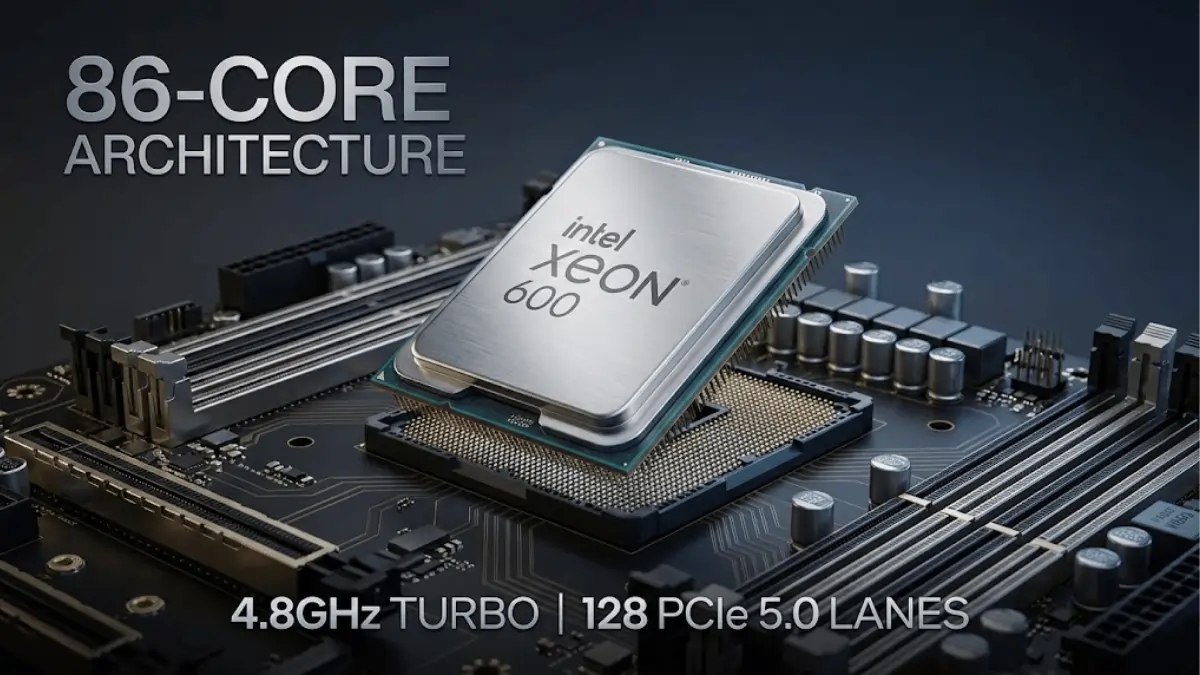
Intel has announced the new Intel Xeon 600 processors for client workstations, supplying a complete update to its high-end workstation platform with the Intel W890 chipset. This latest generation offers more cores, better PCIe connectivity, faster memory support, and improved power efficiency compared to previous models.  

The need for high-performance compute capabilities is increasing daily across a wide range of industries. With the Intel Xeon 600 processors for workstations, we are delivering the platform professionals’ needs in their daily workflows. Incredible performance, effectiveness, extended AI compute features, a host of vPro technologies, and strong connectivity make this platform the right selection for professionals who depend on the performance and capabilities only a high-end workstation can deliver.  

Hector Guevarez, Director of Workstation Segment Client Computing Group.  

The new Intel Xeon 6000 processors for workstations offer many benefits across fields such as Data Science, AI Development, Engineering Simulation, and Media Content Creation. They offer much better multi-thread performance than previous models, stronger I/O capabilities, better wired and wireless connections, and more support for advanced AI training and inference tasks.  

Built with Intel 3 process technology and Redwood Core+ core architecture. The Intel Xeon 600 processors for workstations now have more cores than across the lineup. For example, the 86-core Intel Xeon 698x delivers up to 61% higher multi-thread performance at the same power level compared to the previous 64-core W3595X1.  

Platform specifications include: 

  • The Intel Zion 600 processors for workstations offer up to 86 cores and a 4.8 GHz turbo frequency, which means up to 9 times better single-thread and 61 times better multi-thread performance vs. the previous generation of Intel processors.  
  • With added FP16 data type support in Intel® AMX®, these processors can handle AI training and inference tasks much faster, up to 17% better performance in AI and machine learning workloads compared to the previous generation.  
  • They support up to 128 CPUs and PCIe Gen 5.0 lanes, providing strong connectivity for multiple GPUs, SSDs, and network cards to meet your workflow needs.  
  • These processors support up to 8 channels of DDR5 RDIMM memory at up to 6400 MT/s, an improvement from 4800 MT/s in the previous generation. They now also support DDR5 RDIMM memory at up to 8000 MT/s, which greatly boosts performance for memory-intensive tasks.  
  • Continued support for ECC memory and RAS technologies that improve the integrity of critical data and system dependability.  
  • Continue to support ECC memory and RAS technologies, which help protect important data and keep systems reliable. Voltage baseline and max voltage limits reporting.  
  • (new) per CD IE and per core performance limit reporting  
  • Processor Core Tuning  
  • AVX2, AVX512, and TMUL negative ratio offset tuning.  
  • Per CDIe Ring/Mesh Tuning  
  • Intel Turbo Boost 2.0 frequency tuning.  
  • Intel Turbo Boost Max Technology 3.0 Tuning  
  • They come with built-in Intel Wi-Fi 6E and support for Intel Wi-Fi 7, providing the latest and fastest network connectivity.  
  • These processors include Intel vPro technologies for hardware-based security, such as multi-key memory encryption from version control and Intel one-click recovery, making it easier to deploy systems in enterprise settings.  

With the launch of the new Intel Xeon 600 processors for workstations, Intel sets a new record for overclocking on workstation platforms. Working with ASUS and its overclocking system, Intel has set several new world overclocking records at launch.  

Powered by an Intel Xeon 698X processor and ASUS Pro, WS-W890E Sage SE motherboard, Intel and ASUS have set new overclocking world records across 10 benchmarks, including Geekbench 4 multi-core, Geekbench 5 multi-core, and Cruncher (up to 28B). Additionally, the partnership has led to another 10 global first-place submissions, including Geekbench 3 multi-core, Cinebench R20, Cinebench R23, Cinebench R15, and Y Cruncher (up to 100B).  

When it’s available: Intel Xeon 60, the Intel Xeon 600 processors for workstations will be available from OEM and SI partners, as well as boxed versions, starting in late March 2026 or through retail.

Source: Intel Launches new Intel® Xeon® 600 Processors for Workstation 

Scrolling is a theme of the past. Meta has been rolling out major updates to the Reels algorithm across the US for years. Watch time decided which creators became popular. Now Meta’s latest data shows a big change: direct message (DM) shares are the most important signal.  

For US creators, this is more than a small update. It completely changes what it takes to succeed. If people watch your content but don’t share it with friends, your niche will stop growing.  

The Data Behind The Shift: While Sends Per Reach Is King 

Instagram Head Adam Mosseri has openly discussed the platform’s move forward to more meaningful social connections in his 2026 algorithm briefing. He said that cents per reach is a far stronger factor for distribution than likes, comments, or even completion rates.  

The idea is simple: if someone watches a 15-second Reel to the end, they enjoyed it, but if they share it in a DM, they are starting a conversation. In 2026, Meta’s main goal is to keep users engaged and encourage DM activity. That is now the best way to do that. The DM inbox is now more active than the main feed.  

The New Ranking Hierarchy (March 2026) 

To succeed in these new roles, creators need to know which interactions matter most. Social media strategists have outlined the 2026 Reels ranking as follows:  

  1. DM shares (the gold standard): sharing privately is now the top sign of valuable content.  
  1. Saves: shows the content is worth coming back to or is evergreen.  
  1. Watching time for 30 seconds of a 90-second video is now better than a five-second look at a ten-second video.  
  1. Deep comments go wrong. These are comments that start a fad or get a reply from the creator.  
  1. Lights go on now, seen as the weakest signal and mostly just a vanity metric.  

Strategy: How To Engineer Shareable Content 

The algorithm does not reward creators of shareable content. They need to change how they make content. It’s not simply about catching attention anymore; you want to give people something to say, like “this reminded me of you”.  

  • Relatable Relativity: reels that get shared most often in 2026 focus on specific, relatable experiences. It could be a work-from-home habit or a unique parenting challenge. The aim is to make viewers feel validated, so they want to send it to someone who relates.  
  • The educational Save and Share: lists of hacks and tutorials are becoming more popular than ever. If you share a simple three-step solution to a common problem, people will share it to help others or save it for themselves.  
  • Using Trial Reels or Test Hooks: Meta has launched trial Reels across the US. This feature lets you show a video to people who don’t follow you for 24 hours before it appears on your profile. Use this to see which hooks get the most shares. If a trial Reel gets a lot of shares compared to views, it could be because it gets a big boost when you post it for everyone.  

The Original Penalty 

It has also sharpened its aggregator penalty in this update. Reels with watermarks from competing platforms (such as TikTok or slop-content). Unorganized clips with no creative editing are being strictly throttled. The 2026 algorithm uses AI-powered recognition to detect if a video is recycled. Original audio, clear voiceovers, and native-identity editing tools are now required to reach the explored page.  

Managing New Ads and Algorithm Settings 

Now, US users have more control over the Your Algorithm hub. They can choose to downrank some topics or prioritize others for creators. Changing topics is riskier than before. If you usually post about workouts but switch to crypto, your main audience may be downranked, so they won’t see your new content even if they follow you.  

Conclusion: The Future Of Distribution 

The takeaway for 2026 is simple: Engagement is now about intent, not only numbers. A brand with 10,000 views and 500 shares will do better than one with 100,000 views but no shares. Creator, your focus ought to shift from “How can I make them watch?” to “How can I make them talk?” Master the DM stuff, and you master the 2026 algorithm.

Source: The Instagram algorithm: How it works and strategies for 2026 

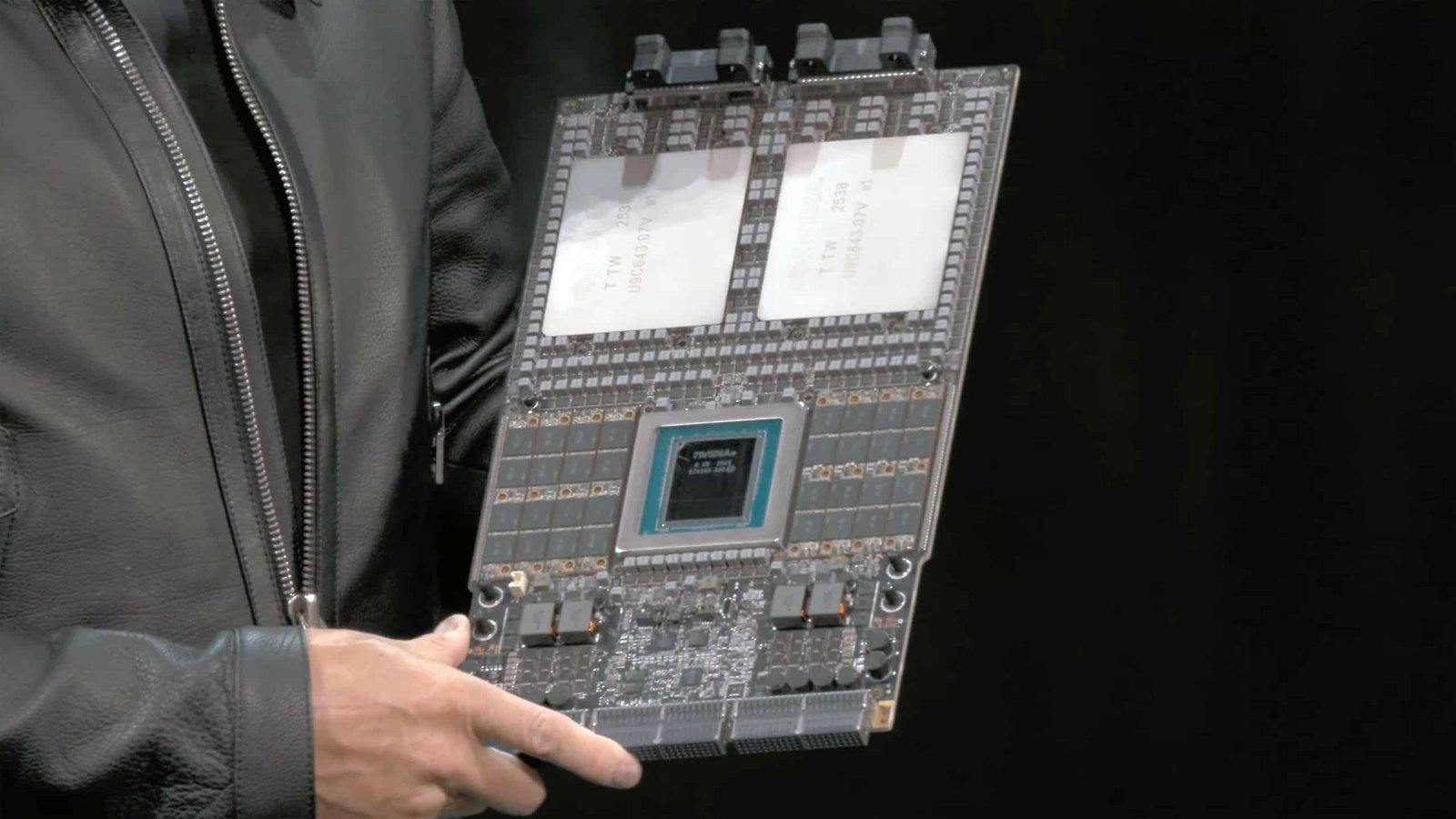
Mobile Conductor: The industry changed direction at CES 2026 when NVIDIA CEO Jensen Huang reviewed the Vera CPU’s technical details, while most of the industry focused on the Blackwell GPU supplies and HBM3e production in 2025. NVIDIA CEO Jensen Huang was working behind the scenes to develop the chip that would transform it from a GPU supplier into a full-stack data center architect.  

Vera CPU is not simply an upgrade to the base architecture. It is a purpose-built agent processor made to remove the last bottleneck in the AI pipeline: serial processing and data management for autonomous agents, with mass production starting this quarter. Vera is set to become the core of the most advanced supercomputers in 2026.  

The Architecture: 88 Olympus Cores 

At the core of Vera lies the Olympus microarchitecture: a custom-designed ARMv9.4a implementation, unlike its predecessor, which had 72 cores. Vera features 88 high-performance cores per die. These aren’t generic, off-the-shelf ARM designs; they are AI-hardened cores with a specific focus on branch-forecasting accuracy for the intricate decision-making trees used by agentic AI.  

The Vera CPU has 512 MB of L3 cache, which is 40% more than the Grace architecture. This on-chip memory helps lower the delay of KV cache lookups, which is important for long context inference. In a dual-socket setup called the Vera-Vera Super Chip, one node can use 176 cores, providing the power needed to handle the heavy data traffic in a Rubin-class data center.  

Breaking the Memory Wall: HBM4 Integration 

Vera’s biggest challenge from standard CPUs is its memory system. Instead of using LPDDR5X, NVIDIA has built HBM4 (high bandwidth memory) right into the CPU. This builds a shared memory pool with this Rubin GPU and offers 2.2 TB/s of memory bandwidth.  

Our system in the news: this unified memory design is a big deal! The CPU can use the GPU’s memory directly without extra copying. When an AI agent needs to perform tasks such as database searches, API calls, and model updates, the Vera CPU manages everything without the usual PCIe slowdown. NVIDIA says this makes the agentic processing five times more efficient than x86-based head nodes.  

The Agentic Instruction Set 

Vera stands out among competitors, such as Intel’s 2026 Diamond Rapids and AMD’s Turin, thanks to its support for enemy agent extensions. This is a special instruction set designed for the chain-of-thought processing used in models such as GPT-5.2 and Gemini 3.1.  

These extensions speed up the token-to-action process when a model needs to use a tool, such as doing a web search or writing to a database. The Vera CPU sends that work to a special secure logic engine on the chip. The main cores continue to focus on high-level reasoning, helping avoid the slowdowns often seen in complex autonomous tasks.  

Connectivity: NVLink 6 and CXL 3.1 

Vera is the first CPU to support NVLink 6, providing a fast 3.6 TB/s connection to the Rubin GPU. It also uses CXL 3.1 for memory pooling in 2026 computers. Vera will let multiple racks share a large global memory pool, enabling the training of world models with more than 50 trillion parameters.  

By adding Bluefield DPU logic to Vera, networking tasks such as encryption, packet inspection, and storage visualization are managed at the processor’s edge. This frees up about 15% of the core capacity that was previously lost to data center overhead.  

Power Efficiency: The 2nm Milestone 

Manufactured on a refined 2nm-class process, Vera is optimized for high-performance computing, with a TDP of about 450 W for the full superchip. It delivers three times the performance of a 2024 x86 server and uses 40% less power when idle for 2026 and 2027. This power profile is the difference between a project being viable or being cancelled due to grid constraints. NVIDIA’s green supercomputing initiative is built entirely on Vera’s ability to do more with every joule of energy.  

The 2026 Supercomputer Roadmap 

The first videos of the Vera CPU will be from the Vera Rubin Superchip, which pairs one Vera CPU with one Rubin GPU. These will be installed in the NVL72 rack, which works as a single large AI processor.  

Research institutions and cloud providers such as AWS, Azure, and Google Cloud have already placed priority orders for Vera-based systems. These machines are expected to lead to breakthroughs in several fields:  

  • Climate Science Coron Running Earth 2 Simulations with 10X Higher Granularity  
  • Drug discovery: Simulating protein folding in real time using agentic feedback loops.  
  • Autonomous Systems Column: Training the Alfa Romeo R1 model for level 3 self-driving vehicles  

Conclusion: The end of the general-purpose era 

A range of CPU specs shows that general-purpose server CPUs are no longer sufficient for high-end AI workloads. By designing a chip for AI agents as its primary users, NVIDIA has built a specialized powerhouse that other companies will likely try to match over the next few years.  

Vera is far more than a CPU. It leads the AI system as production begins in early 2026. Enterprises now need to focus less on which CPU to buy and more on how quickly they can adopt the Vera-Rubin architecture to remain competitive in a world driven by autonomous agentic intelligence.

Source: Built for Accelerated Systems at Scale 

OpenAI and Amazon announced a multi-year partnership to speed up AI innovation for businesses, startups, and consumers worldwide. Amazon plans to invest $50 billion in OpenAI, starting with $15 billion now and an additional $35 billion over the next 4 months, subject to certain conditions.  

Working together to deliver advanced AI tools to businesses worldwide, OpenAI and Amazon are building a stateful runtime environment using OpenAI’s models. The new environment will be available through Amazon Bedrock.  

Stateful developer environments represent the next step in using advanced AI models. They allow models to access resources such as computing power, memory, and identity. With a stateful runtime environment, developers can retain context, preserve previous work, use multiple software tools and data sources, and access computing resources. These environments are built to support active projects and workflows.  

These stateful developer environments will be optimized for AWS’s infrastructure and will work with Amazon Bedrock Agent Core and other AWS services. This way, customers’ AI applications and agents will run smoothly alongside their other AWS applications. The stateful runtime environment is expected to launch in the next few months.  

Making OpenAI’s most advanced enterprise platform available to AWS customers 

AWS will be the only third-party cloud provider for OpenAI Frontier. This will give more businesses access to OpenAI’s most advanced enterprise platform as demand for AI grows across industries.  

Let’s organizations build, deploy, and manage teams of AI agents that work across real business systems with shared context, built-in governance, and strong security. Companies do not need to manage underlying infrastructure as businesses move AI from testing to production. Frontier makes it easy to quickly, securely, and at scale add powerful AI to existing workflows.  

OpenAI will use Trainium’s computing power to meet the growing demand from Amazon customers. OpenAI and AWS are increasing their current $38 billion multi-year agreement by another $100 billion over the next 8 years. As part of this, OpenAI will use about 2 GW of Trainium capacity through AWS to support Stateful Runtime, Frontier, and other advanced workloads. This deal will help lower costs and make large-scale AI production more efficient.  

With this agreement, OpenAI secures long-term computing capacity and works with AWS to use custom-built silicon chips with its larger computing system. This setup lets businesses use AI on demand without managing the underlying infrastructure.  

This Commitment covers both Tranium 3 and the upcoming Tranium 4 chips, which will support many advanced AI workloads. Tranium 4 is expected to be available in 2027 and will offer much better performance, including higher FP4 compute power, more memory bandwidth, and greater high-bandwidth memory capacity to support more powerful AI systems.  

Custom Models Will Be Available to Support Amazon’s Customer-Facing Applications 

OpenAI and Amazon will collaborate to develop custom models for Amazon developers to use in customer-facing applications. Amazon teams will be able to adapt OpenAI models for different AI products and agents that serve customers directly. These new models will add to the options already available to Amazon developers, like the Nova family, giving teams more tools to build and deliver at scale.  

OpenAI and Amazon share a belief that AI should show up in ways that are practical and genuinely useful for people, said Sam Altman, co-founder and CEO of OpenAI. Combining OpenAI’s models with Amazon’s infrastructure and worldwide reach helps us put powerful AI into the hands of businesses and users at a real scale.  

We have many developers and companies eager to run devices powered by OpenAI models on AWS. Our unique collaboration with OpenAI to provide stateful runtime environments will change what’s possible for customers building AI apps and agents, Andy Jassy, President and CEO of Amazon, said. We continue to be impressed with what OpenAI is building, and we’re excited not only about their decision to go big on our custom AI silicon (Trainium), but also about our opportunity to invest in the company and partner with them over the long term.

Source: OpenAI and Amazon Announce Strategic Partnership 

Google has started the countdown for developers and early enterprise users. In a technical bulletin released this morning, the company confirmed that the Gemini 3 Pro Preview, its experimental platform for the latest multi-model architecture, will be shut down on March 9. By March 26, 2026, users will have seven days to move their production workflows and store data to the stable Gemini 3.1 environment.  

This shutdown ends a fast-paced testing phase that started in late 2025. The preview was an important space for testing Gemini 3’s agentic reasoning features, but now Google is focusing its computing resources on the more efficient, optimized 3.1 production version.  

The Migration Mandate: What Happens on March 9 

Teams using the Gemini 3 Pro Preview endpoint through Google AI Studio or Vertex AI must meet the deadline beginning at 12:00 a.m. PT on March 9. Any API calls to the preview models will return 410 (GONE) errors.  

This transition entails more than just changing a name. Developers need to prepare for several important changes:   

  • End Point Redirection: Update all calls to use Gemini 3.1 Pro or Gemini 3.1 Ultra stable endpoints.  
  • Contest window adjustments: The previous supported a 2-million-token window, but the 3.1 stable release has a better contest recall (the needle-in-the-haystack metric). However, you may need to update billing settings for high-value token use.  
  • System Instructions column: The 3.1 architecture has improved safety and is better for those instructions. Early feedback indicates that prompts designed for a more permissive purview may need minor adjustments to maintain consistent output in the stable version.  

Why Is Google Moving So Fast 

The seven-day warning shows the competitive pressure of the Spring AI wars. In 2026, OpenAI retired older models to focus on GPT-5.2, and NVIDIA’s Rubin platform has lowered inference costs. Google now needs to move users to its most hardware-efficient models.  

Gemini 3.1 is much better optimized for the latest TPU v6 clusters by closing the preview. Google is freeing up a large amount of computing power for the upcoming Gemini 3 Live and Project Astra integrations, planned for late Q2.  

Critical Tasks for Developers 

Prevent service interruptions. Technical leads should focus on these tasks before next Monday:  

  • Audit API keys: Identify every new application instance still using the preview model.  
  • Deadshot Fine Tuning Coulombe: If you have fine-tuned versions of the Gemini 3 Pro review, they will not transfer automatically. You need to start fine-tuning jobs again on the Gemini 3.1 base model right away.  
  • Evaluate output latency. The stable 3.1 version usually gives a 15% faster time-to-first token (TTFT), which was used this week to run A/B tests and ensure your UI/UX can handle faster response times without causing issues in downstream parsing.  

The Roadmap Ahead 

The preview is the last step before the full launch of Gemini 3 Ultra for Enterprise clients. The stable 3.1 environment provides enterprise-grade reliability (EGR rating) needed for sectors with strict compliance requirements, such as finance and health care.  

While a 7-day window is aggressive, it shows Google’s commitment to a stronger, more efficient AI lineup. The time for experimental review work is ending, and the era of deployed Agentic AI has begun. Script templates for batch-migrating your Vertex AI model configurations to the Gemini 3.1 stable standpoint.

Source:  Gemini 3.1 Pro