





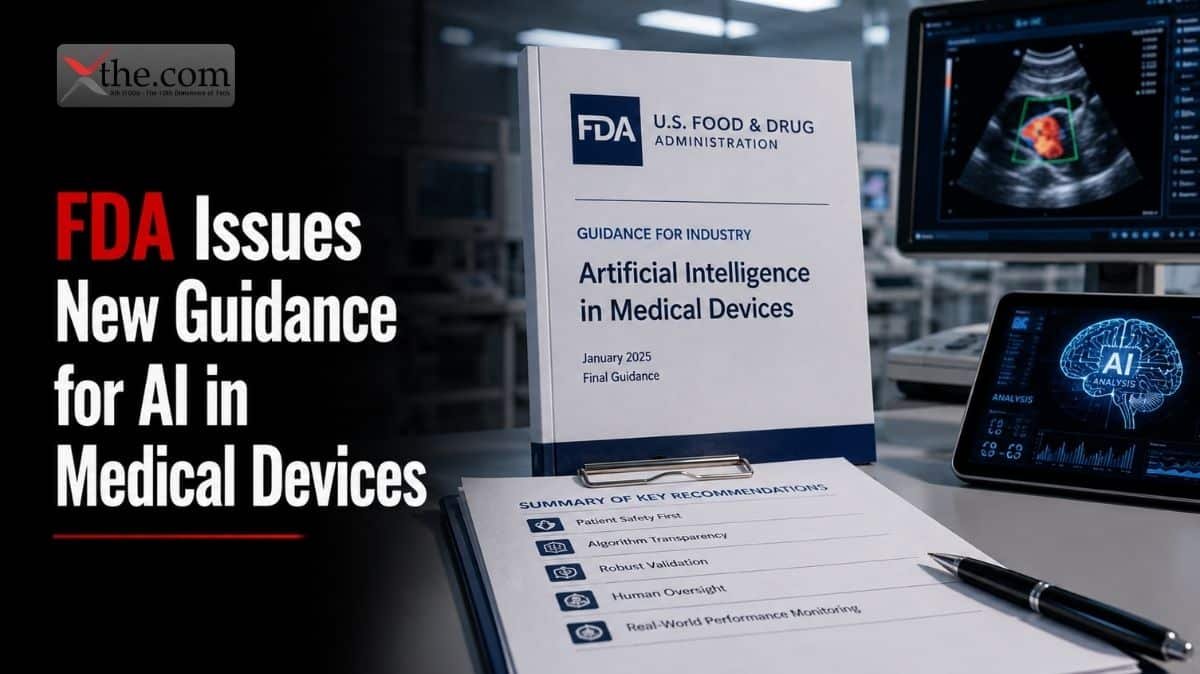
The U.S. Food and Drug Administration (FDA) has released comprehensive new guidance for the development and deployment of artificial intelligence and machine learning (AI/ML) in medical devices, marking a pivotal moment for digital healthcare in America. The guidance, published on August 25, 2026, establishes the first federal framework for regulating AI-powered diagnostic and therapeutic tools.
The new rules affect an estimated 950 AI-enabled medical devices currently on the U.S. market and every new device seeking approval going forward. FDA Commissioner Dr. Robert Califf described the guidance as essential to ensuring patient safety while fostering innovation.
What the Guidance Covers
The FDA guidance addresses four key areas of AI/ML in medical devices. First, it establishes requirements for algorithmic transparency, requiring manufacturers to disclose the training data sources, model architecture, and known limitations of their AI systems. This represents a significant departure from previous policy, which treated AI algorithms as proprietary trade secrets.
Second, the guidance mandates continuous monitoring of AI device performance after deployment. Manufacturers must implement real-time surveillance systems that track diagnostic accuracy, false positive rates, and demographic bias. The FDA requires quarterly performance reports for the first two years after approval, transitioning to annual reports thereafter.
Third, the guidance introduces a tiered risk classification system for AI medical devices. Low-risk devices face minimal regulatory requirements, while high-risk devices such as AI-powered cancer detection systems must undergo rigorous clinical validation including diverse patient population testing.
Fourth, the guidance addresses the use of generative AI in healthcare, establishing strict boundaries for AI-generated medical advice, treatment recommendations, and diagnostic interpretations. Any AI system providing clinical decision support must be validated through the FDA approval process.
Impact on Healthcare Industry
The guidance has significant implications for the rapidly growing AI healthcare market, projected to reach 88 billion globally by 2030. Major technology companies including Google Health, Microsoft, and Amazon Web Services have all developed AI medical tools that will need to comply with the new requirements.
Dr. Eric Topol, director of the Scripps Research Translational Institute, praised the guidance as a necessary step toward responsible AI in medicine. He noted that continuous monitoring is particularly important because AI models can degrade over time as patient populations and disease patterns change.
However, the medical device industry has expressed concerns about compliance costs. The AdvaMed trade association estimated that new requirements could add -5 million to the development cost of each high-risk AI device, potentially slowing innovation. Smaller startups may be disproportionately affected.
Bias and Equity Requirements
One of the most groundbreaking aspects is the focus on algorithmic bias. The FDA now requires AI medical devices be tested across diverse demographic groups including race, ethnicity, age, gender, and socioeconomic status. Devices showing significant performance disparities must address these gaps before approval.
This requirement stems from research showing many existing AI medical tools perform poorly for underrepresented populations. A landmark study in Nature Medicine found that an AI skin cancer detection system was 20% less accurate for patients with darker skin tones.
What Manufacturers Need to Do
Manufacturers have 18 months to comply for existing devices. New submissions after February 2027 must fully comply from the start. Key actions include establishing AI governance frameworks, implementing continuous monitoring systems, conducting bias testing, and preparing detailed algorithmic documentation.
The FDA also announced a new Digital Health Center of Excellence providing technical assistance, employing 150 specialists in AI, data science, and medical device regulation.
Looking Ahead
The FDA guidance positions the United States as a leader in AI healthcare regulation. As AI continues to transform medicine, these regulations will shape how quickly and safely new AI-powered treatments reach patients. The guidance represents a balanced approach protecting patients while encouraging innovation in one of the most promising areas of modern medicine.The guidance also addresses the use of generative AI tools like ChatGPT and similar systems in clinical settings. Hospitals and clinics using AI chatbots for patient triage or preliminary diagnosis will need to register these tools as medical devices and comply with the same transparency and monitoring requirements.
Insurance companies are also affected. AI algorithms used for claims processing, prior authorization, and coverage decisions must now meet the same fairness and transparency standards. The American Medical Association has praised this provision, noting that opaque AI systems have been denying legitimate claims without adequate explanation.
Telehealth platforms that use AI to assist with diagnoses will face new documentation requirements. The guidance requires that any AI-assisted diagnosis be clearly flagged in patient records and that the AI system confidence level be disclosed to both the physician and the patient.
International implications are significant as well. The FDA guidance is expected to influence regulatory approaches in Europe, Japan, and other major markets. Companies developing AI medical devices for global distribution will likely adopt the FDA standards as their baseline, effectively making American regulations the global standard for AI healthcare.
Patient advocacy groups have broadly welcomed the guidance but note that enforcement will be the real test. The FDA has historically struggled with post-market surveillance of medical devices, and adding AI-specific monitoring requirements will stretch already limited resources. Congressional funding of at least 00 million annually will be needed to fully implement the monitoring provisions.
The guidance takes effect in phases, with the transparency and reporting requirements beginning January 1, 2027, and the full bias testing and monitoring requirements taking effect July 1, 2027. Manufacturers can request extensions for specific requirements if they demonstrate good faith compliance efforts. The FDA has also issued companion guidance for software as a medical device (SaMD), which covers AI algorithms that run on smartphones and wearable devices. This includes popular health apps that analyze heart rate data, detect irregular rhythms, or provide mental health assessments. Developers of these apps will now need to submit for FDA clearance if their algorithms make specific health claims.
Consumer electronics companies like Apple, Samsung, and Google are already adjusting their product roadmaps in response. Apple, which has invested heavily in health features for the Apple Watch, said it welcomes the clarity provided by the new guidance and is working closely with the FDA to ensure its products meet the updated standards.
Sources: