





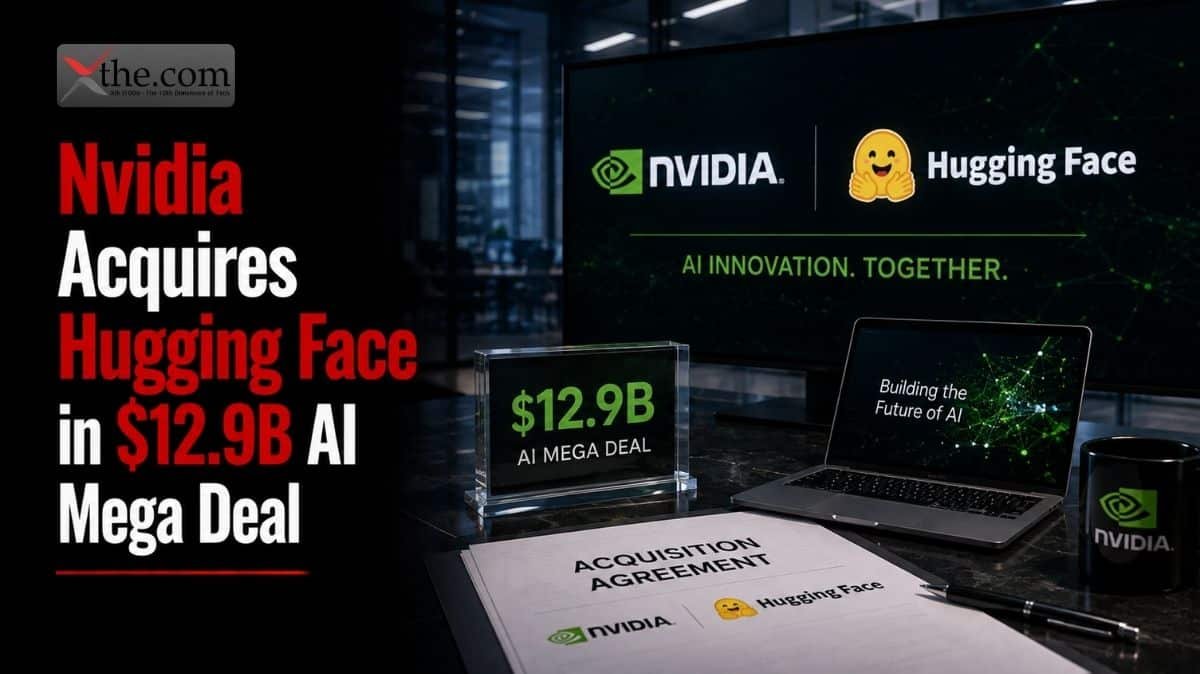
Nvidia has announced the acquisition of Hugging Face, the world’s largest open-source AI platform, for 2.9 billion in a deal that would consolidate its position as the most powerful company in the artificial intelligence ecosystem. The acquisition, revealed on August 26, 2026, represents the largest-ever purchase of an AI software company and signals Nvidia’s ambitious plan to control every layer of the AI technology stack.
The deal gives Nvidia control over the platform that hosts over 1 million AI models and serves more than 100,000 organizations worldwide. Hugging Face has become the de facto standard for open-source AI development, used by researchers, startups, and major corporations alike to share, deploy, and build upon AI models.
Why Nvidia Wants Hugging Face
For Nvidia, the acquisition is strategic on multiple levels. First, it gives the chipmaker direct access to the massive ecosystem of AI developers who build and deploy models on Hugging Face’s platform. Most of these developers already use Nvidia GPUs for training and inference, but the acquisition ensures they will continue doing so by integrating Hugging Face tools more deeply with Nvidia’s CUDA ecosystem.
Second, the deal positions Nvidia to capture a larger share of the AI software market, which is growing even faster than the hardware market. While Nvidia’s dominance in AI chips is well established, the company has been seeking ways to monetize the software layer. Hugging Face’s platform, with its premium enterprise offerings and inference API services, provides exactly that opportunity.
Third, the acquisition gives Nvidia significant influence over the open-source AI community. Hugging Face has been a champion of open AI development, and there are concerns that Nvidia’s ownership could shift the platform toward more proprietary approaches that favor Nvidia’s hardware.
Reaction from the AI Community
The reaction from the AI community has been mixed. Supporters argue that Nvidia’s resources could accelerate Hugging Face’s development and make open-source AI more accessible. Clem Delangue, Hugging Face’s CEO, said the deal would allow us to double down on our mission of democratizing AI while leveraging Nvidia’s incredible infrastructure.
However, critics have raised concerns about concentration of power in the AI industry. One technology analyst warned that one company controlling both the dominant AI hardware and the largest AI software platform creates unprecedented market concentration. Several open-source advocacy groups have called for regulatory review of the deal.
The European Commission has already announced it will conduct a thorough investigation of the acquisition under its merger control rules. The FTC in the United States is also expected to scrutinize the deal, particularly given Nvidia’s already dominant position in AI chips.
Financial Details
The 2.9 billion price tag represents a significant premium over Hugging Face’s last private valuation of .5 billion in 2024. The deal consists of billion in cash and .9 billion in Nvidia stock. Hugging Face investors including Google, Amazon, and Salesforce are expected to realize substantial returns on their investments.
Nvidia CEO Jensen Huang said the acquisition would be immediately accretive to earnings and would not affect the company’s previously announced 0 billion stock buyback program. The deal is expected to close in the first quarter of 2027, pending regulatory approval.
What This Means for AI Development
If approved, the acquisition could reshape the AI landscape. Developers who currently use Hugging Face’s platform for free model hosting and sharing may face changes in pricing and terms. Enterprise customers could benefit from deeper integration with Nvidia’s GPU optimization tools.
The deal also raises questions about the future of AI competition. With Nvidia controlling chips, software platforms, and developer tools, rival chipmakers like AMD and Intel may find it increasingly difficult to compete. Cloud providers like Amazon and Google, which have their own AI chip programs, may accelerate development of alternative platforms.
Industry observers note that the acquisition mirrors historical patterns in technology consolidation. When one company dominates a foundational layer, it often moves to control adjacent layers to strengthen its moat. Just as Microsoft bundled Internet Explorer with Windows to dominate the browser market, Nvidia may use its chip dominance to make Hugging Face the default AI development platform, potentially at the expense of competing approaches.The acquisition also has implications for Nvidia’s competitors in the AI space. AMD, which has been gaining market share with its MI300X AI accelerator chips, now faces the prospect of competing not just against Nvidia’s hardware but against an integrated hardware-plus-software ecosystem. AMD CEO Lisa Su has been vocal about the need for open AI standards and may accelerate AMD’s own software platform development in response.
Meanwhile, cloud providers are reassessing their strategies. Amazon Web Services, which has its own Trainium AI chips and hosts many Hugging Face models, could find itself at a disadvantage if Nvidia redirects the platform’s infrastructure priorities. Google, which offers both cloud AI services and its own Tensor Processing Units, faces similar concerns.
The financial markets reacted strongly to the announcement. Nvidia shares rose 4.2% on the news, adding approximately 30 billion to the company’s market capitalization. AI-focused ETFs also rallied, while shares of smaller AI chip companies like Cerebras and Groq fell sharply on concerns about reduced market access.
For the broader AI industry, the acquisition represents a consolidation trend that has been building for several years. The massive capital requirements of AI development have been pushing the industry toward fewer, larger players. Nvidia’s purchase of Hugging Face is the most dramatic example yet of this consolidation, but analysts expect more deals to follow as the AI market matures.
Looking ahead, the regulatory review process will likely take 6-12 months. During this time, both companies will continue operating independently. The key question for regulators will be whether the acquisition substantially reduces competition in either the AI chip market or the AI software platform market. Given Nvidia’s already dominant position in chips, the case for allowing the deal may ultimately hinge on commitments Nvidia makes to maintain Hugging Face’s open-source character and non-discriminatory access policies. The history of technology acquisitions offers both cautionary tales and success stories. When Google acquired YouTube in 2006, skeptics feared the platform would become a mere distribution channel for Google’s interests. Instead, Google largely maintained YouTube’s independence and invested heavily in its growth. Whether Nvidia follows a similar hands-off approach with Hugging Face will be critical to the platform’s future and to the broader open-source AI community’s trust in corporate stewardship of shared resources.
Sources:
https://techcrunch.com/
https://www.reuters.com/technology/
https://www.bloomberg.com/technology