






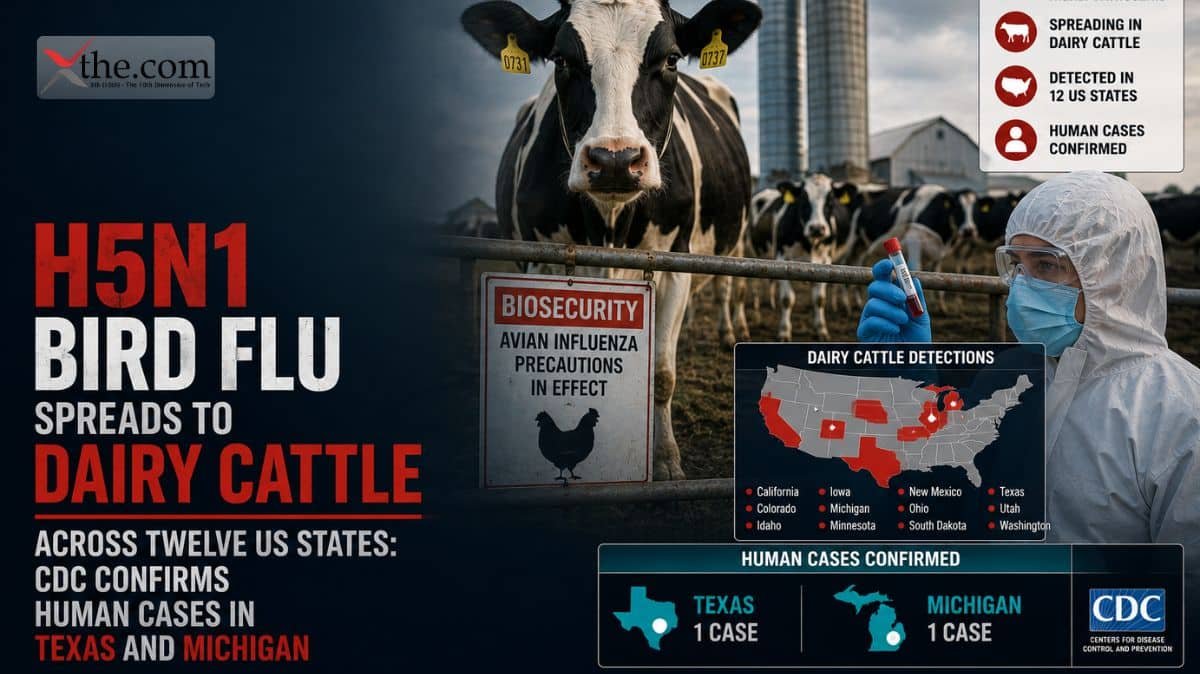
The Centers for Disease Control and Prevention issued an urgent health advisory on Tuesday as the H5N1 avian influenza virus — commonly known as bird flu — jumped from wild birds and poultry into dairy cattle herds across twelve states, with confirmed human infections in Texas and Michigan raising fears of a potential pandemic threat. The outbreak, first detected in Texas dairy cows in March 2026, has now reached California, Idaho, Kansas, New Mexico, North Carolina, Ohio, Oklahoma, South Dakota, Utah, and Wisconsin.
How Bird Flu Reached Cattle
For decades, H5N1 was considered primarily a poultry and wild bird pathogen, with occasional spillover into mammals like seals and foxes. The jump to cattle represents a concerning evolutionary leap. Genetic sequencing by the USDA’s National Veterinary Services Laboratories indicates the virus acquired mutations allowing it to bind to receptors found in mammalian mammary glands — explaining why infected cows shed high concentrations of virus in their milk.
Dr. Dawn O’Connell, Assistant Secretary for Preparedness and Response at HHS, explained the transmission pathway: “Infected wild birds likely contaminated cattle feed or water sources. Once in a herd, the virus spreads cow-to-cow through contaminated milking equipment and close contact. The viral loads in raw milk are extraordinarily high.”
Human Infections Confirmed
As of August 13, the CDC has confirmed 14 human H5N1 cases in the United States — 9 in Texas dairy workers and 5 in Michigan agricultural employees. All cases involved adults with direct exposure to infected cattle or unpasteurized milk. Symptoms have ranged from conjunctivitis (severe pink eye) to mild respiratory illness. Crucially, no person-to-person transmission has been documented, and no deaths have occurred among the infected workers.
However, the CDC is conducting enhanced surveillance because of H5N1’s pandemic potential. The virus carries a roughly 52% case fatality rate globally among the 900 human infections recorded since 2003, though those cases involved earlier viral strains and typically involved prolonged exposure to sick poultry in unsanitary conditions.
The Raw Milk Danger
The FDA and CDC have issued strong warnings against consuming raw, unpasteurized milk — a growing trend among natural health communities. Laboratory testing confirmed that while pasteurization effectively kills H5N1 virus, raw milk from infected cows contains live, infectious particles capable of causing human illness.
“Pasteurization is not optional here — it is lifesaving,” said FDA Commissioner Dr. Robert Califf. “We have traced multiple human infections directly to consumption of raw milk or failure to wear protective equipment during milking.”
Despite these warnings, raw milk sales have actually increased in some states as social media influencers falsely claim that “natural immunity” can be built through raw dairy consumption. The FDA is considering emergency orders to suspend raw milk sales in affected states.
Economic Impact on Dairy Industry
The outbreak is devastating American dairy farmers. Infected herds experience a 20-30% drop in milk production, and some cows develop secondary bacterial mastitis requiring antibiotic treatment. The USDA has ordered the culling of approximately 12,000 infected cattle nationwide, with farmers receiving $1,200 per head in federal compensation — roughly half the market value of a productive dairy cow.
Wisconsin, America’s second-largest dairy state, has seen 34 herds quarantined. The Wisconsin Cheesemakers Association warned that cheese production could decline 8-10% in Q3 if milk supplies tighten further. Retail milk prices have already risen 6% nationally since March, and butter prices are up 11%.
Pandemic Preparedness
The Biden administration activated the National Pandemic Preparedness Plan at “Level 2” — enhanced monitoring — though officials stress this is precautionary. The Strategic National Stockpile contains 10 million doses of H5N1 vaccine matched to the current circulating strain, and Moderna has begun manufacturing an mRNA vaccine specifically tailored to the cattle-adapted variant.
Dr. Rochelle Walensky, former CDC director and now a pandemic preparedness advisor, urged calm but vigilance: “We are not on the brink of a pandemic. The virus has not acquired efficient human-to-human transmission capability. But we must act aggressively now to prevent that mutation from occurring.”
What Americans Should Do
- Consume Only Pasteurized Dairy: Do not drink raw milk or eat raw milk cheeses from unknown sources. Pasteurization at 161°F for 15 seconds destroys H5N1.
- Avoid Contact with Sick Birds or Cattle: If you live near agricultural areas, do not approach dead birds or cattle showing respiratory distress or reduced milk production.
- Monitor Symptoms: If you work in agriculture and develop fever, cough, or severe eye redness after animal contact, seek medical care immediately and mention H5N1 exposure.
- Do Not Panic-Buy: There is no current risk from properly cooked eggs, chicken, or pasteurized milk. H5N1 is destroyed by cooking temperatures above 165°F.
The Bigger Picture
Public health experts view this outbreak as a stress test for pandemic infrastructure built during COVID-19. Wastewater surveillance — expanded nationwide after 2020 — is now detecting H5N1 genetic fragments in 14 municipal systems near dairy operations, providing early warning of community spread. Whether this infrastructure can contain the virus before it mutates into a human-adapted form will determine whether 2026 remains a footnote or becomes a repeat of 2020.








