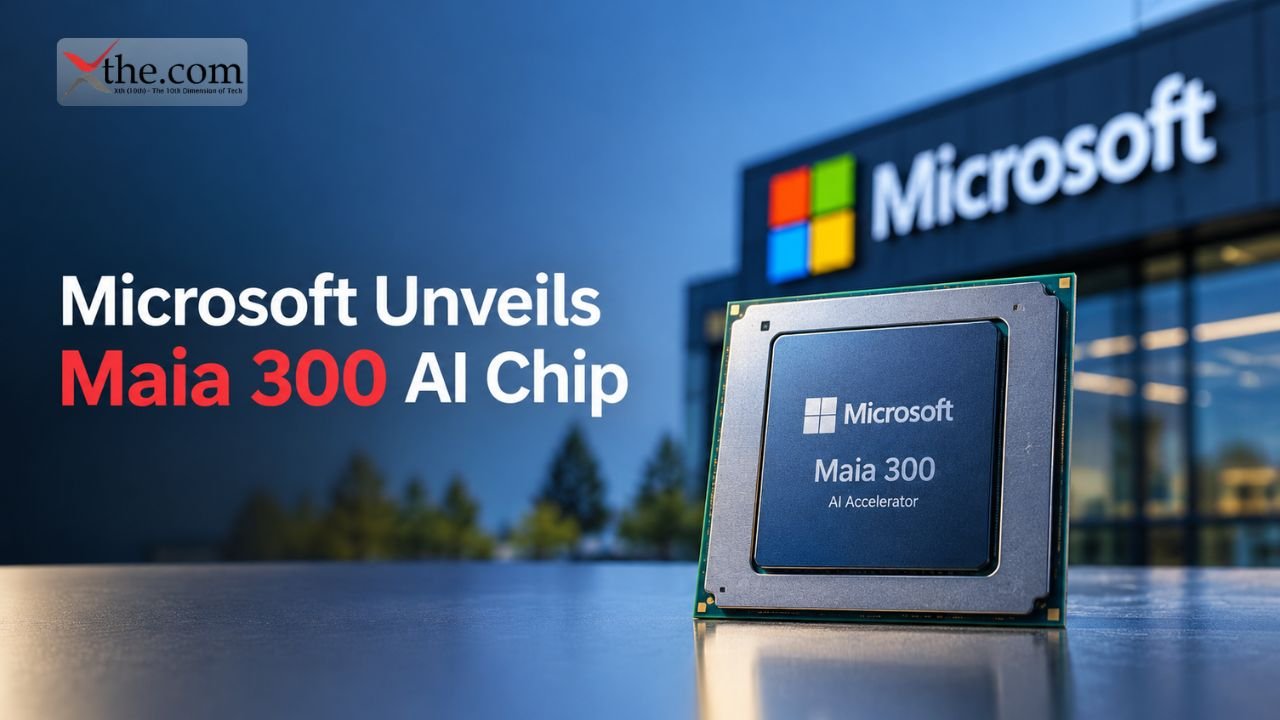
Microsoft Bets Bigger on Its Own Silicon With the Maia 300 AI Chip
Microsoft on Monday, October 12, pulled back the curtain on the third generation of its custom artificial intelligence accelerator, the Maia 300, and paired the unveiling with a deployment ambition that would have sounded implausible from a hyperscaler just two years ago. The company said its Maia family will scale to multi-gigawatt deployments starting in 2027 and will become the primary inference system across its products and services, a statement that frames Microsoft’s own silicon, not Nvidia’s, as the default engine for the largest cloud computing platform’s AI workload.
The announcement lands at a moment when every major technology company is racing to reduce dependence on a single supplier for the most expensive component in the AI economy. For Microsoft, which has spent tens of billions of dollars on Nvidia graphics processors to build out Azure’s AI capacity, the Maia 300 is both an engineering milestone and a negotiating posture. The company is telling its own business units, its customers and its chip supplier that the architecture of the future has alternatives.
The Specs Microsoft Put on the Table
Microsoft’s published numbers for the Maia 300 describe a dense, power-hungry inference part built for rack-scale deployment rather than laboratory benchmarks. The company says a full rack of 96 Maia 300 accelerators can deliver up to seven times the rack-scale token throughput of the previous generation Maia 200, the version now serving production workloads including Microsoft Copilot. On the efficiency measure that matters most to cloud operators paying electricity bills, Microsoft claims the Maia 300 will deliver 40 percent more tokens per megawatt than leading GPU-based systems, a comparison the company is making itself rather than an independent benchmark.
The rack design carries a 167-kilowatt power envelope, 27.6 terabytes of high-bandwidth memory capacity and 1.7 petabytes per second of aggregate memory bandwidth. The chip itself uses a multi-chiplet design, with compute chiplets built on TSMC’s N2P process node, eight stacks of the latest HBM4 memory, peak memory bandwidth of 18.0 terabytes per second and a 950-watt thermal design power. That last figure places the Maia 300 firmly in the class of components that data center builders treat as structural engineering problems, requiring liquid cooling and rack power densities that would have been extraordinary in a pre-AI data center.
Inference Is the Target
The strategic emphasis in Microsoft’s announcement is inference, the act of running trained models to answer requests, rather than training, the expensive build-out phase that has dominated headlines about AI infrastructure. CNBC’s coverage of the announcement was blunt about the company’s intended use for the chip: Microsoft will mainly use Maia for AI inference. Training runs grab the record-breaking purchase orders, but inference is where recurring economics live, because every query a user or enterprise sends flows through inference capacity, forever.
A chip optimized for steady-state inference, serving millions of similar requests with predictable latency, is a fundamentally different product than a training accelerator optimized for raw throughput across massive parallel jobs. By aiming Maia at the workload that generates its cloud revenue daily, Microsoft is chasing the cost curve that determines whether AI services reach the price points enterprises will pay at scale. Tokens per megawatt, the efficiency metric the company foregrounded, is precisely the ratio that governs that economics.
Reducing Reliance on Nvidia
GeekWire framed the announcement as Microsoft making its biggest bet yet on its own silicon, explicitly to reduce reliance on Nvidia, and that framing matches the corporate logic on display. Nvidia remains the dominant supplier of AI compute, and its chips command premium prices precisely because alternatives are not yet proven at hyperscale. Every gigawatt Microsoft generates with Maia is a gigawatt it does not buy from Nvidia or from the cloud competitors reselling Nvidia capacity.
For Nvidia, the competitive pressure is cumulative rather than singular. Amazon has its Trainium line, Google has its Tensor Processing Units, and now Microsoft has committed its largest deployment yet to Maia, positioning it as the primary inference system for its products and services. The data center AI market is large enough that none of these custom efforts needs to displace Nvidia to reshape the industry’s economics. They only need to give the biggest buyers credible alternatives at contract time.
What Multi-Gigawatt Deployment Means
Multi-gigawatt is not a marketing flourish. A gigawatt of data center capacity is roughly the output of a mid-sized power plant, and hyperscale AI data centers are increasingly measured in hundreds of megawatts each. Committing to multi-gigawatt deployments of a single chip family by 2027 means Microsoft is planning data center construction, power procurement and supply chain commitments years in advance, with TSMC’s N2P fabrication serving as the upstream constraint on how fast any of it can happen.
It also means the deployment timeline becomes a public testable claim. Production deployments of the Maia 300 are planned for 2027, and infrastructure projects of this scale leave visible evidence in the form of announced data center sites, power agreements and capital expenditure disclosures. Investors tracking Microsoft’s spending and analysts tracking Nvidia’s customer mix will be able to verify whether the Maia ramp arrives on schedule.
The Existing Maia Footprint
The Maia 300 does not arrive into a vacuum. The second-generation Maia 200 is already serving Microsoft production workloads, including the Copilot features embedded across the company’s productivity suite, with GitHub Copilot and Microsoft Foundry expected to follow by year-end, according to the company’s announcement. That installed base matters for credibility. It means Microsoft has already operated its own accelerators inside live services at commercial volume, and the Maia 300 is an iteration of a proven deployment model rather than a first attempt at vertical integration.
Analysts at Constellation Research described the launch as Microsoft formalizing the inference chip’s place in a hybrid strategy where the company still buys Nvidia hardware for frontier training while shifting the day-to-day serving workload to cheaper, more efficient custom parts. That hybrid posture is arguably the real story. Microsoft is not abandoning the merchant chip market. It is segmenting its workloads by economics.
What Comes Next
The immediate questions are manufacturing and money. TSMC’s N2P node will determine unit economics and volume, and every advanced packaging allocation for HBM4 memory in 2027 is already contested among the industry’s largest buyers. Microsoft did not disclose chip pricing in the announcement, which is typical for internal silicon that never leaves the company’s own data centers, and financial analysts will look to capital expenditure guidance for evidence of the ramp’s cost.
For the broader AI industry, October 12 marks a marker in a shift that has been building for years. The companies spending the most on artificial intelligence have decided that the supply chain for its most important component is too strategic to leave to a single vendor, and they now have the balance sheets, the fabrication access and the workload volume to act on that decision. The Maia 300 is Microsoft’s largest statement of that intent so far, and 2027 is when the market finds out whether the claim survives contact with a fab schedule.
Frequently Asked Questions
What is the Microsoft Maia 300?
The Maia 300 is Microsoft’s third generation of custom AI accelerator, announced October 12, 2026. It is a multi-chiplet inference chip built on TSMC’s N2P process with eight HBM4 stacks, a 950-watt design power, and a rack design of 96 accelerators that Microsoft says delivers up to seven times the rack-scale token throughput of the Maia 200.
When will Maia 300 chips be deployed?
Microsoft says production deployments are planned for 2027, when the Maia family is expected to scale to multi-gigawatt deployments and become the primary inference system for Microsoft’s products and services.
Why is Microsoft building its own AI chips?
To reduce reliance on Nvidia and to lower the cost of AI inference. Microsoft claims the Maia 300 delivers 40 percent more tokens per megawatt than leading GPU-based systems, a company-reported comparison aimed at the electricity and hardware costs that drive cloud AI economics.
Does the Maia 300 replace Nvidia chips at Microsoft?
No. Microsoft is expected to keep using merchant GPUs for large-scale training while shifting inference workloads, the steady-state serving of models, to its own Maia accelerators. The existing Maia 200 already serves production workloads such as Microsoft Copilot.